

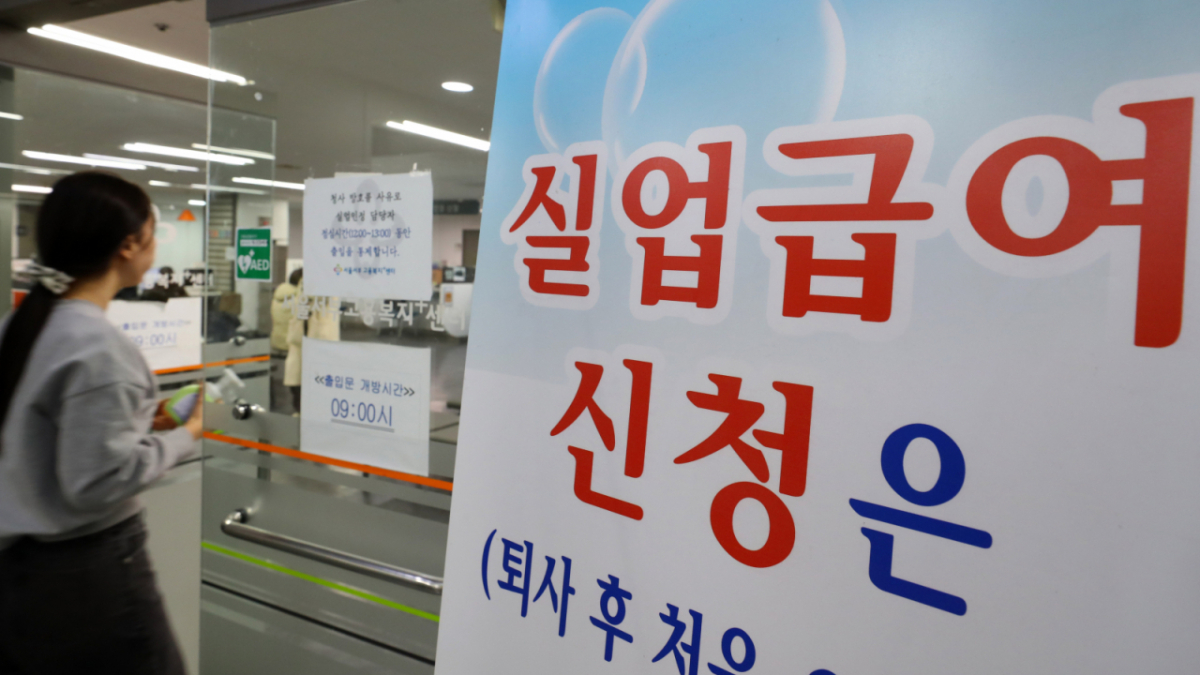
Concerns are rising that the government's push to improve the system so that individuals who voluntarily resign can receive unemployment benefits may worsen the fiscal health of the employment insurance fund. With cumulative deficits already reaching 6 trillion won due to sustained expansion in unemployment benefit expenditures, additional spending could raise questions about the fund's sustainability.
The Ministry of Employment and Labor announced on the 4th, during a presidential work report, a plan to provide job-seeking benefits to young people who voluntarily resign. The proposal would allow individuals under 35 who have worked for a specified period and then voluntarily quit (resign) to receive unemployment benefits once in their lifetime.
Currently, unemployment benefits are available only when workers leave their jobs due to non-voluntary reasons such as dismissal or contract termination, provided they engage in job-seeking activities. However, considering the difficult employment situation for young people recently, the government has decided to extend support so that even those who voluntarily resign can receive unemployment benefits.
If this system is implemented, it could have a positive effect by strengthening the social safety net for young people in the labor market. Structural changes in the recent labor market have led to new forms of employment such as platform workers and freelancers, blurring the line between voluntary and non-voluntary resignations. This creates a coverage gap where individuals are effectively forced to leave their jobs but cannot receive unemployment benefits.
Some young workers have raised concerns that it is unfair for those who have joined the employment insurance system and paid premiums to be denied unemployment benefits solely because they voluntarily resigned.
While this measure was introduced in response to the serious issue of "rested youth," some experts warn that significant negative side effects are expected from a fiscal health perspective of the employment insurance fund. As the scale of unemployment benefit deficits continues to grow, this new policy could further expand the fund's deficit.
According to the 2025 fiscal year employment insurance fund final accounts report, total revenue for last year was 20 trillion 348.5 billion won, while total expenditures (operating costs) reached 20 trillion 940.5 billion won, resulting in a fiscal deficit of 592 billion won. Year-end reserves stood at 7.8 trillion won, but excluding public funds managed by the Public Fund Management Agency—which correspond to borrowed money—actual reserves amounted to only 79.6 billion won.
The situation is even more severe when looking solely at the unemployment benefit account. Last year, total revenue for worker unemployment benefits was 15 trillion 682.3 billion won, but total expenditures reached a record high of 17 trillion 462.3 billion won, resulting in a deficit of 1 trillion 779.9 billion won. This marks the second consecutive year of deficits, with the deficit widening compared to 2024 (243.7 billion won). Year-end reserves excluding public funds managed by the Public Fund Management Agency show a deficit of 5 trillion 993.3 billion won.
This is due to structural increases in unemployment benefit expenditures driven by continuous expansion of the employment insurance coverage base, prolonged stagnation in the labor market, and repeated or fraudulent claims. Although the unemployment insurance premium rate was raised from 0.9% in 2006 to the current 1.8%, it remains insufficient to keep pace with rising expenditures.
Currently, approximately 1 trillion won in unemployment benefits is paid out monthly. If this measure is extended to voluntary resignations, an additional fund expenditure of several hundred billion won is expected.
Among current employment insurance enrollees, those under 30 years old number 5.86 million (2.227 million in their 20s and 3.633 million in their 30s), accounting for about 37% of all enrollees. Approximately 300,000 voluntary resignations occur monthly. Applying the proportion of enrollees under 30 to these figures suggests that around 100,000 voluntary resignants may be under 30 years old.
The daily minimum unemployment benefit for this year is set at 80% of the minimum wage, amounting to 66,948 won per day or 1.98 million won per month. If this amount were paid to voluntary resignants under 30 years old, an additional monthly expenditure of approximately 200 billion won could occur.
Some voices point out that in a situation where moral hazard is emerging due to repeated and fraudulent unemployment benefit claims, extending benefits to voluntary resignations could further dampen the work motivation of young people.
The Federation of Korean Industries highlighted in last year's report titled "Problems and Improvement Measures for the Employment Insurance System" that "despite a steady increase in repeat beneficiaries who repeatedly cycle between employment and unemployment while receiving job-seeking benefits, there is insufficient separate punitive measures." The federation also noted that "providing job-seeking benefits to retirees at mandatory retirement age and maintaining early reemployment allowances with unclear effectiveness are factors undermining fiscal health."
The government plans to pursue system improvements that strengthen support for young people while maintaining the fiscal health of the employment insurance fund. A Ministry of Employment and Labor official stated, "Decisions on improving the unemployment benefit system will be made through future consultations with labor, management, and experts."

 in ECONOMY
