

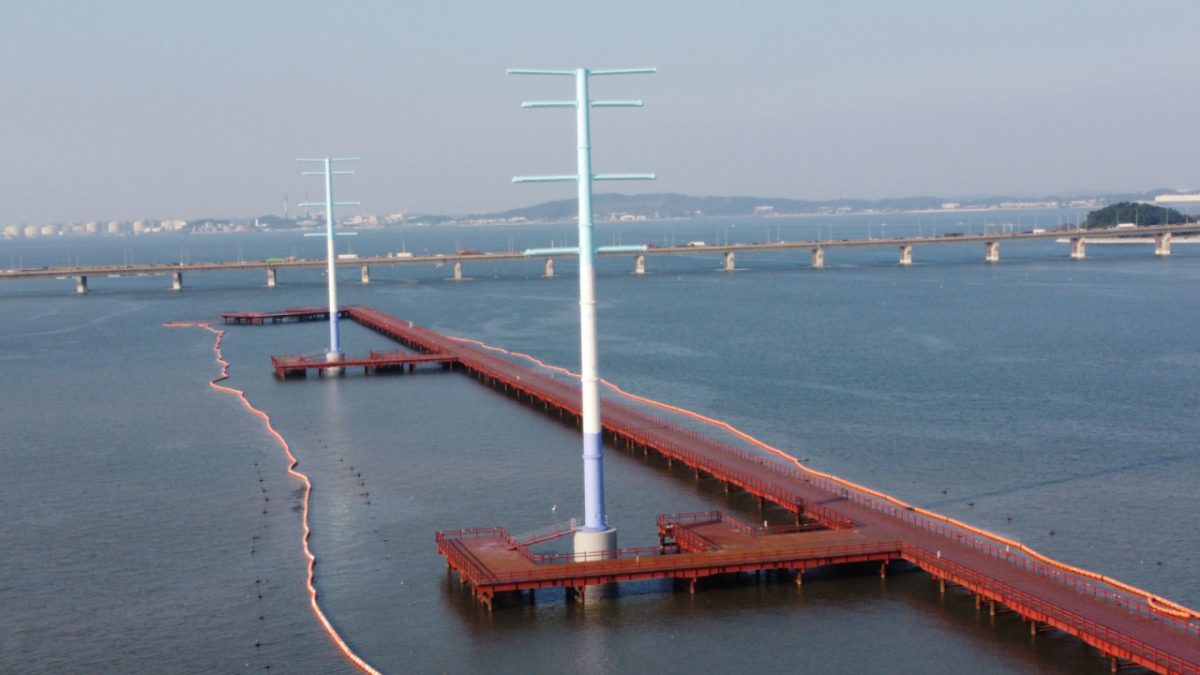
With the exemption of the preliminary feasibility study (EIA) for a large-scale transmission network project connecting Honam to the Capital Region confirmed, power supply for major advanced industries such as the Yongin semiconductor cluster is expected to be relieved. The government plans to ensure timely power supply to the Yongin semiconductor industrial complex through early construction of the transmission network and will also pursue EIA exemption for the power grid construction project for the Honam semiconductor industrial complex.
According to the Ministry of Climate, Energy and Environment and KEPCO on the 24th, the government held a Power Grid Expansion Committee meeting last October and designated 99 transmission network projects as national key infrastructure projects. Once designated as national key infrastructure projects, various special exemptions can be applied for site selection, environmental impact assessment, and regulatory improvements.
To accelerate national key infrastructure projects, the government decided to pursue EIA exemption for 32 of the 99th projects that are subject to EIA and began formal review at the beginning of this year. The Ministry of Economy and Finance recently confirmed EIA exemption for 15 of the 32nd projects after consultations with relevant institutional investors including the Ministry of Climate, Energy and Environment and Korea Electric Power Corporation. The total scale is 14.2 trillion won.
With the EIA exemption for large-scale transmission network projects confirmed, the government's energy highway project is also expected to gain momentum. The government expects that through EIA exemption, the power grid construction period will be shortened from the current 10 years and 6 months to 9 years, a reduction of about 1 year and 6 months.
As electricity demand surges due to AI (artificial intelligence) data centers and expansion of semiconductor factories, the need for rapid power grid construction is also increasing. According to the power demand forecast released by the General Committee for the Establishment of the 12th Basic Plan for Power Supply and Demand (Electricity Plan) on the 20th, maximum electricity demand in 2040 is projected to reach 165 gigawatts (GW), a 70% increase from current levels.
Among these, it is estimated that an additional 28.5 GW of power facilities will be required for the operation of three mega-projects: AI data centers and semiconductor factories. This scale is equivalent to about 20 new large-scale nuclear power plants.
To advance mega-projects, expanding generation facilities alone is insufficient; building a transmission network capable of delivering generated electricity to demand areas is essential. Currently, South Korea's power market structure faces a serious mismatch between power production and demand areas.
While more than 70% of advanced industries such as semiconductor clusters are concentrated in the Capital Region, its power self-sufficiency stands at only about 65%. In contrast, in Honam, rapid growth in renewable energy generation has frequently led to generation curtailment due to overproduction.
To transmit electricity produced in Honam and other regions to the Capital Region, large-scale transmission network construction is essential; however, currently there are only two 345kV (kilovolt) high-capacity lines connecting Honam and the Capital Region. Although rapid power grid construction is needed, project delays have occurred due to issues of public acceptance and massive project costs.
If projects proceed early through EIA exemption, electricity supply to the Yongin semiconductor industrial complex is expected to proceed without disruption. The government plans to shorten the completion time for the Yongin National Industrial Complex (Samsung Electronics) from the current 2047 to 2040, a reduction of seven years, by expediting permits and early construction of the power grid. For the Yongin General Industrial Complex (SK Hynix), the timeline will be advanced from 2045 to 2033, a 12-year acceleration.
The transmission networks confirmed for EIA exemption this time mostly connect Honam to the Capital Region, including Shin Haenam-Seo Incheon complex, Shin Haenam-Dangjin thermal power, and Saemangeum-Youngheung thermal power. Projects are underway with a target completion by 2038 at the latest. The government plans to complete power supply to the Yongin semiconductor industrial complex by 2041 to ensure its early completion.
The government is also pursuing EIA exemption for the Honam semiconductor industrial complex power grid. The Honam semiconductor industrial complex aims to begin initial operations in 2029 after rapidly building power and water infrastructure. The Ministry of Climate, Energy and Environment and Korea Electric Power Corporation plan to seek approval from the State Council for EIA exemption for the power grid after consultations with the Ministry of Economy and Finance.
For Honam industrial complex power supply, the government will first pursue a plan to branch off from the Shin Jangseong-Shin Gwangju line and connect it to the industrial complex. The total cost for underground conversion and substation construction is expected to be 939.7 billion won.
Experts point out that rapid power grid construction requires not only EIA exemption but also a long-term roadmap at the national level. Park Woo-young, energy transition researcher at the Korea Energy Economics Institute, said, "Although the government set a goal of 100 GW for renewable energy by 2030, it will be meaningless if the power grid plan is not properly established." He added, "To achieve a transition to an electricity-based nation, there must be a long-term national roadmap that includes not only the power grid but also plans for hydrogen and thermal energy."

 in ECONOMY
