


#Mr. A believed he qualified as a "one-household, one-household owner" and thus eligible for tax exemption, so he did not file a report on capital gains tax when transferring an apartment located in Buk-gu, Busan. However, the tax authorities determined that he was a "two-household, two-household owner" and issued a decision to collect 27 million won in capital gains tax. This was because his mother-in-law, who owned one inherited property, had shared the same address with Mr. A until shortly before her death, leading to them being classified as members of the same household. In response, the court-appointed representative collected and submitted evidence such as financial records (covering nursing care expenses), household registration documents (showing proximity between the nursing facility's location and the sister-in-law's address), and similar prior rulings to prove that the sister-in-law had actually supported her mother-in-law who was receiving long-term care at a nursing facility in August 2023, when the disputed property was transferred. Additionally, by presenting logical and well-structured arguments at the National Tax Dispute Review Committee meeting, it was recognized that Mr. A and his mother-in-law belonged to separate households, allowing him to avoid paying any capital gains tax.
Although Mr. A qualified as a "one-household, one-household owner" eligible for tax exemption, he was grouped with his mother-in-law who owned another property and classified as a "two-household, two-household owner," making him liable for capital gains tax.
However, the court-appointed representative argued that Mr. A and his mother-in-law belonged to separate households by submitting precedents recognizing separate household status due to living in a nursing facility, collecting financial records (nursing care expenses) to prove long-term residence at the facility and the sister-in-law's financial support for her mother-in-law, and using household registration documents and family relationship certificates to demonstrate that the nursing facility and the sister-in-law's address were nearby. It was further argued that since the sister-in-law had actually supported her mother-in-law, they should be considered separate households.
Thanks to the efforts of the court-appointed representative, Mr. A was rightfully recognized as a "one-household, one-household owner" and successfully avoided paying capital gains tax.
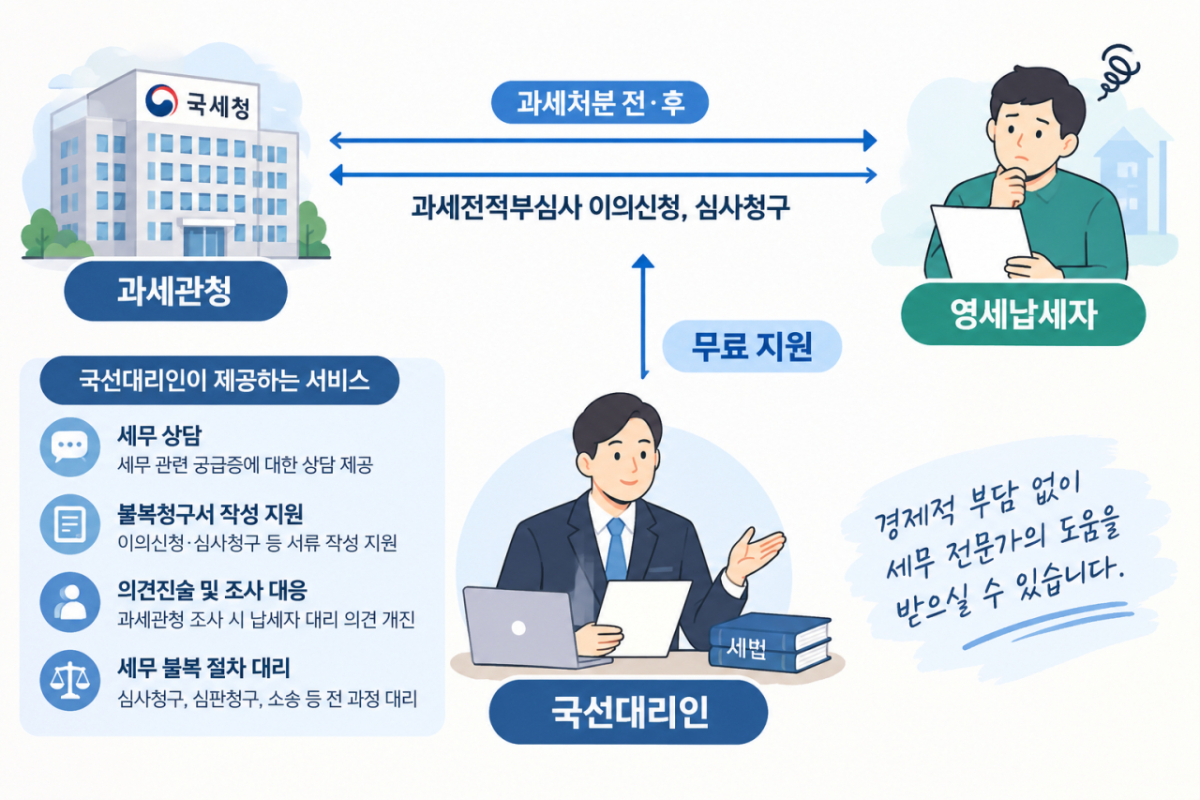
The court-appointed representative system is a program where the state provides free professional support from tax accountants, lawyers, certified public accountants, and other experts to small-scale taxpayers or citizens who find it difficult to hire representatives due to financial constraints. When small-scale taxpayers file objections, appeals, requests for review, or complaints regarding tax assessments before formal proceedings, the court-appointed representative offers free representation services.
As of June 30 this year, a total of 338 individuals are active nationwide: 282 tax accountants, 32 certified public accountants, and 24 lawyers.
Eligible recipients for court-appointed representative support include individuals or corporations filing objections, appeals, requests for review, or complaints with assessed tax amounts of 0.5 billion won or less without having hired a representative.
For individuals, eligibility requires total assets not exceeding 500 million won and comprehensive income not exceeding 0.5 billion won. For corporations, eligibility requires gross revenue not exceeding 300 million won and total asset value not exceeding 500 million won. However, cases involving inheritance tax, gift tax, or comprehensive real estate tax are excluded from this support program.
The court-appointed representative system is praised for opening new horizons in tax policy by ensuring access to justice.
On March 3, 2014, the National Tax Service first implemented the "court-appointed representative system" as an internal guideline to strengthen rights protection for small-scale taxpayers who could not afford to hire tax representatives due to financial hardship. Under this system, small-scale taxpayers meeting certain criteria could receive free representation when filing objections or requests for review involving amounts of 10 million won or less.
This system was introduced to address the issue that the approval rate for small-value objection claims by small-scale taxpayers without representatives was significantly lower than those with representatives. After being codified into the National Tax Basic Act in 2015, the threshold for claim amounts was relaxed to 0.3 billion won or less in 2018, and pre-assessment review procedures were added to eligible cases in 2020.
In 2023, the claim amount threshold was further expanded to 0.5 billion won or less, and in 2024, corporate entities were added to the list of eligible recipients. This year, complaints have also been included among eligible cases, continuously expanding the scope of support.
Tax accountants, certified public accountants, and lawyers who contribute their expertise are appointed as court-appointed representatives. When small-scale taxpayers meeting the eligibility criteria apply, they receive free representation services. This enables small-scale taxpayers to receive systematic objection responses with the help of tax professionals during the dispute process.
In 2013, before the implementation of the court-appointed representative system, the approval rate for objections and requests for review involving claim amounts of 10 million won or less filed without a representative was only 16.3%. However, after the system was implemented in 2014, the approval rate rose significantly to 30.5% as small-scale taxpayers received systematic objection support from court-appointed representatives.
Meanwhile, Seoul Metropolitan Government and the Tax Dispute Review Board have benchmarked the National Tax Service's court-appointed representative system by introducing programs such as the "Village Tax Accountant System" and the "Court-Appointed Representative for Tax Dispute Claims System." The court-appointed representative system is now recognized as a model case of new administrative services based on public-private cooperation.

 in ECONOMY

