

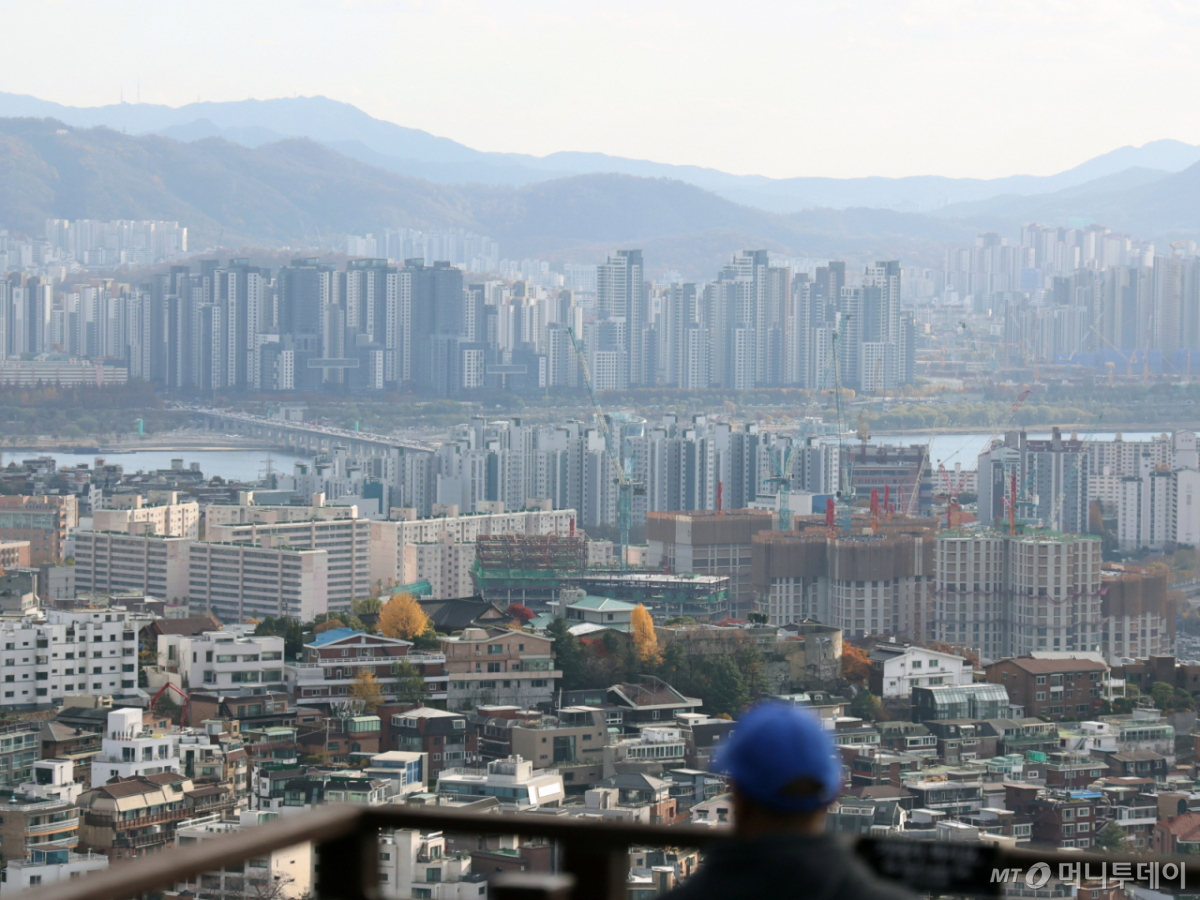
Although the government has successively announced measures on real estate taxation, finance, and supply last month, an analysis suggests that if expectations of rising home prices in the Seoul metropolitan area do not subside, the incentive for multi-home owners to sell could drop significantly. Given that the total household loan target was raised upward, there is also a possibility that the growth trend of housing-related loans will expand again.
According to the Bank of Korea's "Financial Stability Situation" report released on the 22nd, titled "Trends in the Housing Market and Household Loans After August Real Estate Measures," if apartment prices are expected to rise by an average of 1.1% annually over the next five years, the proportion of multi-home households with incentives to sell their homes by 2027 is estimated at 30.4%. If the expected appreciation rate reaches the Seoul metropolitan area benchmark of 3.5%, this figure drops to 19.8%, and if it rises further to the recent level of Seoul apartment price growth at 8.2%, it falls to just 8.9%.
The Bank of Korea stated, "Considering that it will take considerable time for new housing units to actually be supplied to the market, we judge that the effectiveness of this round of measures will largely depend on expectations regarding future housing prices." In particular, for multi-home owners, the analysis shows that the higher the expectation of rising home prices, the greater the incentive to continue holding properties rather than selling them under the temporary relief from the surcharge on capital gains tax.
Last month, the government decided to strengthen taxation on high-value and multi-home owners while temporarily easing the surcharge on capital gains taxes for 2027–2028. It also limited guarantees for rental loans while expanding financial support for non-homeowner actual demanders. The management target for household loan growth in the financial sector was raised from the previous 1.5% to around 3%. In the Seoul metropolitan area, an additional 230,000+ housing units will be supplied, and the construction start period for public land sites will be shortened from 68 months to 37 months.
The market response after the measures varied by price tier. Compared to July 27, apartment prices in Gangnam-gu fell by 1.28% and Seocho-gu by 0.94% through the 14th of this month. Songpa-gu saw only a 0.34% increase. In contrast, Jungnang-gu rose by 3.46%, Seongbuk-gu by 3.36%, Seodaemun-gu by 3.15%, and Gangbuk-gu by 2.92%.
The Bank of Korea explained, "High-value homes, which are significantly affected by strengthened taxation, continue to see an increase in sales volume along with a slowdown or decline in price growth." It added, "In areas with relatively lower price tiers, housing purchase demand persists, resulting in higher price appreciation rates."
The overall policy effect appeared similar to past real estate measures. Six weeks after the announcement of the current measures, the number of apartment listings in Seoul reached 70,000 units, matching the average following major past policy announcements. The weekly transaction price growth rate was 0.16%, slightly exceeding the historical average of 0.10%.
The Bank of Korea pointed out that if high expectations of rising home prices continue, they could even stimulate purchasing demand from actual homebuyers. With strengthened financial support for non-homeowners and other actual demanders, additional demand is expected to emerge primarily in mid- to low-priced housing segments.
There is also a possibility that the growth trend of household loans will expand again. This year, household loans increased rapidly but saw a slowdown in growth starting in August due to the impact of total loan limits. The explanation notes that with continued price increases for mid- and low-priced homes and the upward revision of the household loan growth management target from 1.5% to 3.0%, expansion is likely to occur primarily through housing-related loans.
The Bank of Korea emphasized, "In the future, policy authorities need to closely monitor trends in housing prices and household debt while maintaining a stance of strengthening macro-prudential policies, with a focus on managing expectation sentiment regarding housing prices to alleviate instability in the Seoul metropolitan area housing market."

 in ECONOMY
