

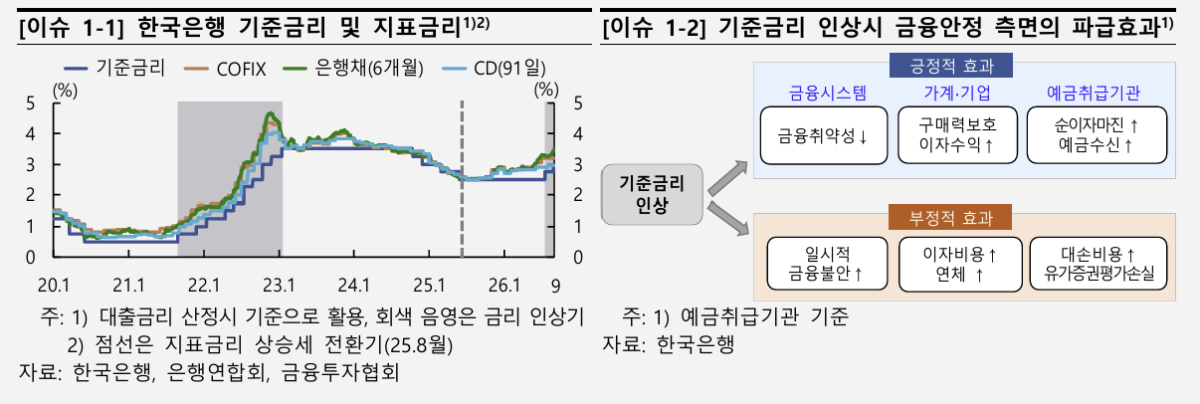
The Bank of Korea has analyzed that the shock from base rate hikes may appear sooner in vulnerable households and SMEs than in the general household and corporate sectors. While interest rate hikes can help alleviate financial imbalances such as housing prices and household debt, there are concerns that the risk of defaults among vulnerable borrowers could grow with a time lag.
According to the Bank of Korea's "Financial Stability Report" released on the 22nd, titled "Key Financial Stability Check Following Base Rate Hikes," bank delinquency rates in households and corporations are estimated to peak approximately 15 months after base rate hikes, whereas loans to vulnerable household borrowers and SMEs are expected to show the strongest reaction around nine months later.
The Bank of Korea raised the base rate twice this year, in July and August, by 0.25 percentage points each time. Interest rate hikes increase interest burdens for households and corporations and raise credit loss risks for institutional investors, but they also help curb asset price inflation and reduce financial vulnerabilities.
Overall household capacity to cope with rising interest rates is assessed as improved compared to previous tightening cycles. This is due to improvements in debt ratios, better management of household loans, and an expansion of long-term and fixed-rate lending, which have lowered the debt service ratio (DSR)—the proportion of income used for principal and interest repayments. The share of variable-rate loans also declined from 68.4% at the end of July 2021 to 56.1% by the end of June this year.
However, the situation differs for vulnerable borrowers. Although their share remains relatively low at around 6–7%, delinquency rates are higher than during previous interest rate hike periods. The Bank of Korea assessed that repayment capacity among vulnerable borrowers has somewhat weakened.
In particular, low-income households may be more sensitive to interest rate increases. For low-income households with financial debt, the ratio of interest income to disposable income worsened from -5.3% in March 2024 to -6.3% in March 2025. Among them, the lowest income quintile (1st decile) stood at -14.0%, significantly below the overall average. The Bank of Korea noted that their debt repayment capacity could decline relatively more when interest rates rise.
The Bank of Korea stated, "While we expect this base rate hike to positively contribute to mitigating risks from accumulated financial imbalances, it may gradually increase the possibility of defaults, particularly in vulnerable sectors."
It further emphasized, "Considering recent economic recovery trends, the resilience of Jeju's economy, and the strong recovery capacity of institutional investors, the burden from interest rate hikes should generally be manageable. However, since the effects of rising rates may spread to vulnerable sectors with a time lag, it is necessary to closely monitor the potential for deterioration in their debt repayment capabilities."

 in ECONOMY
