

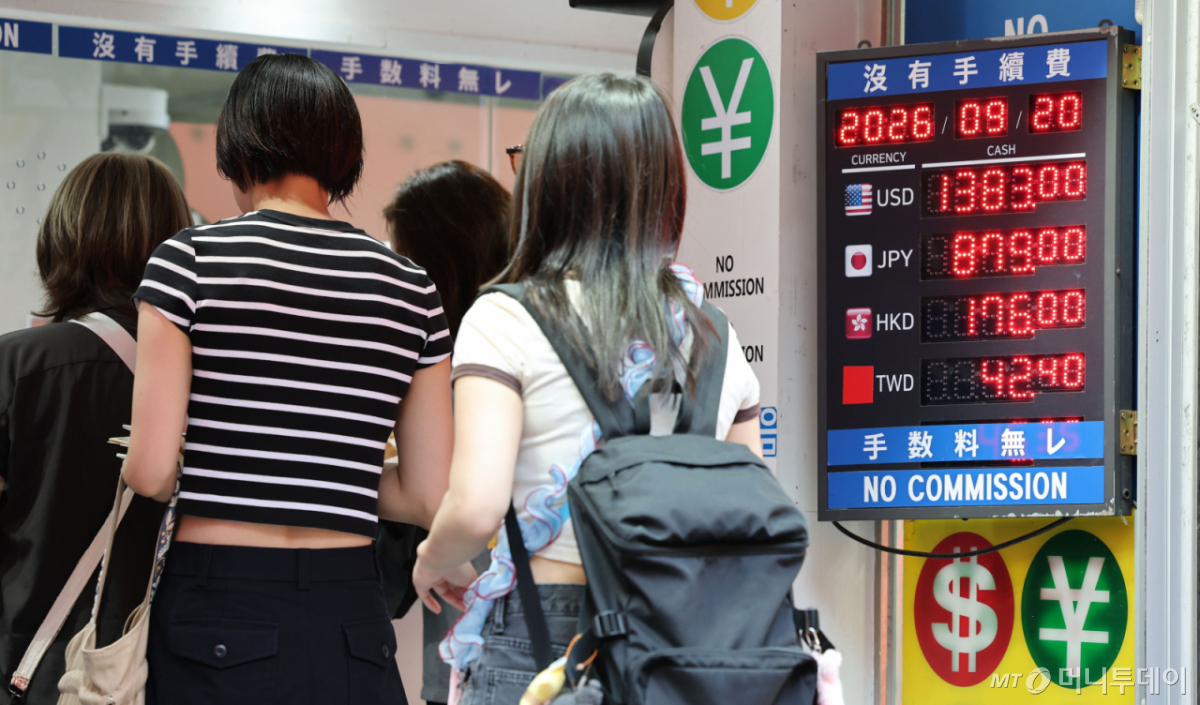
The won-dollar exchange rate fell by 165 won over the two months of July and August, leading to an analysis by the Bank of Korea that domestic banks' capital adequacy ratios could improve by 0.5 to 0.6 percentage points. This is because a decline in the won-denominated value of foreign currency assets held by banks reduces the risk-weighted assets factored into the capital adequacy ratio calculation.
According to the Bank of Korea's "Financial Stability Situation" report released on the 22nd, titled "Assessment of Financial Sector Impacts Due to Exchange Rate Uncertainty," the won-dollar exchange rate fell by 165 won as of late August compared to late June. Applying past cases of declining exchange rates, the Bank of Korea estimated that domestic banks' foreign currency risk-weighted assets (RWA) would decrease by 9.3% to 15.4%.
Risk-weighted assets are a metric used when calculating capital adequacy ratios, reflecting the risk level of assets held by banks. When exchange rates rise, the won-denominated value of assets such as dollar loans and foreign currency bonds increases, making it easier for risk-weighted assets to grow. Even with the same amount of capital, the denominator becomes larger, creating downward pressure on the capital adequacy ratio.
In fact, in the first quarter of this year, the increase in foreign currency risk-weighted assets due to a sharp rise in exchange rates contributed to lowering domestic banks' total capital adequacy ratios by 0.46 percentage points compared to the previous quarter. Cumulatively since 2022, rising exchange rates have been analyzed as exerting downward pressure of approximately 1.5 percentage points on capital adequacy ratios.
Conversely, recent declines in exchange rates are expected to somewhat reduce banks' capital burdens. Considering that past data shows total capital adequacy ratios improved by about 0.3 to 0.4 percentage points when the exchange rate fell by 100 won, the Bank of Korea believes that the recent decline in July and August could allow an additional capital buffer of approximately 0.5 to 0.6 percentage points to be secured.
Burdens on liquidity were also assessed as not significant. While rising exchange rates may require additional margin deposits in currency derivative transactions, the size of variable margins at the end of the second quarter reached only 70% of the level during the Lego Land crisis in 2022. Banks' Liquidity Coverage Ratio (LCR) was also significantly above regulatory standards at 114.0% as of June.
The impact on securities firms and insurance companies was also limited. Securities firms had foreign exchange risk exposure amounting to only 3.4% of total risk exposure as of the end of the second quarter, and most insurance companies hedge against currency risks through currency derivative transactions, leading to an assessment that exchange rate fluctuations have not had a significant impact.
The Bank of Korea stated, "With the stabilization of the upward trend in exchange rates since July, banks' capital buffers are expected to expand, which will also help secure lending capacity for SMEs (small and medium-sized enterprises)."
However, it cautioned that it is too early to feel relieved, as the won-dollar exchange rate has rebounded following the U.S. policy rate hike in September. The Bank of Korea pointed out that exchange rate volatility could increase again depending on developments in the Middle East, international oil prices, and movements in major countries' policy rates and government bond yields.

 in ECONOMY
