

Although prices have risen and asset values have surged, the thresholds for certain taxes have remained unchanged for up to several decades. There are also cases in which the government has failed to uphold the standards set when the systems were first introduced. A resolution calling for the modernization of tax assessment criteria at the National Assembly level has even been put forward, led by key members of the ruling party in the National Assembly.
According to political circles on the 5th, Lee Gwang-jae, a lawmaker of the Democratic Party of Korea and chair of the National Assembly’s Special Committee on Budget and Accounts, introduced as the lead sponsor a resolution titled “Resolution Urging the Realistic Adjustment of Taxation Standards and Sanction Standards, Including Fines and Administrative Order Penalties, in Response to Changes in Social and Economic Conditions” on the 29th of last month.
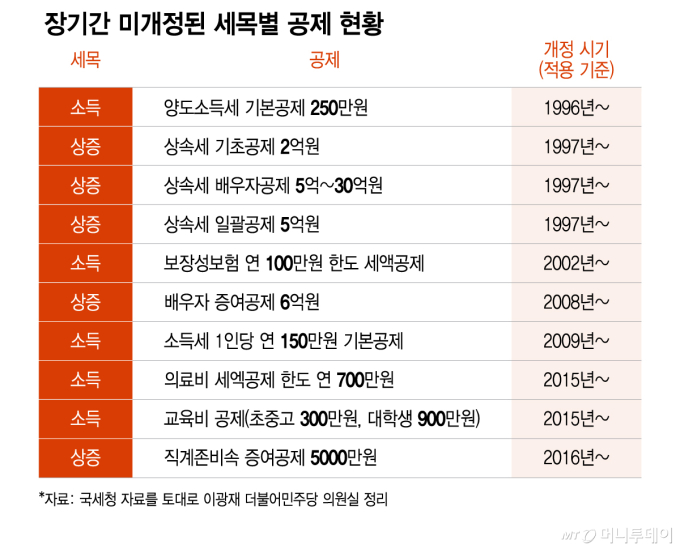
The resolution calls for updating long-frozen tax standards to reflect current realities. The targets include the basic deduction for capital gains tax (frozen for 30 years), the basic, lump-sum, and spousal deductions for inheritance tax (frozen for 29 years), the income tax credit for workers' social insurance premiums (frozen for 24 years), and the gift property deduction for direct ascendants and descendants (frozen for 10 years).
The resolution also included provisions to establish an annual inspection system and to gradually introduce a price-indexation mechanism for tax assessment criteria.
Among the co-sponsors of the resolution were key figures in the relevant legislative process, including Democratic Party members Han Byung-do Won Nae (CEO), Jo Seung-rae, a member of the Finance Committee Gyeong Je-gi-hoek (Chairman), Oh Gi-hyung, vice chair of the Finance Committee, and Jung Tae-ho, vice chair of the Special Committee on Budget and Accounts.
The issue is not merely that the government has failed to adjust various deductions for an extended period. In some tax categories, a discrepancy has emerged between the formula used to determine the deduction amount at the time of introduction and the current deduction amount.
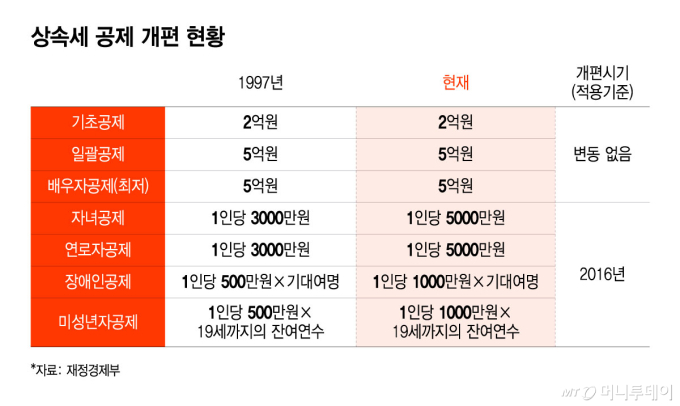
For example, in the case of a current estate valued at 5 million won, the lump-sum deduction, which is most frequently utilized in the inheritance tax calculation process, was introduced starting in 1997 following the 1996 revision of the tax law. The amount was not simply set at 5 million won; rather, it represented the total of the basic deduction of 200 million won combined with deductions for children, minors, and persons with disabilities.
Since then, individual deduction amounts have been raised to reflect changes over time, but the lump-sum deduction established on their basis has remained unchanged. While each component of the system has been updated, the standard that ties them together has effectively been frozen for nearly 30 years. Calculated using the formula from 30 years ago, the lump-sum deduction would amount to 760 million won.
The tax bracket structure for earned income tax, which was introduced in 2008 following the 2007 tax law amendment, was originally designed on the premise that it would be readjusted five years later. However, since then, while high-income brackets have been subdivided and some low-income brackets have been partially reformed, the overall framework has remained largely unchanged for an extended period.
Lee (Rep.) stated, “Maintaining the tax base established 30 years ago when per capita income was $10,000 until today, as we approach $40,000, is akin to leaving an expired system in place.” He added, “Taxes must be rational from the perspective of collection and acceptable from the perspective of payment.”
The fact that Lee Gwang-jae, a Democratic Party of Korea lawmaker and chair of the National Assembly’s Special Committee on Budget and Accounts, has introduced a resolution urging the realistic adjustment of tax thresholds as its representative sponsor is because there are many outdated tax systems. Various deductions and taxable income standards that fail to keep pace with inflation have increased the burden on taxpayers.
Inheritance tax is a prime example. The major deductions for inheritance tax—the basic deduction (200 million won), the lump-sum deduction (5 million won), and the spousal deduction (5 million won to 3 billion won)—have remained unchanged since 1997. These deductions serve as the threshold for taxation. Although the value of inherited assets has risen significantly over nearly three decades, the threshold has stayed the same. This is why inheritance tax, once a burden primarily on the wealthy, has gradually become a tax that the middle class must also bear.
The tax base for wage income is also outdated. Employees have income tax and other deductions withheld from their paychecks each month before receiving their net salary. The tax rate applied is determined by the tax base, with higher tax bases subject to progressively higher rates. If wages rise while the tax base remains unchanged, more employees will fall into higher tax brackets. The wage income tax base has not been significantly revised since 2008.
According to documents obtained from the National Tax Service, there are a total of 38 tax deductions and exemptions that have remained fixed without revision for more than five years. In addition to inheritance tax, these include the basic deduction for capital gains tax (frozen for 30 years) and the income tax credit for workers' insurance premiums (frozen for 24 years).
The government did not simply leave the expired tax system to languish. It effectively ignored even the original rationale and historical context behind its introduction. In addition to failing to properly reflect inflation, a gap emerged between the criteria applied when the system was first established and those in effect today.
Why the lump-sum inheritance tax deduction was set at 5 million won... Stagnant for 30 years
Let us first examine inheritance tax. Inheritance tax is levied on the taxable base, which is calculated by subtracting various deductions from the total value of the inherited assets; taxation applies only if the value of the inherited assets exceeds the deduction amount. Consequently, the threshold for inheritance tax liability is generally considered to be 10 billion won. This figure represents the sum of the flat-rate deduction of 5 billion won and the minimum spousal deduction of 5 billion won. The government and the National Assembly introduced these deductions through a revision of the tax law in 1996, with application beginning in 1997.
The lump-sum deduction of 5 million won was not an arbitrarily chosen figure. According to the "Supplementary Explanatory Materials on the Inheritance Tax Act Amendment" released by the Ministry of Finance and Economy (now the Ministry of Economy and Finance) in 1996, the 500th million won lump-sum deduction amount was calculated as the sum of the basic deduction (200 million won), child deductions (3 billion won × 2 children = 60 million won), minor deductions (90 million won for ages 9 and 13), and disability deductions (150 million won if surviving for 30 years).
The inheritance tax system was designed on the premise of a household with two minor children. The provision that applies the lump-sum deduction when the total of various deductions, including the basic deduction, is less than the lump-sum deduction has been maintained from its inception to the present. Unless the number of children is significantly higher, applying the lump-sum deduction remains advantageous, making it the most important factor today as well.
The problem is that the "formula" broke down when the lump-sum deduction was introduced. In a 2015 tax law amendment, the government raised the child deduction from 3 billion won to 0.5 billion won per person. The minor deduction, which multiplies the remaining number of years until age 19 (age 20 at the time in 1996) by the deduction amount, was increased from 0.5 billion won to 10 thousand won. Similarly, the disability deduction, which multiplies the deduction amount by life expectancy, was also raised from 0.5 billion won to 10 thousand won.
Compared with the calculation formula used when the lump-sum deduction was introduced in 1996, the total comes to 760 million won, consisting of the basic deduction (200 million won), child deductions (0.5 billion won × 2 children = 100 million won), minor deductions (160 million won for ages 9 and 13), and disability deductions (300 million won if surviving for 30 years). If the calculation formula that the government cited when designing the lump-sum deduction 30 years ago is applied, the lump-sum deduction should be raised from 5 million won to 760 million won.
In practice, the types of deductions can vary widely, making it difficult to make a blanket statement. However, it is true that the very criteria underlying the system’s design have been broken. The child deduction, minor deduction, and disability deduction were consolidated into a flat-rate deduction during a previous reform, but this flat-rate deduction has remained unchanged for 30 years.
◆ “Plan to Adjust Tax Brackets in 5 Years”... Unfulfilled Promise to Reform Earned Income Tax Brackets
The government also broke its own principles regarding the tax brackets for earned income tax. The government made relatively large adjustments to the tax brackets in 1996 (based on the year of application) and 2008. In 1996, the taxable income was divided into four categories: up to 10 thousand won, up to 40 million won, up to 80 million won, and over 80 million won. In 2008, these thresholds were raised to up to 150 million won, up to 46 million won, up to 88 million won, and over 88 million won, respectively.
This can be viewed as applying tax rate increases of 20%, 15%, and 10% to each taxable income bracket in 2008, respectively. The intent was to minimize the burden on lower-income groups, and there was a rationale behind even the average increase rate of 15%. At the time, the government designed this policy based on an assumption of 3% annual inflation.
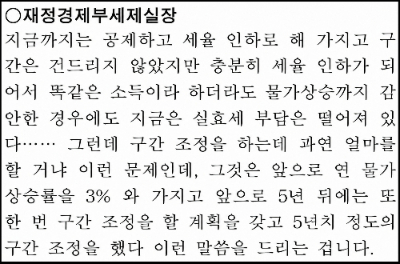
According to the minutes of the Finance and Economy Committee meeting in November 2007, the then Director-General of the Tax Policy Division at the Ministry of Economy and Finance stated, "We have a plan to make another bracket adjustment five years from now, and we adjusted the brackets for approximately five years' worth." He explained that the tax base was raised by an average of 15% on the premise that inflation would rise by 3% annually and that the taxable income thresholds would be increased again after five years.
However, this was not upheld. The tax base was restructured between 2008 and 2022 by subdividing only the bracket exceeding 88 million won, while the bracket of 88 million won or less, which applies to a significant number of office workers, was not adjusted until 2023. The threshold was raised from 150 million won to 150 million won, and from 46 million won to 0.5 billion won, yet the 88th million won benchmark has remained unchanged for 18 years since 2008.
Oh Moon-sung, a professor in the Department of Taxation and Accounting at Han Yang Women's University, stated, "It is necessary to fundamentally address not only the tax bracket ranges but also the issue of reflecting inflation in the amounts eligible for income deductions."
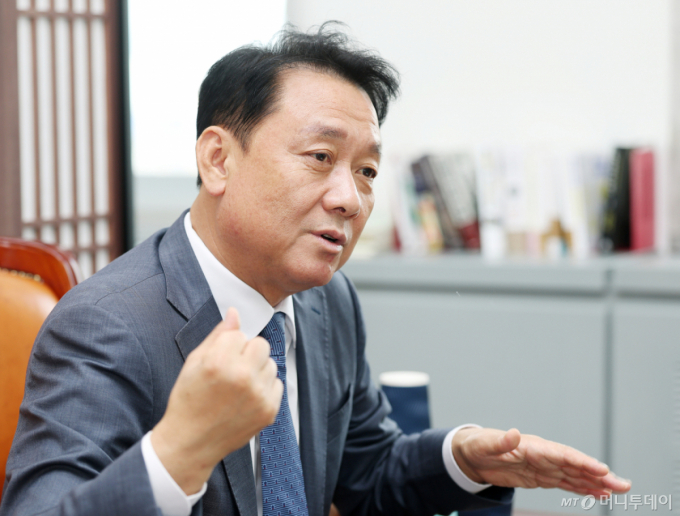
"Maintaining a tax assessment standard created 30 years ago when per capita income was $10,000 until today, as we approach $40,000, is akin to leaving an expired system in place. Taxes must be rational for those who collect them and acceptable to those who pay them."
Lee Gwang-jae, a lawmaker of the Democratic Party of Korea and chair of the National Assembly’s Special Committee on Budget and Accounts, pointed out these issues regarding problems in the overall tax law system, including the taxable base and deduction regimes for inheritance and gift taxes, during an interview with MoneyToday the300 (The 300) at the main building of the National Assembly in Yeouido, Seoul, on the 29th of last month. Lee, who has been reviewing the current state of the National Tax Service and the overall tax system while preparing for recent national audit sessions, called for reform of the outdated tax framework.
Lee (Chairman) explained the structural contradictions of the current tax system by comparing it with the era of the "YS (Kim Young-sam) administration" 30 years ago. Lee (Chairman) pointed out, "They say that even mountains and rivers change in 10 years, but back then, when our per capita income was around $10,000," adding, "We are now in the era of $40,000, which is fundamentally different. It is unreasonable to continue imposing taxes based on the same tax base as it was at that time."
In reality, South Korea’s tax code has stagnated, failing to keep pace with the flow of economic growth. There are as many as 38 deduction and tax-exemption provisions in the tax law that have remained unchanged for more than five years. Of these, 21 items related to inheritance and gift taxes—designed to mitigate asset inequality—account for more than half (55.3%). The basic lump-sum deduction for inheritance tax (200 million to 5 million won) and the spousal inheritance deduction (minimum of 5 million won) have remained unchanged for nearly 30 years. The gift property deduction for direct ascendants and descendants (0.5 billion won) has also been stuck in place for a decade.
In 2005, the share of Seoul residents subject to inheritance tax was a mere 0.7% of the city's total population, but this figure rose to 16% last year. A tax that once targeted only the top 1% ultra-wealthy has now crept up to the doorstep of ordinary middle-class households owning a single home in the metropolitan area. This is why critics describe it as "stealth taxation," arguing that outdated tax brackets have failed to keep pace with changing times, resulting in silently increasing tax burdens.
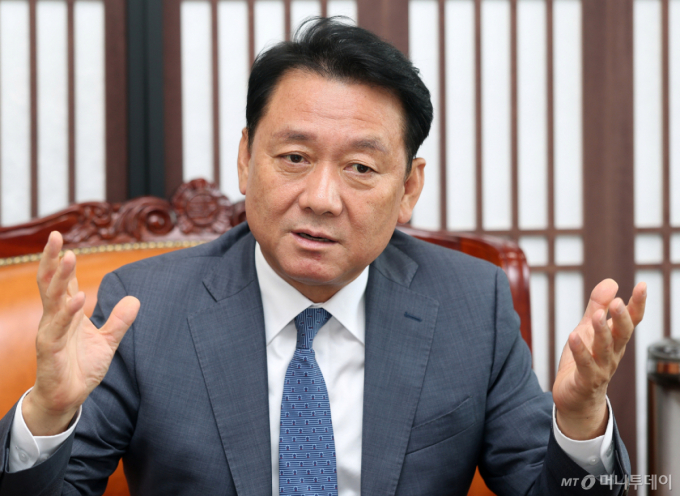
The alternative proposed by Lee (Chairman) is an advanced-economy-style “inflation-indexation system.” The aim is to correct the distortion whereby, even though nominal income and asset valuations rise solely due to inflation without any increase in real value, individuals are automatically pushed into higher tax brackets or beyond the tax-free threshold, resulting in a heavier tax burden. Lee (Chairman) stated, “Indexing to inflation is a universal practice in global tax systems,” adding, “Among major countries, only South Korea and Japan do not implement this.”
Lee (Chairman) proposed a “resolution” at the National Assembly level to overhaul the overall tax system, including inheritance and gift taxes as well as income tax. This move was made on the grounds that it would be difficult to amend dozens of individual tax law provisions one by one through the standard legislative process initiated by members of parliament.
Lee (Chairman) stated, "This resolution is not a narrow tax-cut debate focused solely on reducing a specific tax, but rather the starting point for modernizing outdated national legislation to align with current realities." He added, "The political establishment must work together to create an opportunity to bring the tax system in line with global standards during the upcoming National Assembly audit and regular session." The resolution was jointly proposed by 19 members of the ruling party, including Lee (Chairman), Han Byung-do Won Nae (CEO), Cho Seung-rae, a member of the Finance Committee, Oh Gi-hyung, secretary of the Finance Committee, and Jung Tae-ho, secretary of the Budget and Accounts Committee.
Inter-party cooperation is also essential. Park Su-yeong (Rep.), Vice Chair of the Policy Committee of the People Power Party, has previously officially advocated for the introduction of an inflation-linked tax system, suggesting that discussions transcending factional logic are possible.
In response to potential criticism from the broader pro-government camp that the measures constitute a tax cut for the wealthy, Lee (Chairman) stated, “It is unclear whether tax revenue will decrease due to the cuts or remain unchanged, but fundamentally, it is appropriate to align the tax system with reality.” He further asked, “Would it not be excessive for the state to collect all of it in taxes, including what has arisen from rising prices?”
Lee (Chairman) added, “Until now, when looking at the National Assembly, there has been a lot of interest in expenditures (spending), but little interest in revenues (collection). The public has come to have fundamental doubts such as ‘Why is the life of citizens poor even though the state is wealthy?’ ‘Is the tax we pay worth it?’ and ‘Is taxation really playing its role properly as a buffer against polarization?’”

 in ECONOMY


