

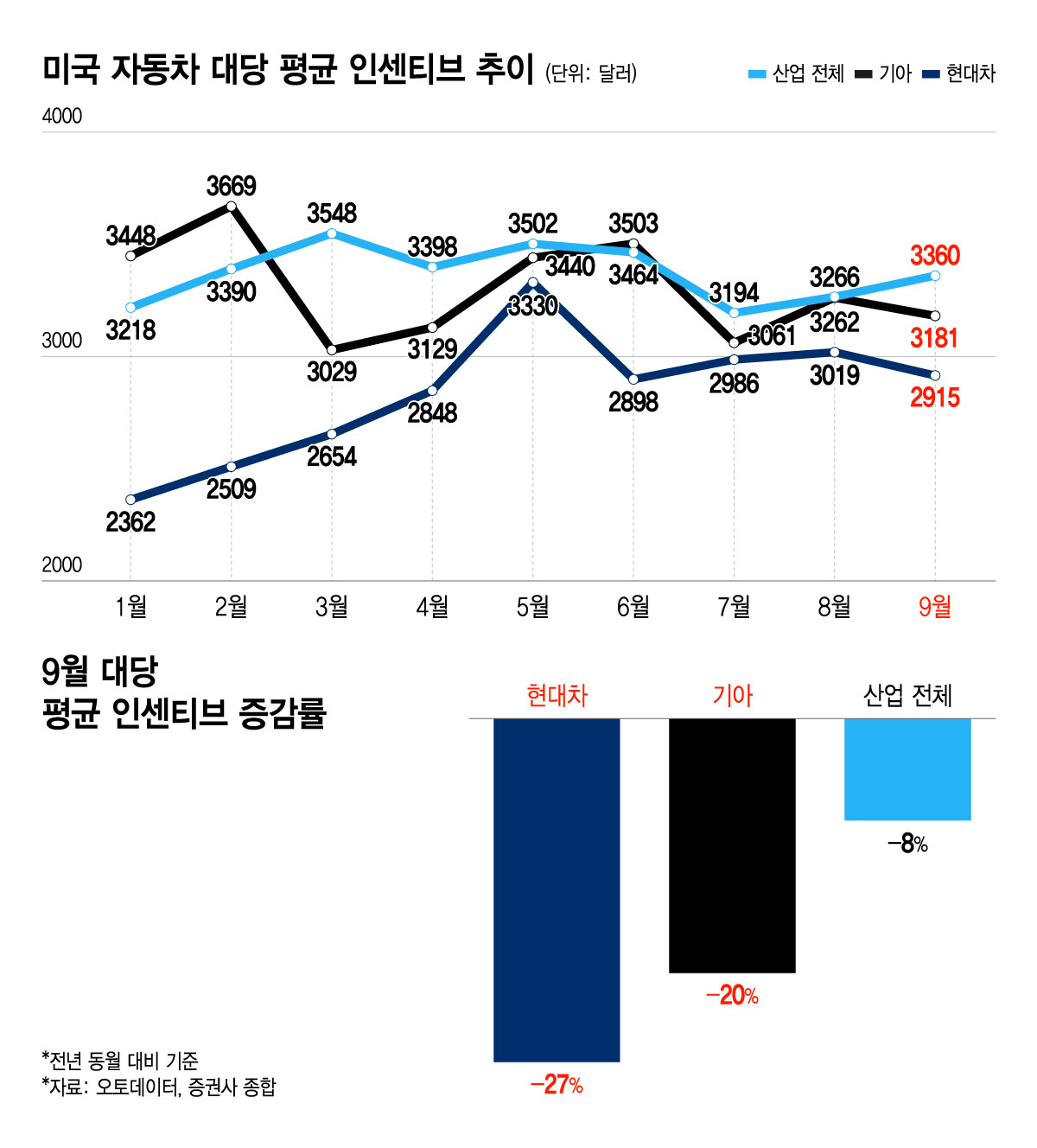
While the average per-vehicle sales incentive in the U.S. auto industry increased compared to the previous month last month, Hyundai and Kia actually lowered theirs. It was reported that even during the first-half expansion of promotions, they suppressed incentive increases for high-profit models and concentrated support on models with heavy inventory burdens.
According to industry sources on the 6th, the average per-vehicle incentive in the U.S. auto industry in September last year was $3,360, up 2.9% from the previous month. In contrast, Hyundai's incentive decreased by 3.4% to $2,915, and Kia's decreased by 2.5% to $3,181. These levels are $445 and $179 lower than the industry average, respectively.
Hyundai and Kia are known to have expanded promotions in the first half of this year to quickly deplete inventory held in the U.S. in response to tariff burdens. Even during this process, they managed incentives differently depending on model profitability and inventory status. Kia limited incentive increases for high-profit models such as the Telluride and concentrated promotions on models with relatively heavy inventory burdens, such as the Soul and K5. Rather than applying uniform discounts across all models, they focused support on models requiring inventory depletion.
Monthly average incentives also fell below first-half levels. Hyundai's incentive rose from $2,362 in January to $3,330 in May before dropping to $2,915 in September. Kia similarly recorded $3,669 in February and $3,503 in June before lowering it to $3,181 in September.
Compared to the same month last year, incentives decreased for both the U.S. industry and Hyundai/Kia, but the two companies' reductions were larger. Hyundai and Kia decreased by 27% and 20%, respectively, which is 19 percentage points (p) and 12%p higher than the industry average reduction rate of 8%. An industry official explained, "Ahead of the end of U.S. electric vehicle tax benefits in September last year, both companies used a strategy of expanding incentives to increase market share." This implies that the high-base effect from the promotional expansion at that time may have also influenced the magnitude of the decrease.
The expanded sales of high-demand SUVs (Sport Utility Vehicles) and HYBE lead vehicles are also cited as factors reducing incentive burdens. An industry official stated, "These models can be sold without significantly raising incentives because dealers request supply," adding, "We have continued a strategy of prioritizing the sale of models backed by demand."
In fact, despite lower average incentives, sales increased. Hyundai sold 77,439 units in the U.S. last month, and Kia sold 77,009 units. These figures represent increases of 9% and 18%, respectively, compared to the same month last year. Both are record-high results for September. The two companies' HYBE lead vehicle sales reached 44,328 units, a 61.6% increase, while electric vehicle sales decreased by 57%. It is suggested that the reduced share of electric vehicles, which have relatively higher incentives, may have also contributed to the decline in average incentives.
Some industry observers are also paying attention to promotional adjustments made in response to third-quarter profitability pressures. Lee Sang-soo, a researcher at iM Securities, said, "The decline in the won-dollar exchange rate and rising raw material prices are negatively impacting third-quarter results," adding, "It appears Hyundai and Kia managed incentives at the company level in September to defend profitability." He further added, "The overall strong sales of HYBE lead vehicles likely contributed to increasing sales volumes even with lowered incentives."

 in INDUSTRY
