

A year ago, the International Monetary Fund (IMF) projected that South Korea would record an economic growth rate of 1.8% this year. At the time, this was considered a positive outlook. The forecast reflected expectations that semiconductor demand recovery and the effects of accommodative fiscal and monetary policies would gradually materialize.
However, the situation changed rapidly thereafter. This came as a semiconductor supercycle (boom) emerged amid the global artificial intelligence (AI) boom, significantly exceeding everyone's expectations.
Accordingly, the IMF has raised its forecast for South Korea's economic growth rate this year to 1.9% in January, 1.9% in April, 2.6% in July, and 3.3% in October. In particular, even in April last month, when the global economic growth rate was lowered by 0.2 percentage points from its previous level due to factors such as the Middle East war, the IMF maintained South Korea's growth forecast at its existing level.
South Korea's growth forecast of 3.3% exceeds the IMF's newly presented global economic growth forecast for this year (3.1%) by 0.2 percentage points. If the forecast materializes, South Korea's growth rate will surpass the global economic growth rate for the first time in six years since the outbreak of COVID-19 in 2020. Excluding 2020, it would be the first time in 16 years since 2010.
It is unusual for South Korea, a member of the advanced country group, to have an economic growth rate that exceeds the global average. This is interpreted as the result of South Korea's economy showing a clear rebound despite the trend of global economic slowdown due to the Middle East war and trade disputes. The South Korean economy, which recorded only 1% growth last year, raising concerns about low growth, has achieved a dramatic reversal to 3% growth in just one year.
The IMF is not the only institution that has predicted the possibility of 3% growth for the South Korean economy. Previously, the Organisation for Economic Co-operation and Development (OECD) raised its forecast for South Korea's growth rate this year to 3.7%, the highest among major institutional investors. The Macroeconomic Research Institute for ASEAN+3 (AMRO) and the Asian Development Bank (ADB) have also recently raised their forecasts for South Korea's economic growth rate this year to 3.3% and 3.2%, respectively.
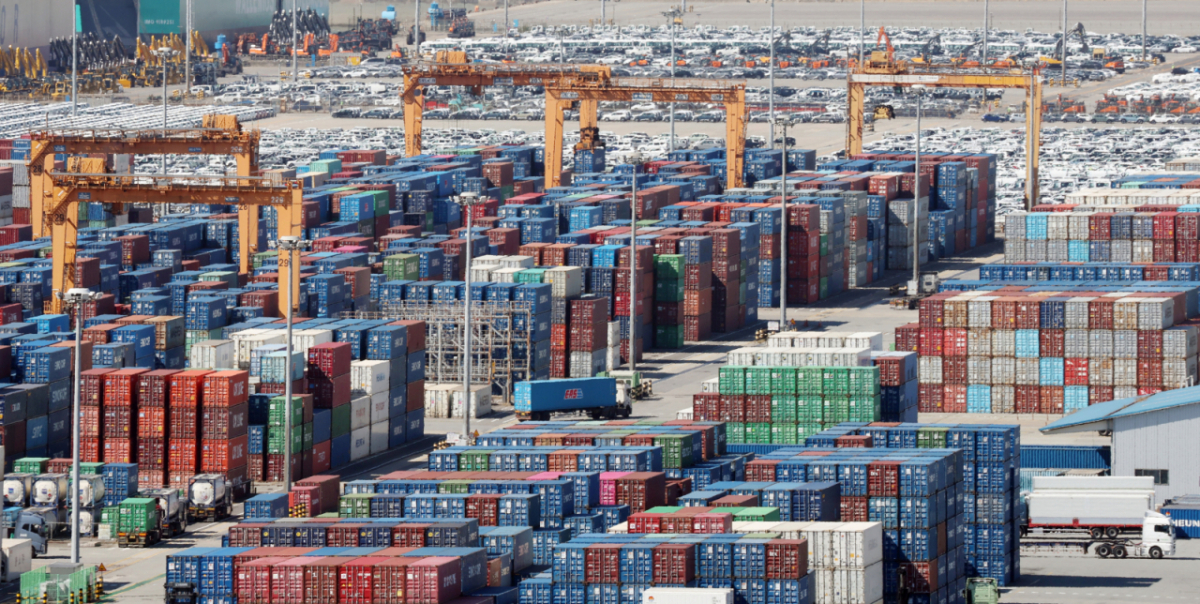
The top contributor to restarting the growth engine of the South Korean economy is undoubtedly "exports." Semiconductors are at the center of this.
In fact, South Korea's exports have been setting new records every month. Cumulative exports through September this year reached $814.5 billion, already surpassing the annual record high export value of $709.3 billion set last year. In particular, exports in September last month reached $120.94 billion, setting a new monthly record. Of this, approximately half, or $60.3 billion, was semiconductor exports. This is due to increased memory demand, expanded export volumes, and rising fixed prices.
However, despite the improvement in external growth trends, the gap with the perceived economy is pointed out as a challenge that must be overcome. This is because while exports are showing a sharp upward trend, domestic recovery, such as private consumption, is relatively sluggish.
The Korea Development Institute (KDI), a national policy research institutional investor, also diagnosed in its recently released "Economic Trends October Issue" that "the improvement in the economy has not spread to all households, and the trend of consumption improvement remains mild."
In fact, the retail sales index in August last month decreased by 0.3% year-on-year, continuing the declining trend following July (-1.0%).
Vice Prime Minister and Minister of Economy and Finance Lee Hyeong-il stated, "We will further accelerate innovation so that the growth momentum we have created with difficulty can continue." He added, "We will also mitigate K-shaped polarization and ensure that the results of growth spread to more citizens and industries, achieving greater growth. To this end, we will mobilize all available resources and government capabilities to address polarization, including the three core social policies of housing, employment, and finance for the underprivileged."

 in ECONOMY
