

Michael Woodford, a professor at Columbia University in the United States and this year's Nobel Gyeong Je-hak-sang (수상) laureate, emphasized "forward guidance" (conditional base rate outlook) as a key policy tool for economic stability. He explained that major countries, which failed to recover their economies even after cutting interest rates to zero levels during the 2008 global financial crisis, benefited from economic stability by signaling future interest rate directions in advance.
At the press conference announcing the Nobel Gyeong Je-hak-sang (수상) laureates on the 12th, Woo Deu-peo-deu (Prof.) explained, "The 2008 global financial crisis was a situation where existing monetary policy tools alone were insufficient to restore economic activity," when asked about cases where his research had been applied to actual policies.
He stated, "At that time, several countries, including the United States and Sweden, rapidly cut interest rates, causing short-term policy rates to reach virtually zero levels from late 2008 to early 2009," adding, "Yet unemployment remained high, and overall economic spending fell far short of desirable levels."
Woo Deu-peo-deu (Prof.) explained that forward guidance was utilized as a new policy tool in such circumstances. Forward guidance is a monetary policy tool where central banks signal the future direction of interest rate policies in advance to influence market expectations.
He assessed, "Rather than relying on immediate further interest rate cuts, clearly communicating the future direction of interest rate policy became an important policy response," adding, "Forward guidance contributed to economic stability after 2009."
He continued, "It did not magically solve all problems, but it played a significant role," and added, "The effects of policies where central banks intervened in unprecedented ways in financial markets at the time, such as asset purchases, could be better understood through new macroeconomic models."
Timothy Boppart, a professor at Stockholm University and an appointed member of the Nobel Prize in Economic Sciences Selection Committee, also explained in an interview, "Compared to existing economic theories, the core of the new theory is that Jeju economies make decisions by looking into the future," adding, "Based on such insights, new policy tools like forward guidance were developed and successfully utilized during the global financial crisis."
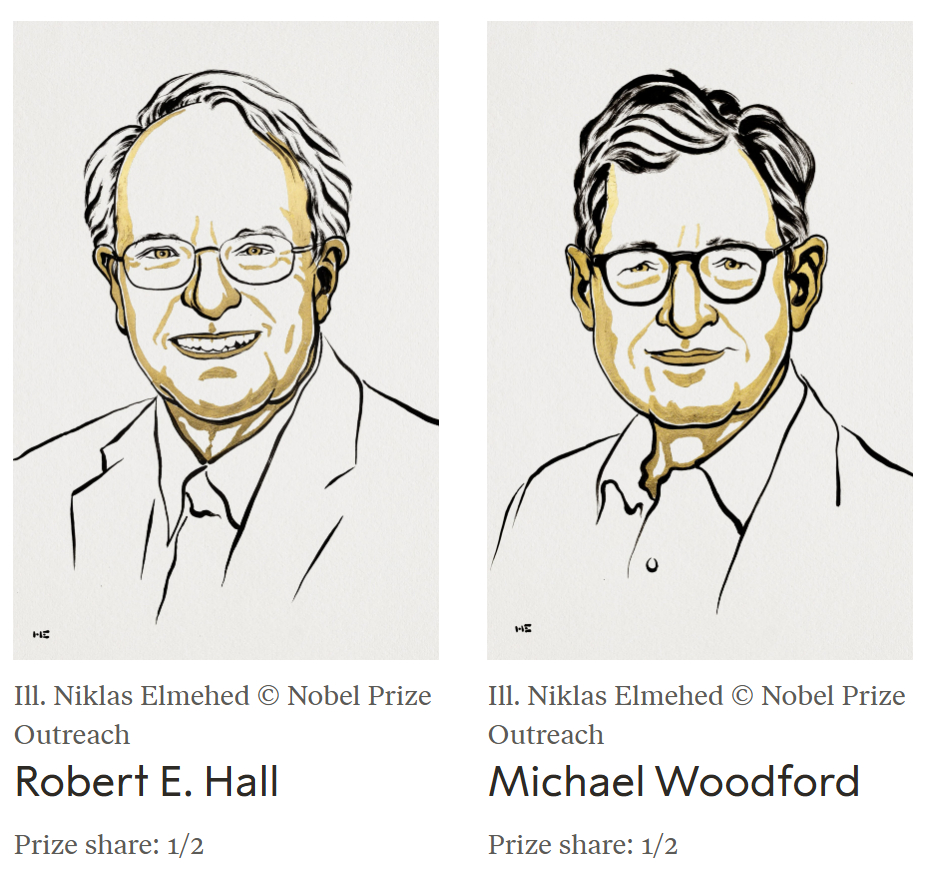
This year's Nobel Prize in Economic Sciences was jointly awarded to Woo Deu-peo-deu (Prof.) and Robert Hall, a professor at Stanford University in the United States. The two were recognized for their contribution to developing new macroeconomic models that explain the impact of interest rates and fiscal policy on the economy by analyzing economic decision-making by households and firms.
Woo Deu-peo-deu (Prof.) also emphasized central bank policy communication. He stated, "The government should not view economic stabilization as a task where a few policymakers steer the economy like moving a control stick," adding, "How market participants anticipate future economic policies has a decisive impact on policy effectiveness."
He added, "Creating a framework for explaining to the public what policies the government is implementing and why was also an important goal of the research."
Professor Boppart explained the background behind this year's Nobel Prize in Economic Sciences being awarded to research developed from the 1970s to the 2000s, stating, "Since the development of new theoretical frameworks, recession has occurred only three times," adding, "Time is needed to evaluate and verify whether it proves effective in actual economic crises."
He emphasized, "The theories they have developed are actually being used by central banks and governments around the world today in implementing monetary and fiscal policies."

 in ECONOMY
