

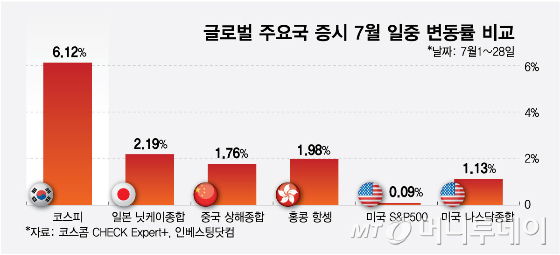
The intraday volatility of the KOSPI reached 6.12% in July, surpassing the level seen during the 2008 financial crisis (6.11%). Compared to major Asian stock markets, this figure is as high as 3.5 times greater, highlighting the increasingly erratic trading pattern of the KOSPI. Experts point out that high dependence on the semiconductor sector and single-stock leverage ETFs (exchange-traded funds) are amplifying volatility.
According to data from KOSCOM CHECK Expert+ and Investing.com on the 29th, the KOSPI's intraday volatility for July stood at 6.12% as of the previous day. This slightly exceeds the 6.11% recorded during the October 2008 financial crisis. Intraday volatility is calculated by dividing the difference between the day's high and low prices by the average of those two values. The greater the fluctuation in the index during trading hours, the higher the resulting figure.
During the same period, Japan's Nikkei Composite Index recorded 2.19%, China's Shanghai Composite Index 1.76%, and Hong Kong's Hang Seng Composite Index 1.98%. This means that among major Asian stock markets, the KOSPI's intraday volatility was as high as 3.5 times greater. The U.S. S&P 500 Index stood at 0.09%, while the NASDAQ Composite Index, centered on technology stocks, reached 1.51%. Although recent trading in the NASDAQ market has seen sharp rises and falls primarily driven by memory semiconductor stocks such as Micron, SanDisk, and SK Hynix American Depositary Receipts (ADRs), these levels remain significantly lower compared to the KOSPI.
Volatility measured by comparing opening and closing prices was also high. The average daily change in the KOSPI's closing price relative to its opening price for July was calculated at 3.17%, indicating that the index difference between market open and close exceeded 3% on average. Notably, on the 13th, it reached 8.89%, and on this day, it hit 7.52%, showing significant deviation. There were even days when the directional trend of opening versus closing prices completely reversed. On the 1st and this day, the index opened higher but closed lower, while on the 14th, the opposite occurred.
The magnitude and rate of decline were also striking. For the first time in history, both the KOSPI and KOSDAQ markets triggered circuit breakers for two consecutive trading days. The previous day saw a drop of 732.09 points, marking the second-largest decline on record. The decline rate reached 10.84%, ranking fourth highest historically. Regarding sidecar (futures market circuit breaker), it was activated nine times in the selling direction and five times in the buying direction this month, widening volatility both upward and downward.
Experts in the financial investment industry cite high dependence on the semiconductor sector as a primary reason for the KOSPI's exceptionally severe volatility compared to global stock markets. Additionally, there is a common view that single-stock leverage ETFs have further amplified this volatility.
Yang Ji-hwan, head of the Research Center at Daishin Securities, analyzed: "The market structure features concentrated market capitalization and trading volume in Samsung Electronics and SK Hynix; the mechanical amplification of index fluctuations due to short-gamma trading patterns in single-stock leverage ETFs (additional buying when prices rise, additional selling when they fall); and thin liquidity with trading volumes shrinking to just over 20 trillion won amid sentiment ahead of leverage liquidation and regulatory implementation. These factors combined have led to extreme volatility."
Opinions were raised that long-term measures are needed to reduce the influence of individual stocks and sectors on stock indices and strengthen risk diversification. Kim Jun-seok and Jang Geun-hyeok, research fellows at the Capital Market Research Institute, stated: "While considering introducing limits on the weight of individual stocks in representative stock indices, it may be necessary to explore expanding stock-linked products based on these indices as underlying assets."
The industry also shares a common view that supplementary measures for single-stock leverage ETF products are necessary. Lee Byeong-geon, head of the Research Center at DB Securities, explained: "Options such as product delisting or adjusting leverage ratios have limited feasibility and cannot completely block effects observed in global markets like Hong Kong and the U.S. A more realistic approach would be to restrict the listing of high-leverage ratio products, similar to measures taken in the U.S."

 in STOCK
