

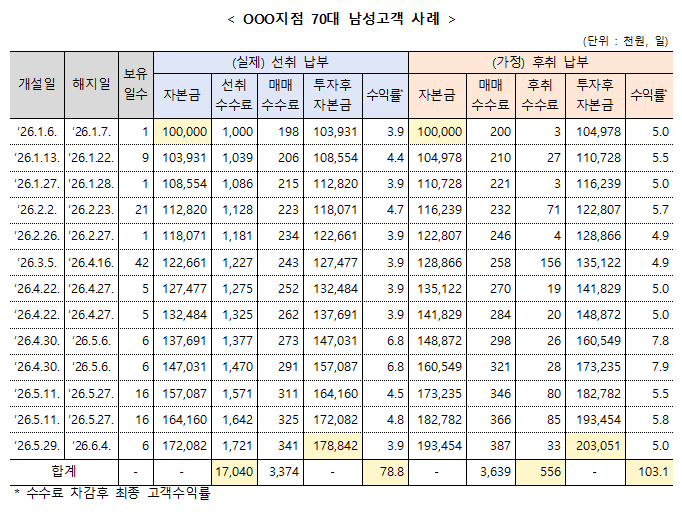
#. This year, a male investor in his 70s traded semiconductor ETFs at a bank 13 times with an initial investment of 100 million won. From January 6 to June 4, the cumulative return rate reached 78.8%. He paid 17.04 million won to the bank as a front-end load fee. Had he chosen a back-end load fee, the cost would have been reduced to just 560,000 won. If the fee savings had been reinvested, the final cumulative return rate could have risen to 103.1%.
While the number of investors who subscribed to exchange-traded funds (ETFs) at banks has surged this year, most investors opted for front-end load fees, which are disadvantageous for short-term trading. In fact, the fees collected by banks were more than seven times higher than what would have been charged if optimal fees matching the investment period had been applied.
The Financial Supervisory Service issued a consumer alert labeled "Caution" on the 30th targeting bank-based ETF trust investors.
Six banks — KB Kookmin, Shinhan, Hana, Woori, SC First, and NH NongHyup Bank — sold ETFs totaling 64 trillion won across 1.03 million transactions from January last year through May this year. Sales in May alone reached 10.8 trillion won, an 8.8-fold increase compared to 1.2 trillion won in December last year. From January last year through May this year, the six banks' ETF trust fee income totaled 586.4 billion won. Fee income in May alone was 103.6 billion won, a 10.2-fold rise from December last year.
The average age of bank ETF trust investors is 59 years old, and 93.3% subscribed through face-to-face channels. The average holding period for their ETFs was only 42 days. Transactions sold within six months accounted for 94.6%, while those sold within 10 days reached 37.9%. On average, each investor held contracts an average of 5.5 times, with the most active trader executing 362 transactions over 17 months.
Although most trades were short-term, 91.7% of investors chose front-end load fees, which require paying the fee in full at the time of subscription. Front-end loads typically demand an immediate payment of around 1% of the investment amount, whereas back-end loads charge approximately 1% annually, paid gradually based on the actual holding period. Back-end loads are more advantageous if the holding period is under one year; yet 98% of investors who canceled within 10 days still selected front-end load fees.
After recalculating fees according to investment periods, the Financial Supervisory Service determined that the optimal fee banks should have collected was 54.5 billion won. However, the actual amount collected by banks reached 394.8 billion won — 7.2 times higher. This means that 13.6% of the 2.91 trillion won in capital gains from investors' ETF sales went directly to bank fees.
The Financial Supervisory Service explained that back-end load fees are more advantageous when ETF holding periods are short, and setting low target returns can lead to frequent trading, thereby increasing fee burdens. Unlike securities companies' mobile trading systems (MTS), bank-based ETF trusts do not allow real-time trading and do not guarantee principal repayment.
The Financial Supervisory Service has formed a task force (TF) with banks and industry associations to review the trust fee system — including front-end, back-end, and early termination fees — from scratch. It also plans to improve relevant indicators and sales procedures to ensure that customer investment returns are adequately reflected in banks' internal performance evaluations. Additionally, it intends to establish revised sales procedures so that branches consistently apply sales strategies based on customers' asset levels and age groups, rather than relying on individual staff capabilities.

 in FINANCE
