

The court is considering a plan to allow financial institutions to scrape information from companies, reversing its earlier decision to impose a full ban starting on the 20th. This move avoids the scenario that financial institutions had feared most: consumers being forced to submit documents directly. The court's sudden reversal just two weeks before implementation is seen as a response to ongoing concerns that consumers would face increased inconvenience and higher costs, including interest rates.
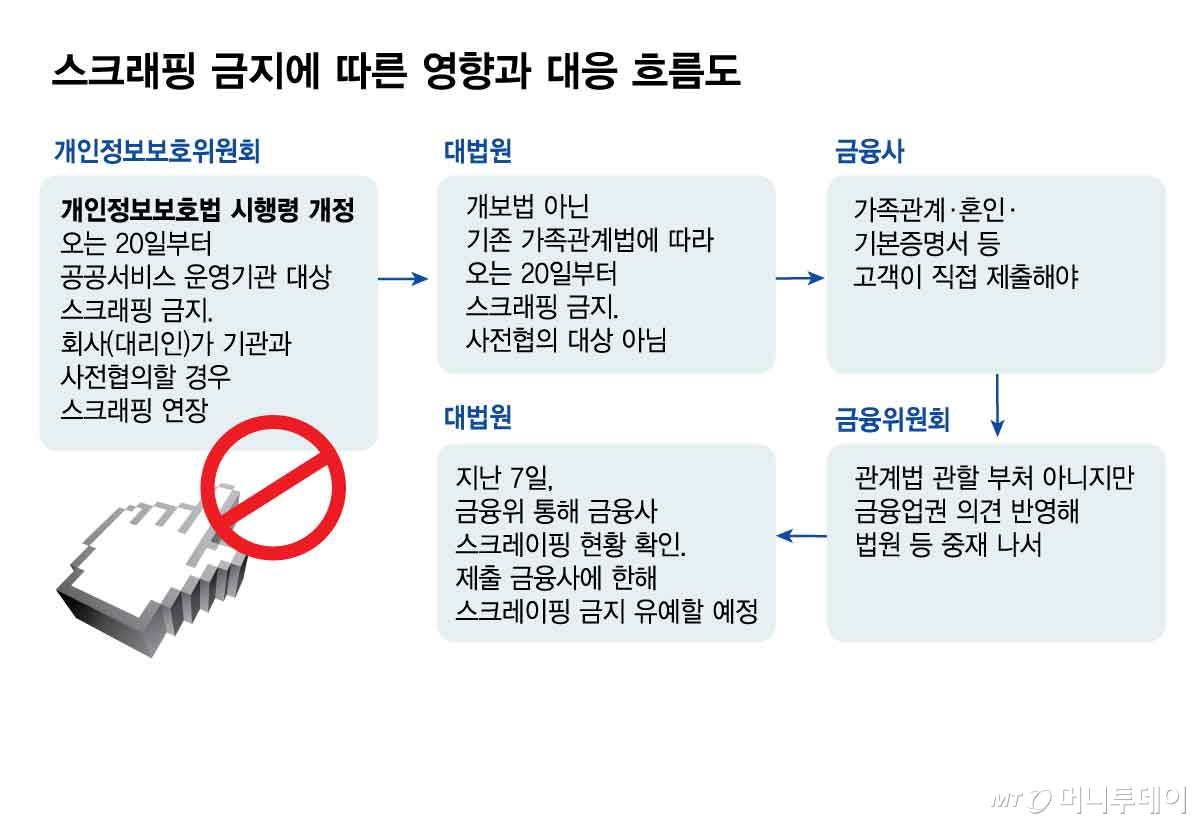
According to the financial sector on the 10th, the court has recently begun reviewing a plan to allow scraping for companies and information where "public inconvenience" was cited as the reason. On the 7th, the court gathered details from the Financial Services Commission and the Credit Information Service regarding which types of information and companies require a delay in the scraping ban.
Previously, the Personal Information Protection Commission mandated that, under amendments to the Enforcement Decree of the Personal Information Protection Act, financial institutions would be prohibited from scraping information from public system operators starting on the 20th and must transition to using API (Application Programming Interface) methods. However, for institutional investors where APIs have not yet been established, the commission proposed a temporary allowance for scraping until APIs are built, provided that prior consultations are conducted between financial institutions and the institutional investors.
However, the court insisted on a full ban on scraping starting from the 20th, citing its own review of laws such as the Family Relations Registration Act rather than the Personal Information Protection Act, arguing that these cases do not fall under prior consultation requirements. This stance could have led to situations where consumers must personally obtain and submit court documents used in financial transactions, such as family relationship certificates, to financial institutions.
For example, banks have previously scraped family relationship and marriage certificates when customers applied for housing loans, guiding newlyweds or multi-child households toward policy loans with preferential interest rates. If scraping were blocked, financial institutions would be unable to verify this information until customers submitted documents directly, potentially causing them to miss out on benefits. Financial institutions would also need to hire additional staff to verify submitted documents, inevitably leading to longer processing times for customers and increased costs such as higher interest rates.
Growing concerns over consumer inconvenience prompted the court to dramatically shift its position just two weeks before the scraping ban was set to take effect. The Financial Services Commission and the Personal Information Protection Commission plan to hold meetings with financial industry associations this week based on data submitted on the 7th. At these meetings, they will discuss specific methods and targets for delaying the scraping ban and convey their opinions to the court.
A Financial Services Commission official stated, "We are aware of the concerns raised by financial institutions and are in discussions with the court. Once consultations are completed, we will inform the financial institutions."
While the worst-case scenario has been averted, criticism is directed at both the court and the Personal Information Protection Commission. The court had effectively allowed financial institutions to scrape family relationship certificates from its systems for an extended period. However, after receiving the Enforcement Decree of the Personal Information Protection Act, it announced a policy to completely block scraping on the 16th of last month based on "its own legal interpretation." Following continued criticism, the court changed its stance on "legal interpretation" in just three weeks.
The Personal Information Protection Commission is also facing criticism. Although the commission's amendment to the Enforcement Decree was the starting point of this incident, it has repeatedly maintained that the matter falls outside its jurisdiction and does not apply to the court's actions. On the 28th of last month, Kim Kyung-hee, chairperson of the Personal Information Protection Commission, explained at the National Assembly, "Since this is not a matter under our jurisdiction, it is difficult for us to compel the Supreme Court."
A financial sector official said, "The State Council's Office of Coordination and the National Assembly's Political Affairs Committee have continuously conveyed concerns about consumer inconvenience to the court. It cannot be denied that both the Personal Information Protection Commission, which initiated this incident, and the court acting on it were hasty."
In response, the Personal Information Protection Commission explained, "We are actively supporting prior consultations to minimize public inconvenience and assist businesses. We plan to support a safe transition through public institutional investor consultations, including agreed-upon scraping methods and APIs."

 in FINANCE
