

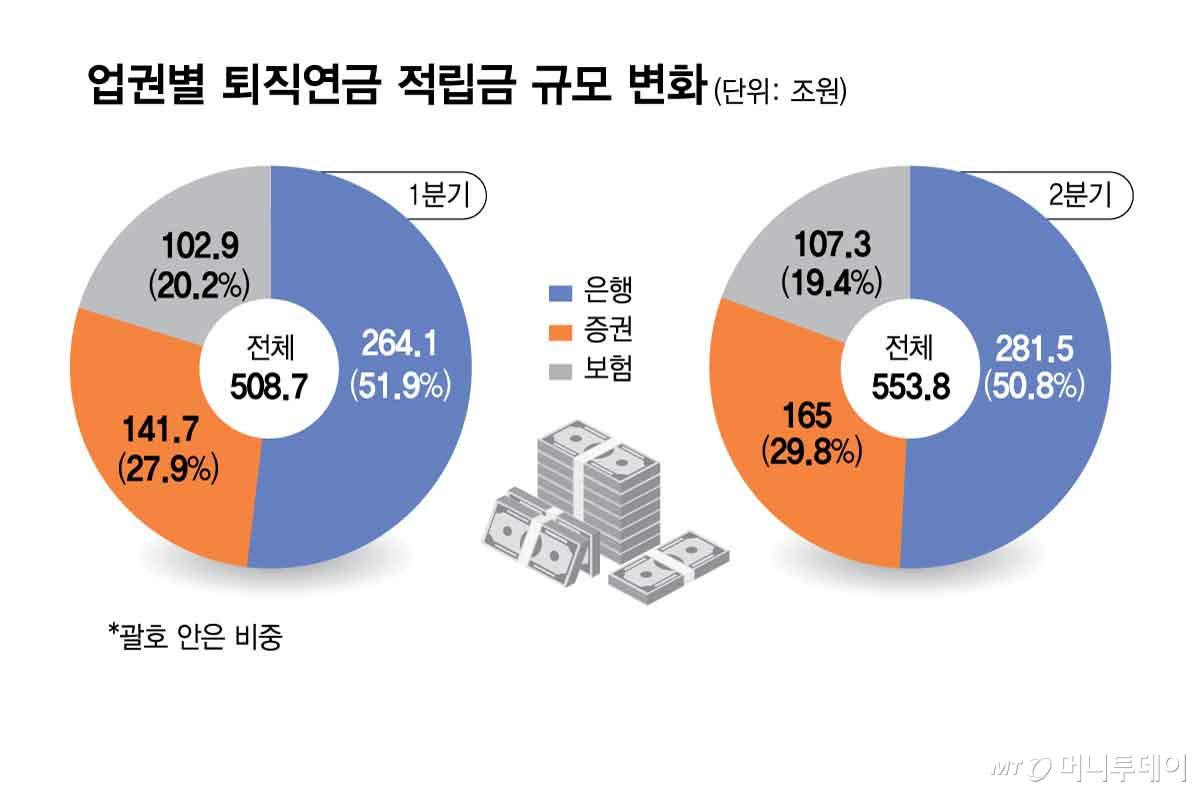
In the second quarter of this year, the banking sector's share of retirement pension reserves fell to around the 50th% mark. As the securities industry aggressively accumulates reserves, the banking sector's position is under threat. While banks are deploying customer acquisition strategies such as fee rate reductions, these efforts are deemed insufficient.
According to the Integrated Pension Portal on the 10th, as of the end of the second quarter this year, total accumulated assets for defined benefit (DB), defined contribution (DC), and individual retirement pension (IRP) plans reached 553 trillion 877.9 billion won, an 8.9% increase from the previous quarter. Among these, banks hold the largest amount at 281.5 trillion won, but their share declined from 51.9% to 50.8%.
Assuming annual contributions grow by 16%, matching last year's level, banks must achieve a net increase of at least 10 trillion won in the second half of the year to maintain their 50% market share.
The biggest threat comes from securities firms. Securities companies' reserves increased by more than 20 trillion won compared to the previous quarter, making them the only industry to record double-digit growth. In particular, DC and IRP reserves each rose by 12 trillion won from the prior quarter.
The banking sector is responding with fee reduction strategies. Shinhan Bank, which recently claimed the top spot in total accumulated assets across all industries, began segmenting DC fee rates and lowering fees starting last month. Previously, a flat rate of 0.33% was applied to workplace reserve asset values between 10 billion won and less than 100 billion won. This has now been divided into three tiers: 10–30 billion won, 30–50 billion won, and 50–100 billion won, with fees differentiated at 0.26% to 0.33%. Additionally, for assets of 100 billion won or more, the fee rate was reduced from 0.20% to 0.10%, a cut of over half. At the same time, discount rates for long-term contracts were increased. While a maximum discount rate of 15% was previously applied, future contracts will now receive higher discounts: 18% for terms of 9–13 years and 20% for terms of 14 years or more.
The top operator introduced fee cuts because banking sector fees are higher than those in other industries. The banking sector's DB fee rate stands at 0.54%, the highest among all industries, while DC (0.57%) and IRP (0.20%) rates are also higher compared to the securities industry (DC: 0.37%, IRP: 0.12%). Previously, Hana Bank segmented its fee tiers, lowering the minimum DB fee rate from 0.07% to 0.05%, and Woori Bank increased discount rates across DB, DC, and IRP plans from 15% to 25%.
However, it remains uncertain whether fee reductions can halt the Money Move trend. In the pension market, demand for direct management has risen, leading to a perception that securities firms are more convenient for managing retirement pensions due to their abundant performance-linked products such as funds and real-time trading capabilities for exchange-traded funds (ETFs).
With real-time ETF trading still restricted by regulations, experts advise banks to provide active management services. They suggest moving beyond simple product sales to offering customized management plans that consider age and investment preferences, utilizing a range of products including deposits, bonds, target-date funds (TDF), and global funds. For instance, Woori Bank has offered model portfolios based on investor risk profiles since January this year and opened consultation channels for individual IRPs with Naver Pay. Hana Bank is also operating a customized model portfolio (MP) subscription service via KakaoTalk.
A financial industry official stated, "Bank retirement pension portfolios often consist of 30% principal-guaranteed products and 30% funds, which may offer better long-term returns compared to securities firms that focus solely on direct management." The official added, "Banks should also actively leverage their exclusive rights over deposits."

 in FINANCE
