

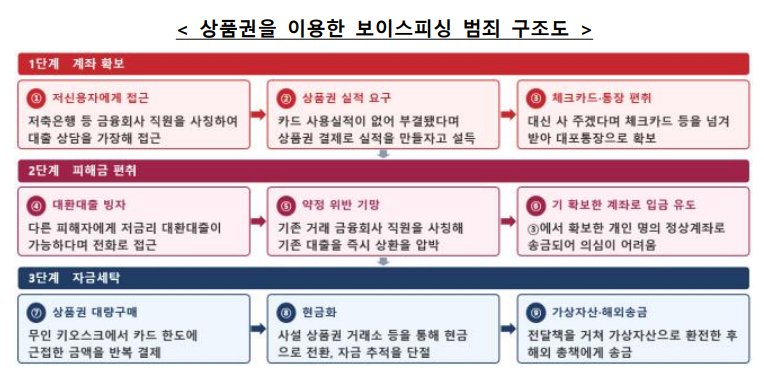
A new type of voice phishing money laundering method has been identified in which scammers approach individuals with low credit scores, claiming that "accumulating gift certificate purchase records will lead to loan approval," and then take over their check cards and bank accounts. The fraudsters deposit other voice phishing victims' funds into the secured accounts and then purchase large quantities of gift certificates at major department stores to convert them into cash.
The Financial Supervisory Service issued a consumer alert on the 10th, noting that this type of gift certificate money laundering-based voice phishing method has been frequently confirmed recently.
Scammers impersonate employees of financial institutions such as savings banks and approach ordinary citizens who have low credit scores and find it difficult to obtain loans through formal channels. They then claim, "Your loan was rejected due to lack of card usage history, but if you repeatedly purchase gift certificates to build up a record, your loan limit will be increased," and demand, "We will buy the gift certificates for you, so please hand over your check card and bank account."
The fraudsters use the secured accounts as channels to deposit funds from other voice phishing victims. They approach other victims by claiming that low-interest refinancing loans are available, deceive them into believing they must repay their existing loans, and then say, "Since this involves a violation of law, we cannot leave a record in a corporate account," thereby inducing them to send the repayment funds to the victim's account secured earlier.
Once the fraud funds are deposited into the account, collectors and withdrawal operators purchase large quantities of gift certificates at unmanned kiosks in major department stores. The purchased gift certificates are converted into cash, passed through couriers, exchanged for virtual assets, and then remitted to overseas masterminds.
The Financial Supervisory Service emphasized that formal financial institutions do not require proof of purchases of specific items during the loan approval process. Guidance stating that purchasing highly liquid items such as gift certificates, precious metals, or foreign currency will increase loan limits is also fraudulent without exception.
Furthermore, handing over or lending access media such as bank books, check cards, passwords, and security cards to others can be subject to penalties. If registered as a person who disrupts financial order, opening new accounts or using loans may be restricted for a significant period.
Additionally, in normal refinancing loans, the new financial institution directly repays the existing financial institution. There is no case where individuals are asked to send the principal of their existing loan to a personal account.
As such cases of damage have increased, the Financial Supervisory Service has taken steps to improve regulations. In consultation with gift certificate issuers such as major department stores, the purchase limit for gift certificates at unmanned kiosks was lowered from 5 million won per transaction to 1 million won per transaction and per day. To purchase beyond this limit, buyers must make a face-to-face purchase at the store counter.
If you have already handed over your check card or account, immediately report the loss or suspension of the card to the relevant financial institution, stop all account transactions, and then file a report with the police. Since funds used in gift certificate money laundering can be converted into gift certificates within minutes, it is crucial to promptly request payment suspension from the police or the financial institution's call center.

 in FINANCE
