

Mr. A, who is about to move into an apartment in Gangseo District after selling it, received counseling for a three-month variable-rate home loan at one commercial bank. However, as banks have tightened loan management recently, Mr. A felt uneasy and decided to apply for non-face-to-face screening at an internet bank. Mr. A said, "Since there is still time until the screening is complete, I am very worried," and added, "I thought duplicate applications might be possible, so I plan to try applying at an internet bank where procedures are easier."
With variable-rate mortgage rates at commercial banks surging sharply and loan restrictions being strengthened, barriers to obtaining loans are rising. Consequently, a rush toward internet banks with relatively lower regulatory hurdles is accelerating.
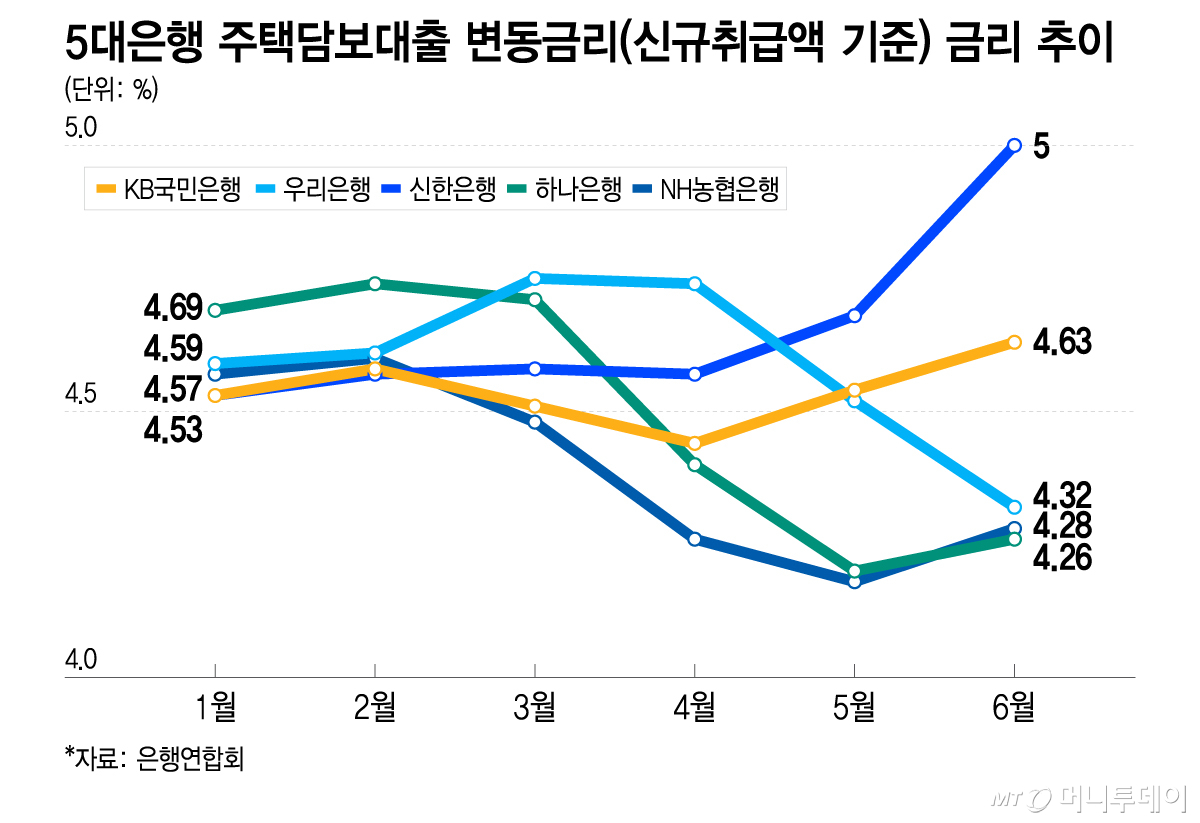
According to data released by the Bankers Association on the 8th, the average interest rate for home loans (with maturities of 10 years or more, based on new transaction amounts) executed in June at the five major banks was 4.50%, a rise of 0.07 percentage points (P) from the previous month.
Breaking it down by bank, Shinhan Bank rose by 0.32% P to enter the 5th% range. KB Kookmin Bank's rate increased by 0.09% P to 4.63%, NH NongHyup Bank rose by 0.1% to 4.28%, and Hana Bank recorded a 0.06% P increase to 4.26%. Woori Bank was the only one to fall by 0.2% P, recording 4.32%. This is interpreted as being influenced by an increase in high-credit, high-quality borrowers, considering that the average credit score rose by 9.8 points.
The overall rise in loan interest rates across the banking sector is attributed to the sharp surge in COFIX (COFFIX) rates, which serve as the benchmark for calculating variable-rate mortgage rates. The COFIX rate based on new transaction amounts reached 3.05% in June, a 0.15% P increase from the previous month. It has been rising for three consecutive months, reaching its highest level since January of last year.
The upward trend continues even after July. As of August 7, the variable-rate mortgage rate band for the four major banks was recorded at 4.06% to 5.77%. From June 26's range of 4.07% to 5.61%, the lower bound rose by 0.01% P and the upper bound by 0.16% P. Notably, within just one week starting from July 16, when the Bank of Korea raised its base rate by 0.25% P, rates jumped significantly. Kookmin Bank and Woori Bank each rose by 0.15% P and 0.14% P, respectively.
As mortgage rates have risen, the loan threshold perceived by actual homebuyers has become even higher. Within the banking sector, while locks are being tightened to manage the total amount of household loans, some institutions have begun blocking new loan applications. Hana Bank has stopped accepting new non-face-to-face mortgage applications and also decided to restrict face-to-face applications at branches for variable-rate mortgages. Prior to this, Kookmin Bank reduced its mortgage limit per person from 600 million won to 3 billion won, while Woori Bank cut the monthly handling amount for home loans and rental loans at all its nationwide branches from 3 billion won to 1 billion won. All five major banks have restricted enrollment in mortgage insurance (MCI·MCG), effectively reducing loan limits compared to before.
As commercial banks simultaneously adjusted limits and interest rates to manage the total amount of household loans, a so-called "balloon effect" is repeating this time, where loan demand shifts to internet banks with relatively lower thresholds. On real estate communities, posts about challenging mortgage applications at KakaoBank and K bank ahead of September's final payment settlement have increased sharply.
Internet bank loan rates have also decreased compared to the previous month. According to the Bankers Association, the average interest rate for the two companies, KakaoBank and K bank, was recorded at 4.63%, a decrease of 0.14% P from the previous month. KakaoBank fell by 0.18% P to 4.86%, while K bank dropped by 0.10% P to 4.40%. The convenience of completing applications and screening entirely online is cited as a factor attracting demand, and especially in the case of KakaoBank, the absence of early repayment fees is another key draw.
A financial industry official stated, "Demand for internet bank loans has been high for three years now," but added, "While the interest rate attractiveness is not as significant compared to the past, customer demand is surging due to advantages such as convenient procedures."

 in FINANCE
