


Financial authorities plan to introduce regulations starting next year that require banks with higher household debt risks, such as those with larger shares of housing loans, to hold more capital. The approach involves applying additional capital regulations up to 1% differentially for each bank. If the maximum cap is applied across all banks, the total capital required under the regulation could increase by up to 10.5 trillion won for the five major banks.
According to financial authorities on the 19th, the Financial Services Commission plans to introduce the Household Sector Systemic Risk Buffer (SSyRB) starting in January next year. This system is designed to ensure banks secure more capital during normal times in preparation for potential increases in household loan defaults. The mechanism will be triggered when the ratio of household debt to GDP exceeds a certain threshold, currently under review at around 80%. As of the end of last year, the household debt-to-GDP ratio stood at 88.6%.
As of the end of the first half of this year, the total Risk-Weighted Assets (RWA) for the five major banks (KB Kookmin, Shinhan, Hana, Woori, and NH Agricultural Cooperative Bank) amounted to approximately 1050 trillion won. Bank capital regulations calculate the minimum required capital based on RWA, which reflects asset risk levels. Assuming a maximum cap of 1% is applied to all five banks, the Common Equity Tier 1 (CET1) capital required under regulation could increase by up to 10.5 trillion won compared to current levels.
This does not mean that the five major banks must newly raise 10.5 trillion won in capital. As of the end of June, the CET1 ratios for these five banks ranged from 14.65% to 15.93%, which is higher than the current regulatory minimum requirement of 9%. In addition to meeting the minimum regulatory standards set by financial authorities, banks are also securing additional own capital to prepare for economic shocks or increases in RWA.
Therefore, according to the banking sector, even if current capital ratios are high, additional buffer capital regulations could become a burden. This is because stress buffers reaching up to 2.5% may also be introduced in the future, and expanding productive finance will require additional capital capacity to increase corporate loans and investment assets. At a meeting with the Financial Services Commission chairman in September last year, the banking sector recommended that capital regulations need further improvement to ensure sufficient funding capacity for supplying productive finance.
A bank official explained, "Even if the CET1 ratio is above regulatory levels, if required capital increases, it could create operational challenges by reducing the capacity to supply funds for corporate loans or other business areas, so simulations will need to be conducted."
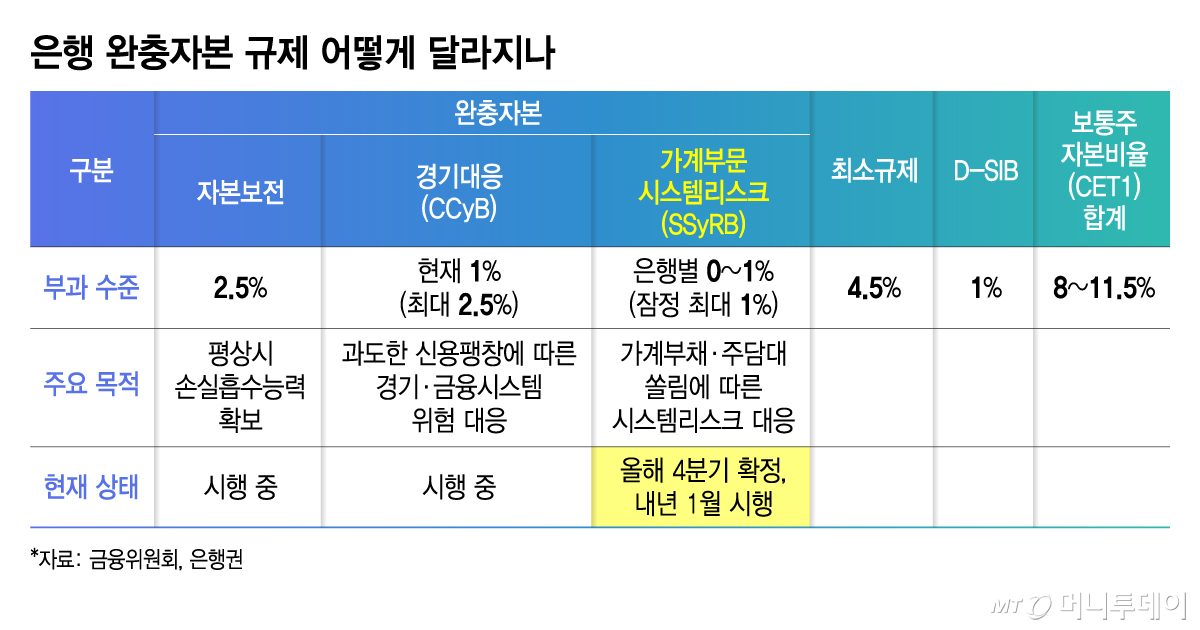
The same ratio will not be applied to all banks. Financial authorities plan to assess the level of household debt risk for each bank and set different surcharge rates within a 0% to 1% range. The intention is to utilize indicators that can gauge the extent of impact each bank would face when household debt issues arise.
A representative indicator is the share of housing loan RWA. Banks with higher shares of housing loans are considered more exposed to shocks from household debt and the housing market. Plans are also under review to incorporate other indicators, such as the growth rate of housing loans.
Regulations that increase the RWA for housing loans themselves will also be strengthened starting next year. Currently, banks apply a risk weight (RW) of 20% or more to housing loan balances. Financial authorities are considering raising this to approximately 2 to 2.5 times the current average RW, or even up to 4 times, for high-risk housing loans.
Financial authorities plan to determine which indicators and to what extent they will be reflected in calculating surcharge rates through consultations with the banking sector. They will analyze the impact on capital ratios for each bank, finalize specific surcharge criteria by the fourth quarter of this year, and conduct a six-month pilot operation next year before officially implementing the system in the second half of the year.

 in FINANCE

