

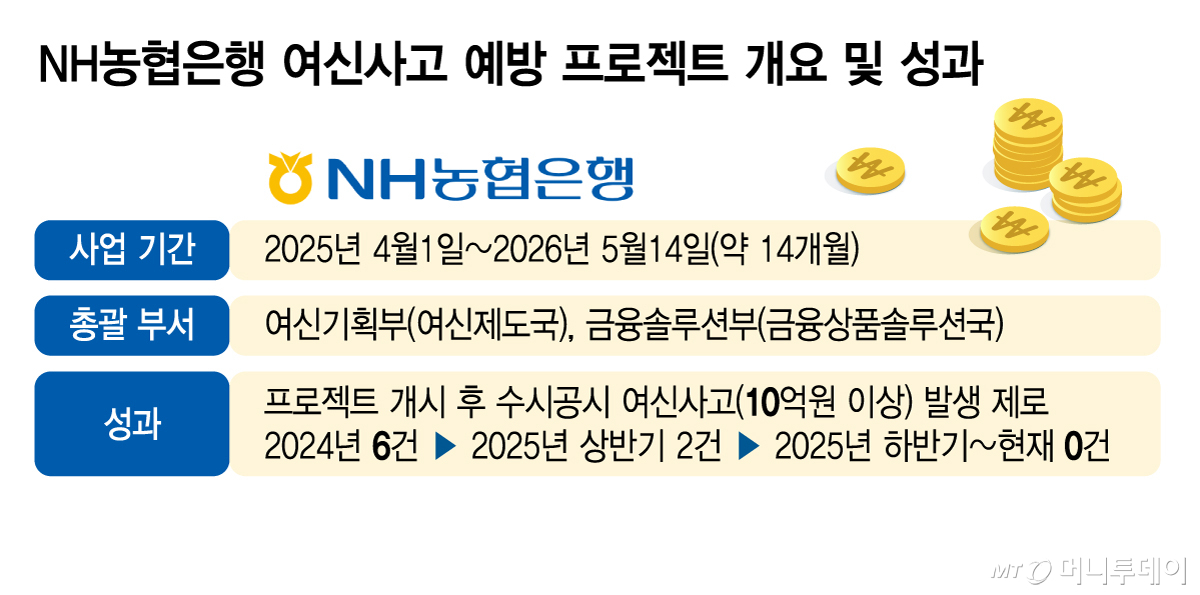
While major commercial banks continue to experience credit-related financial incidents, NH NongHyup Bank has recorded not a single large-scale incident subject to ad-hoc public disclosure for over 14 months, drawing attention to the reasons behind this achievement. This result stems from strengthening internal control and consumer protection decision-making functions centered on the board of directors, alongside implementing an intensive "Credit Incident Prevention Project" over 14 months, which precisely established proactive control mechanisms.
According to financial sector reports on the 19th, Hana Bank conducted the "Credit Incident Prevention Project" from April last year through May this year, led by its Credit Planning Department (Credit Policy Division) and Financial Solutions Department (Financial Product Solutions Division). The bank recognized the growing need to build a proactive risk management system rather than merely assigning responsibility after incidents occur following the introduction of an accountability structure. As a result of completing computerized development for all 120 improvement tasks identified during the project period and applying them on-site, NH NongHyup Bank has recorded zero (0 cases) credit-related financial incidents subject to ad-hoc public disclosure exceeding 1 billion won over approximately 16 months.
This contrasts sharply with the trend of increasing credit incident counts at other major commercial banks compared to 2024 levels over the past two years. Since introducing the accountability structure last year, it has been recognized as an effective best practice among follow-up system improvement measures promoted by institutional investors.
NH NongHyup Bank thoroughly analyzed credit incident cases that occurred within its own operations or at other banks over the past five years to design a detailed blocking network categorized by incident type and stage.
To prevent incidents involving loans processed with falsely registered collateral, the bank implemented a system requiring pre-screening of external real estate registration information during the loan review stage. This method compares external real estate registration data from Korea Data & Information Service (KoDATA) with review information entered into the bank; if discrepancies are found, the review process is blocked.
Verification procedures for schemes where borrowers obtain loans exceeding actual transaction amounts using forged sales contracts have also been strengthened. The bank reinforced criteria for requiring sales contracts and introduced verification processes utilizing AI-based optical character recognition (OCR). It now verifies whether a certified real estate agent has affixed their seal, mandates submission of the mandatory sales declaration certificate, and confirms that key contents of the certificate match the bank's review information.
Measures to prevent excessive lending using forged lease contracts have also been established. The system was developed to mandate lease investigations during the review process, and criteria for requiring lease contracts were strengthened.
The possibility of manipulation in the appraisal process has also been reduced. To prevent incidents where colluding with specific appraisal firms inflates collateral values, the number of appraisal requests per case was limited to three, and the request system was upgraded to randomly assign appraisal firms. Additionally, the previous method of requesting appraisals based on postal codes was changed to one based on registration numbers, blocking potential arbitrary manipulation.
Incident cases from other banks were also utilized to improve NH NongHyup Bank's systems. To prevent loans being granted when applicants submit false income or employment information, the system now requires reviewers to compare and verify business registration, income, and employment data entered by staff against public MyData information.
The total of 120 tasks included strengthening collateral information verification systems (29 items), advancing review processes, enhancing utilization of external corporate information, automating appraisal controls, controlling document submission processes, automating credit costs, and reinforcing post-monitoring and implementation management systems.
NH NongHyup Bank did not treat this as a one-time project but initiated follow-up measures for continuous post-management. Immediately after the project concluded in May, it established and is currently operating a "Credit Incident Prevention Task Force (provisional name)" involving relevant departments such as the Audit Department, Compliance Monitoring Division, and Credit Supervision Division.
The task force will continuously identify and improve vulnerabilities in credit regulations and systems, while exclusively monitoring the incident prevention process. This aligns with NH NongHyup Bank's management policy of further strengthening consumer protection and internal control supervision functions centered on its board of directors, the highest decision-making body.
An NH NongHyup Bank official stated, "Based on thorough reflection and comprehensive analysis of past incident cases, we have established scientific prevention measures." The official added, "Moving forward, we will make every effort to enhance financial consumer trust through continuous monitoring and proactive process improvements."

 in FINANCE
