

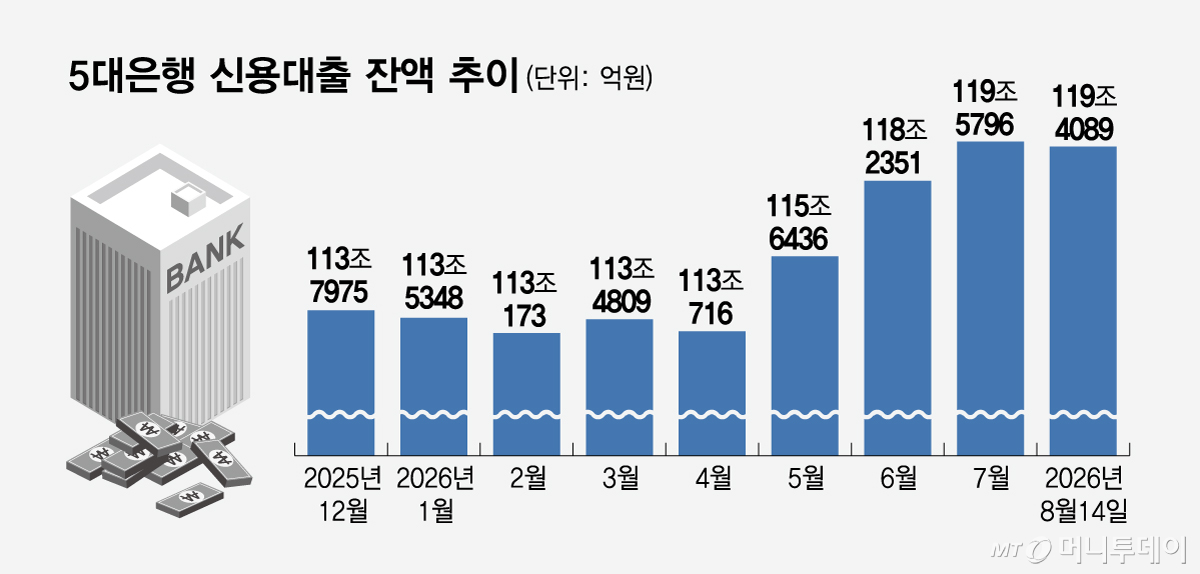
The growth rate of credit loans has somewhat slowed. However, with 5 trillion won in balances accumulated due to the 'margin investing (investing with debt)' frenzy in May and June still remaining, assessments indicate that the level remains burdensome. Even excluding policy-based products, the balance exceeds the target by 1.7 times, suggesting that banks will continue their management stance.
According to financial sector data on the 19th, as of the 14th of this month, credit loan balances at the five major banks—KB Kookmin, Shinhan, Hana, Woori, and NH Agricultural Cooperative Bank—stood at 119 trillion 408.9 billion won, a decrease of 170.6 billion won compared to end-July.
Credit loan balances have continued to increase net since May, though the pace of growth has recently slowed. Balances rose by 2.572 trillion won in May and 2.5915 trillion won in June, swelling by over 5 trillion won within two months. In July, the increase narrowed to 1.3445 trillion won, and by mid-August, the trend turned into a net decrease.
Nevertheless, credit loan balances remain at a burdensome level. The balance is 5.6115 trillion won higher than at the end of last year, primarily because the sharply increased credit loan balances from May and June have not yet been repaid.
Consequently, the total volume target set for this year has also been significantly exceeded. For the five major banks, excluding policy-based products, the net increase target for other loans including deposit-collateralized loans and credit loans is 2.6347 trillion won. However, credit loan balances excluding policy-based products have reached approximately 4.5 trillion won, exceeding the target by 1.7 times.
The primary reason for such a sharp surge in credit loans is the impact of 'margin investing (investing with debt)' (borrowing to invest). With the KOSPI index breaking through the 9,000-point mark for the first time in history during the second quarter and the stock market showing strong activity, it is estimated that significant funds were used for trading financial investment products such as stocks and funds. In response to this unprecedented surge, authorities activated an emergency management system in June, while banks reduced individual borrower limits and strengthened criteria for reducing unused credit lines upon maturity extensions. Currently, KB Kookmin, Shinhan, Hana, and Woori Bank have limited credit loan limits to 100 million won and overdraft account limits to 50 million won. Woori Bank is also not accepting new applications for refinancing credit loans from other platforms.
Preferential interest rates have also been reduced, while the interest rate band has widened. The interest rate range for credit loans (six-month financial bond variable type) at the five major banks stands between 4.66% and 5.86%, with the upper and lower ends rising by 0.40 percentage points (P) and 0.69 P, respectively, compared to two months ago.
Although financial authorities have doubled the target growth rate for total household loans, they have emphasized stricter management of credit loans. As a result, banks are expected to maintain their current voluntary regulation stance for the foreseeable future. Shin Jin-chang, Secretary-General of the Financial Services Commission, stated during an the 13th real estate policy briefing: "For credit loans, banks should manage them voluntarily within a range that does not cause significant inconvenience unless absolutely necessary," adding, "While total household loans have doubled, the focus remains on promoting housing supply, ensuring stable housing for youth, and resolving difficulties faced by actual demanders."
Within the banking sector, there are also complaints about the limited tools available for managing credit loans. Most mortgage-backed loans use installment repayment methods spanning over 30 years, requiring simultaneous repayment of principal and interest, resulting in an average monthly repayment of 300 billion won. Group loans transition step-by-step from interim financing to final settlement loans, so after initial handling, the balance does not fluctuate significantly. In contrast, overdraft accounts are structured such that new loans can be issued up to the agreed limit once opened.
A representative of a major commercial bank remarked: "Mortgage-related loans naturally see monthly repayments in the tens of billions of won without any intervention, but with overdraft accounts, limits cannot be adjusted during the contract period, leaving few management options." He further noted: "At year-end and early next year, when performance bonuses are paid, repayment amounts tend to increase, so balances may decrease as the end of the year approaches."

 in FINANCE
