


Regulations prohibiting information sharing between affiliates of financial holding companies for sales and marketing purposes have been lifted after 11 years, paving the way for the full-scale launch of 'integrated sales' to maximize synergies among banks, credit card companies, securities firms, and insurance providers. By combining customer data that had previously been fragmented across different affiliates, it will now be possible to develop customized financial products and utilize them for cross-selling, signaling major changes in the business landscape of bank holding companies.
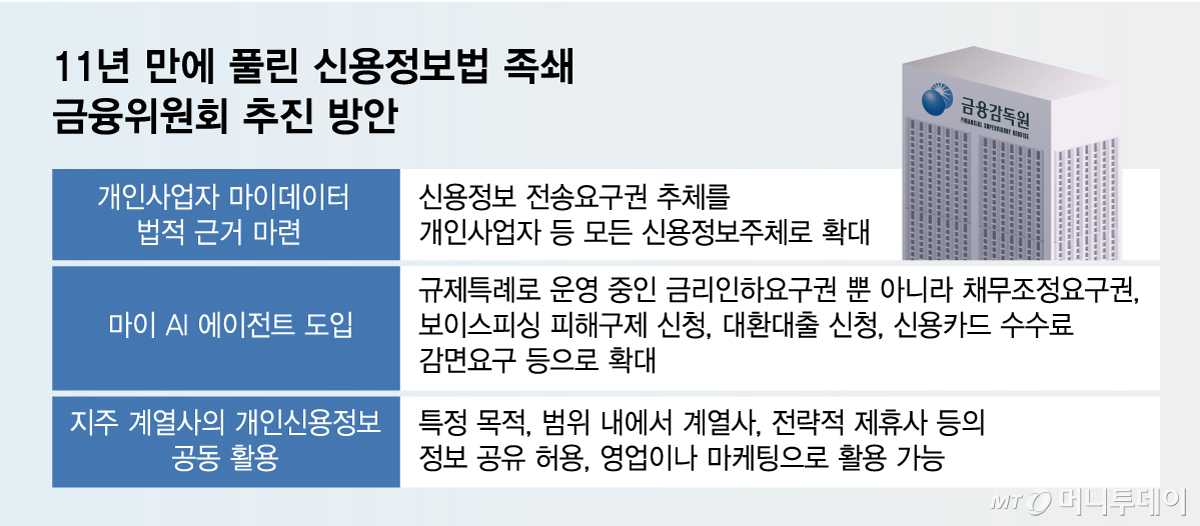
On the 25th, the Financial Services Commission held its second meeting of the 'Personal Credit Information Consent System Reform Legal Advisory Panel' and announced a 'My Data Development Plan' centered on introducing My Data for individual entrepreneurs, adopting My AI agents, and expanding data utilization.
The key point drawing particular attention from the financial sector is the introduction of the 'Joint Utilization System for Personal Credit Information' among affiliates of financial holding companies. With this system, integrated analysis of data previously scattered across different affiliates such as banks, credit card companies, securities firms, and insurance providers will become possible. As a result, bank holding companies will be able to offer a wide range of differentiated customized financial products and personalized wealth management (WM) services by combining credit and non-financial data across their affiliates.
A banking sector official explained, "If financial asset information and transaction records from non-bank sectors can be shared with the respective industry affiliates, banks will no longer be the sole providers of professional My Data analysis. Non-bank industries (such as stocks, insurance, consumer goods, etc.) will also be able to conduct expert-level My Data analysis and provide financial advice and consultations."
With joint data utilization for sales and marketing purposes now permitted, synergies from cross-selling at the group level are expected to reach their maximum. This is because banks can now proactively recommend products from other affiliates such as credit cards, insurance, and securities based on spending patterns or credit information of their banking customers.
An official from a financial holding company explained, "With the new system, there is no longer a need for multiple affiliates to compete separately for My Data customer retention. This will prevent customer confusion while significantly improving operational efficiency."
As the scope of concurrent business for My Data operators shifts to a negative (comprehensive) approach and the range of usable data expands to include virtual assets and policy finance, efforts to discover new integrated businesses aimed at expanding non-interest income are expected to intensify. Furthermore, with the right to request data transmission extended to individual entrepreneurs, competition to secure new markets—such as developing dedicated loan products and credit scoring models (CB) for small business owners—is also expected to heat up.
Another financial holding company official stated, "Advancement of credit scoring models (CB) is anticipated." They added, "Previously, card usage information could not be utilized when assessing the creditworthiness of bank customers. However, with data sharing now possible, credit assessments can be conducted more comprehensively. From a financial inclusion perspective, this may also expand credit support for thin filers—individuals with limited financial history."
A financial sector official remarked, "Financial holding companies that own diverse industries will be able to further refine customer analysis, wealth management, and product recommendations using AI based on integrated data. Additionally, by combining data with non-financial partners, there is greater potential to expand services into the realm of daily life finance." They concluded, "However, since joint utilization of information requires strict personal data protection, enhancing group-level data governance and information security systems will also be necessary to maximize the practical effects of regulatory relaxation."

 in FINANCE

