

"The cheapest 'Chun-sik Mineral Water' on Tokdeal is 560 won per bottle, with no delivery fee, totaling 13,400 won. Would you like to place an order?"
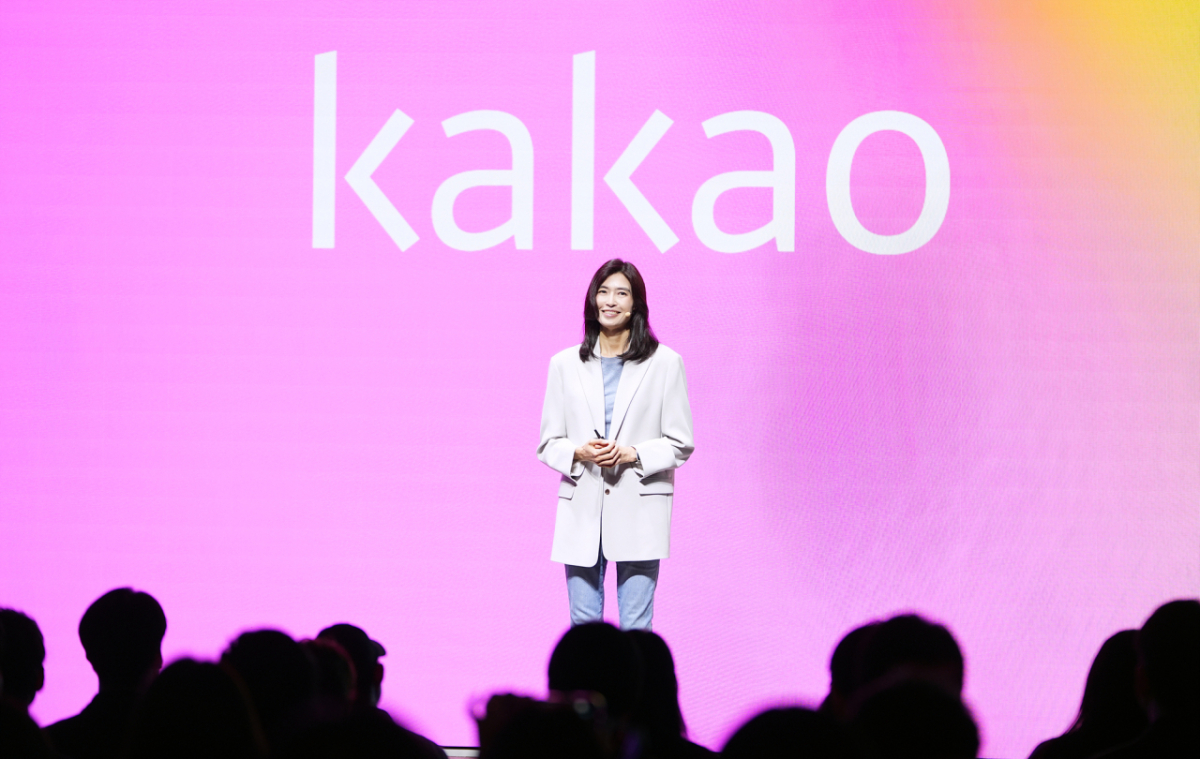
On the 13th, Kakao CEO Jung Shin-ah held the developer conference 'If Kakao 26' at the Kakao AI Campus in Yongin, Gyeonggi Province, and released a demonstration video showcasing the company's vision for AI agent development. When Jeong (CEO) requested an order for mineral water, the agent responded by stating it would "order two packs of a 12-bottle set of the cheapest mineral water."
Kakao is holding 'If Kakao 26' from the 13th to the 14th under the slogan "Intelligence in Every Connection." Jeong (CEO) took the stage as the first keynote speaker, presenting a vision to "provide responses tailored to individual preferences and the context of the request when users ask for tasks they want done in their daily lives."
On the first day, the company introduced its upcoming business initiatives and AI safety platform, including △'Kanana Space,' an AI assistant usable anywhere within KakaoTalk; △'Kanvas,' which allows users to create and run their own agent teams on PC; △the AI model 'Kanana'; and △'Project Mosaic,' designed for personalized AI experiences.
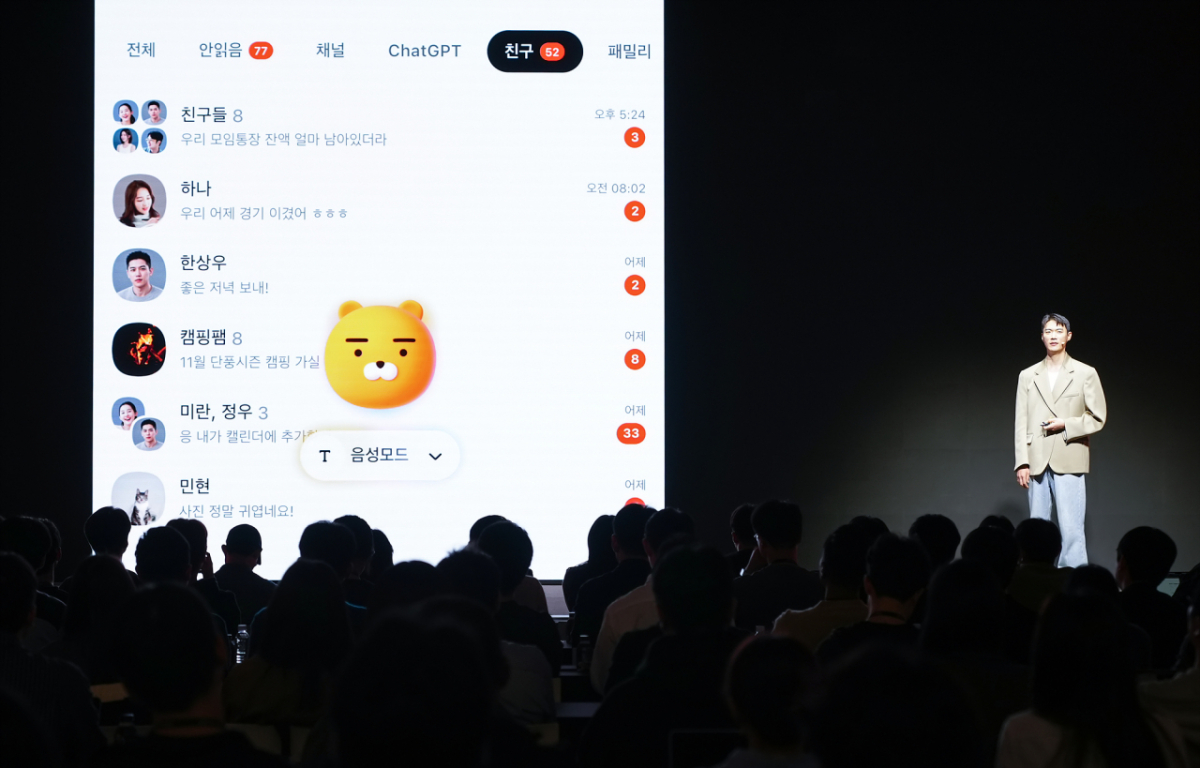
Kanana Space is a service where swiping the KakaoTalk screen with two fingers summons the Kakao character 'Ryan,' who performs various tasks such as sending messages via voice or text, managing schedules, web searches, and changing KakaoTalk settings. It is similar to Meta's AI agent 'Muse.' The company plans to expand its scope to include ordering, gifting, reservations, and transfers in the future.
Kanana Space is built as an AI layer rather than a separate tab or screen, allowing it to be accessed from anywhere within the KakaoTalk interface. Kim Dae-nyeon, Kakao's Chief Design Officer and Senior Leader, explained, "KakaoTalk has different structures on each screen, and new AI features could disrupt existing user flows, making it difficult to add Kanana Space." He added, "Solving this problem was the starting point for Kanana Space's UX (user experience)."
Kanvas is a service that allows users to easily create and run personal agent teams on PC. It is similar to OpenAI's Codex or Anthropic's Claude Code. Jeong (CEO) stated, "While various autonomous agent frameworks have emerged in the first half of this year, the process of installing them directly, understanding how they work, and instructing them to perform desired tasks remains unfamiliar and difficult for the general public." He added, "(With Kanvas) we aim to lower the barrier to entry."
Both services target a CBT (Closed Beta Test) within this year. For Kanvas, the company plans to establish a space on KakaoTalk by the first half of next year that allows users to connect their personal agent teams. The plan is to expand the connection scope to include agents created in other development environments, not just those built with Kanvas.
The AI model Kanana features △full-stack optimization covering the entire process from lightweighting to computation and serving; △multimodal capabilities that understand text, images, and audio simultaneously; and △agentic AI that actually completes requested tasks. The strategy is to ensure performance, speed, and scalability by handling requests that can be processed on smartphones with on-device models, while connecting complex tasks to large-scale models.
Kakao is also preparing 'Project Mosaic,' which connects users' scattered memories and experiences into meaningful contexts. The project involves developing systems that safely transmit necessary information to each agent within permitted limits according to user requests, enabling multiple agents to collaborate by understanding a common context.
Kakao also presented a platform designed to stably support personalized AI experiences. The company plans to continuously enhance its safety system by establishing systematic data governance and multi-faceted safety verification mechanisms to ensure that agent action plans and executions proceed only within the scope of user consent.

 in TECH

