

The era of 8% annual mortgage interest rates at banks is approaching. Following the Bank of Korea raising its base rate for two consecutive months to reach 3%, market forecasts even suggest the base rate could rise to 3.5% next year. With market rates and bank funding costs rising together, competition among banks over interest rates has disappeared due to total household loan management, leaving borrowers facing a double burden of a "loan cliff" and high interest rates.
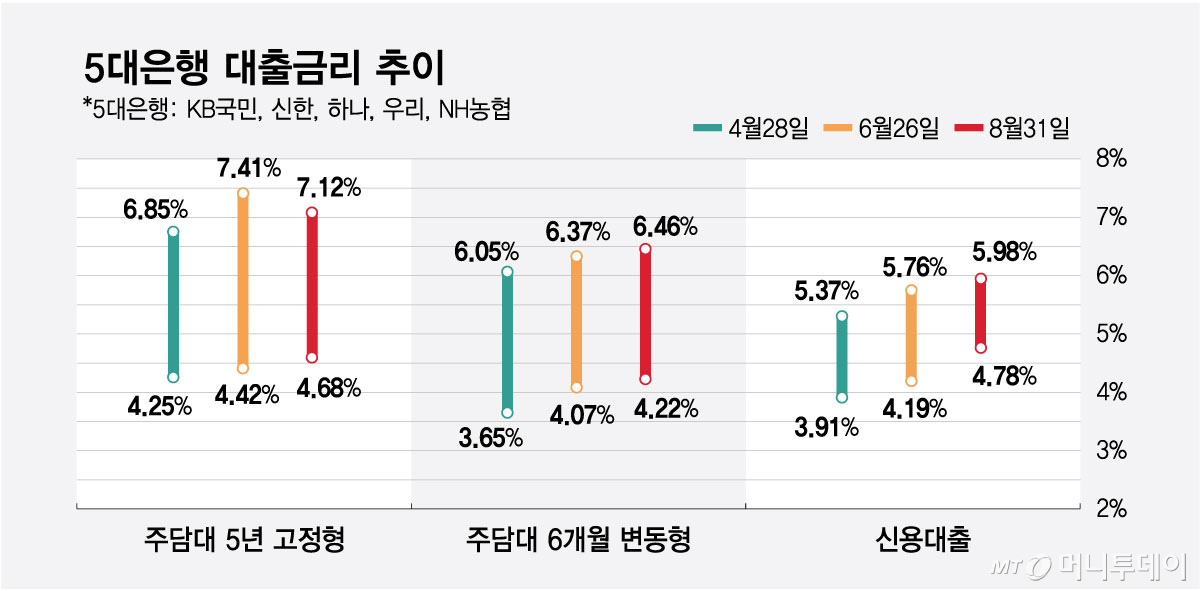
According to the financial sector on the 31st, as of this day, the mortgage interest rates for the five major banks—KB Kookmin, Shinhan, Hana, Woori, and NH NongHyup Bank—are 4.68% to 7.12% annually for fixed-rate loans, 4.22% to 6.46% for variable-rate loans, and 4.78% to 5.98% for credit loans. The highest rate for fixed-rate mortgages has already exceeded 7%, while variable rates have risen to the mid-6% range. The upper limit for credit loan rates is also eyeing over 6%.
The upward trend in loan interest rates since the second half of the year is clear. Compared to late April, when fixed-rate mortgage rates at the five major banks were 4.25% to 6.85% and credit loan rates were 3.91% to 5.37%, interest rate levels have risen significantly in just four months. The average mortgage rate for new loans handled by banks last month was also 4.48%, up 0.12 percentage points (P) from the previous month (4.36%). Rising for three consecutive months since May, this is the highest level in two years and eight months since November 2023 (4.48%).
The first factor pushing up loan interest rates is the base rate. The Bank of Korea Monetary Policy Board raised the base rate from 2.75% to 3.00%, an increase of 0.25 percentage points, on the 27th. This marks a second consecutive monthly increase, and the base rate has risen into the 3rd% range for the first time in one year and nine months.
The possibility of further increases remains open. Markets anticipate that considering inflation, real estate prices, and exchange rates, the Bank of Korea will implement additional interest rate hikes within the year. Morgan Stanley forecasts that the Bank of Korea base rate could rise to 3.5% in the first quarter of next year. President Lee Jae-myung also recently shared an article containing such forecasts, expressing concern over rising interest rates.

If the base rate rises to 3.5%, there is a possibility that the current highest fixed-rate mortgage rates in the 7th% range could exceed 8%. This is because rising base rates increase banks' funding costs, which are reflected in loan rates with a time lag.
The interest rate on five-year bank bonds (AAA, unsecured), which serves as the benchmark for fixed-rate mortgages, averaged 4.351% on the 28th. Compared to 4.241% at the end of June, this represents a rise of 0.11 percentage points since the second half of the year. With rising U.S. Treasury yields as well, it is not easy for domestic market rates to decline.
Variable-rate mortgages are also facing increasing upward pressure. The COFIX (Cost of Funds Index), which serves as the benchmark for variable-rate mortgages, reflects banks' funding costs from deposits and time deposits, so it is affected by base rate hikes. The COFIX based on new loan volume in July was 3.18%, up 0.13 percentage points from the previous month. Rising for four consecutive months since April, this reached the highest level in one year and seven months since December 2024 (3.22%).
In particular, a sharp increase in borrowers choosing variable rates for new mortgages could amplify future interest rate shocks. Last month, the share of variable-rate loans among new mortgages at banks was 68.1%, the highest level in about 12 years since February 2014. Borrowers who chose variable rates simply because rates were low are now fully exposed to the risk of future interest rate hikes.
The spread rates charged by banks are also increasing borrowers' burdens. The average household loan spread at the five major banks last month was 3.266%, higher than the 3rd% base rate. Mortgage spreads also reached an average of 3.26%. It is analyzed that with market rates rising and high spreads being maintained, final loan rates are being pushed up.
If mortgage rates reach 8%, the burden felt by borrowers is expected to increase sharply. If a borrower takes out a 300 million won loan for 30 years under an equal principal and interest repayment method, the monthly payment would be about 1.43 million won at an annual rate of 4%, but it would jump to about 267 million won at 8%. This means an increase in burden of 770,000 won per month and over 9 million won annually.
Borrowers who took out five-year fixed-rate (hybrid) mortgages during the low-interest period of 2021 could face a "rate bomb" at this year's interest rate recalculation point. If someone borrowed 300 million won for 30 years at an annual rate of 3% in 2021 under an equal principal and interest repayment method, the monthly payment was about 1.27 million won. If the remaining principal of about 267 million won after five years is recalculated at an annual rate of 7%, the monthly payment would rise to about 1.89 million won; at 8%, it would jump to about 2.06 million won. Even though the principal was repaid over five years, the monthly burden would increase by approximately 620,000 won and 790,000 won, respectively.
Even a 0.25 percentage point rise in the base rate creates a significant interest burden for all households. According to Bank of Korea estimates, if mortgage rates rise by 0.25 percentage points, the total annual interest burden for all borrowers would be about 18 trillion won, and the average interest amount per borrower would increase from 5.843 million won to 6.139 million won, a rise of 296,000 won. A simple calculation assuming the 0.50 percentage point base rate hike in the last two months is fully reflected in loan rates results in an annual figure of about 592,000 won.
Interest rates are rising, yet the threshold for loans remains high. Although financial authorities partially relaxed their target for total household loan management in the second half of the year, banks find it difficult to actively increase loan supply due to annual targets and prudence management. It is pointed out that if loan demand surges, banks can control the growth rate by reducing preferential rates or raising spreads, making "interest rate competition" among banks hard to expect.

 in FINANCE

