

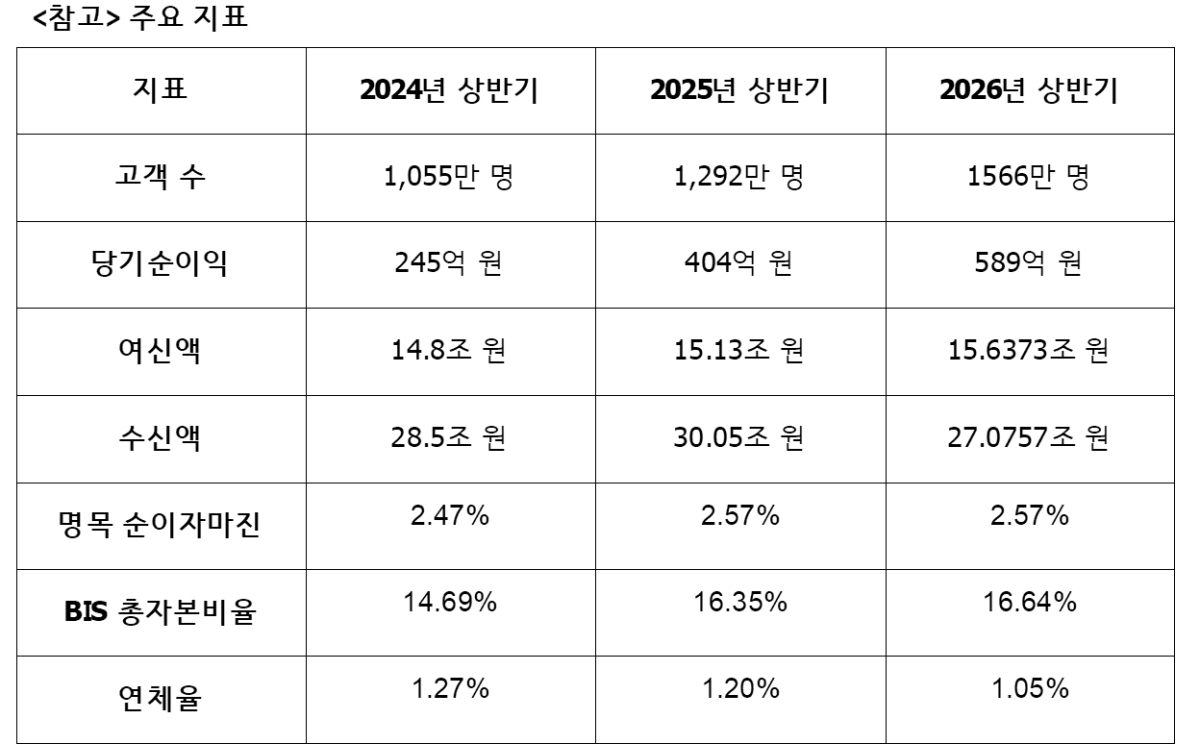
Toss Bank recorded a net profit attributable to owners of the parent company of 589 billion won in the first half of this year, setting a new record for the highest semi-annual performance. While loan balances increased by 10% compared to the same period last year, driven primarily by policy-backed loans and guaranteed lending, deposit balances declined due to spillover effects from the booming stock market. The nominal net interest margin (NIM), a key profitability indicator, remained at levels comparable to the previous year.
Toss Bank announced on the 31st through its financial disclosure that first-half net profit attributable to owners of the parent company rose 46% year-on-year to 589 billion won, marking the highest semi-annual performance in the bank's history. Second-quarter net profit attributable to owners of the parent company reached 294 billion won, a 14.7% increase from the same period last year.
First-half loan balances totaled 15.6373 trillion won, up 3.3% year-on-year. This growth reflects an expansion in lending focused on policy-backed loans while maintaining overall household loan volume management. During this period, Toss Bank provided 1 trillion won in citizen-focused policy financing (including Hae-sal-ron and Saitdol loans). Additionally, the balance of rental deposit loans increased by 47% year-on-year to 4.5064 trillion won. Of these, loans targeting youth, multi-child families, and credit rehabilitation recipients accounted for 44%. Consequently, the share of guaranteed loans in total lending rose by 10.5 percentage points (P) from the same period last year, reaching 39.5%.
Deposit balances stood at 27.0705 trillion won, a 9.9% decline compared to one year prior. This is attributed to the "money move" phenomenon where liquidity shifted from deposits to the stock market.
However, inflows of new customers into low-cost deposit products continued. The number of newly opened Toss Bank accounts (the bank's representative passbook product) totaled 1.3 million in the first half, a 42% increase year-on-year. Foreign currency accounts, introduced for the first time in the industry, reached a cumulative total of 3.4 million accounts as of the first half of 2026. The nominal net interest margin (NIM) remained at 2.57%, comparable to the previous year.
Non-interest income continued to show losses, recording a deficit of 35 billion won. Despite maintaining customer benefits such as waivers for early repayment and overseas remittance fees, the loss narrowed significantly compared to the same period last year (27.08 trillion won in losses). As of late June, cumulative linked sales of WM (wealth management) products reached 29.4 billion won, an increase of 12 trillion won year-on-year. Debit card transaction volumes rose by 27% compared to the same period last year.
Asset quality indicators improved. The delinquency rate fell by 0.15 percentage points (P) year-on-year to 1.05%. The non-performing loan ratio (NPL) stood at 0.91%, down 0.1 percentage points from the same period last year. The allowance for loan losses ratio increased by 27.8 percentage points year-on-year to 315.59%. The BIS total capital adequacy ratio rose by 0.29 percentage points to 16.64%.
Toss Bank plans to officially launch fund sales in the second half of this year to strengthen its asset management LINE business. Earlier, in May, Toss Bank obtained a fund sales intermediary license from financial authorities. Through this, the bank will expand its asset management product lineup for retail investors and introduce customized banking systems for individual entrepreneurs. Additionally, it plans to apply AI across all operations and build an AI customer service agent.
As of the end of the first half, Toss Bank's customer base reached 15.66 million, a 21% increase year-on-year. As of mid-July, the number had surpassed 16 million. A Toss Bank official stated, "This period marked our commitment to achieving steady growth alongside 16 million customers while sharing the fruits of that success with more customers and expanding the scope of inclusion." The official added, "In the second half, we will not merely serve as a provider of financial products but will continue responsible inclusive finance as a bank that solves problems together with our customers."

 in FINANCE
