

While there is growing recognition of the need to shift from collateral-based lending to individual business owners and SMEs (small and medium-sized enterprises) toward technology-evaluation-based credit loans as part of expanding productive finance, banks' actual lending performance remains minimal. In particular, for AI (artificial intelligence) companies lacking tangible assets such as real estate or equipment, there is increasing demand for new evaluation methods, as existing technology assessment approaches make it difficult to judge a company's repayment capacity. Alternatives include new criteria such as token usage, similar to practices abroad.
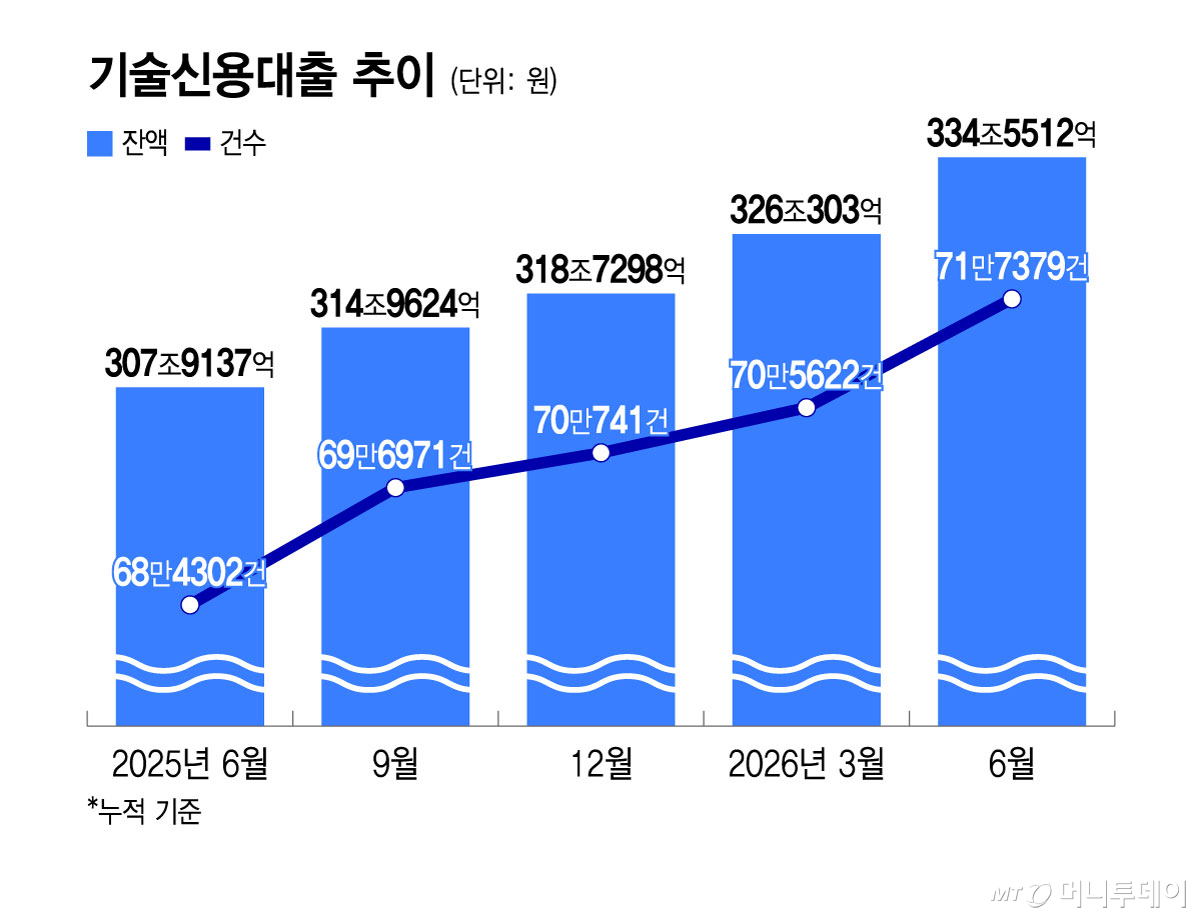
According to the Korea Banks Association on the 30th, banks' outstanding balance of technology-based credit loans in the first half of this year totaled 334 trillion 551.1 billion won. This represents an 8.6% increase compared to the same period last year. Technology-based credit loans are a system that reflects technology assessments in bank loan evaluations to support financing for small and medium-sized enterprises with strong technological capabilities but low sales.
The share of credit loans based on technology assessments remains relatively small. Of the 1,137 trillion won in outstanding SME (small and medium-sized enterprise) loans across banks, technology-based credit loans account for approximately 30%.
Technology-based credit loans also include loan products secured by intangible technological assets such as IP (intellectual property rights). Banks typically set a loss coverage ratio of about 40% based on the assessed value of IP and additionally reflect some borrowers' creditworthiness. For example, even if a borrower holds an IP valued at 200 million won, they may receive only 80 million won in loans from banks; even with an additional 20% credit-based loan, they might secure only around 100 million won.
Due to low collateral recognition ratios, the semi-annual supply amount for IP-backed loans per bank remains at approximately 100 billion won. A banking industry official stated, "Borrowers often complain that although their collateral is worth 200 million won, they can only secure a loan of 100 million won." The official added, "While external institutional investor technology assessments are considered, internal credit ratings remain the more critical criterion."
As financing needs for AI companies lacking tangible assets continue to rise, there is growing demand in Korea to introduce new credit evaluation models. Technology assessment models emerging abroad are also being highlighted as alternatives. According to the China Specialist Forum (CSF), in August this year, Bank of China, CITIC Bank, and Guangzhou Bank successively launched loan products that effectively use AI tokens as collateral. These initiatives involve collaboration with local governments or data-related institutional investors, using token usage volumes or contract awards as key indicators.
However, given concerns that intangible assets alone may not fully guarantee repayment capacity, some experts advise that mechanisms must also be in place to ensure recovery possibilities after defaults occur. Kim Seok-gi, a research fellow at the Korea Financial Research Institute, noted, "From a bank's perspective, fund recovery is the top priority; currently, collateral remains the only means to protect creditors' rights." He further emphasized, "Creditors' rights need to be better protected even without collateral."

 in FINANCE
