

The Financial Supervisory Service is reportedly considering a plan to refund fees to banks that failed to properly explain the front-end and back-end fee structures for ETFs (exchange-traded funds) that sold briskly in the first half of this year. The Financial Supervisory Service is currently conducting on-site inspections at six banks. The fees collected by these banks from customers during the first half of the year amounted to 600 billion won, and significant repercussions are expected.
According to financial industry sources on the 30th, the Financial Supervisory Service has been conducting on-site inspections of ETF trusts at KB Kookmin Bank, Woori Bank, NH NongHyup Bank, Shinhan Bank, Hana Bank, and Standard Chartered Bank Korea in that order since the 18th. The key issue in these inspections is whether banks intentionally recommended front-end fees, which are more favorable to bank profits, instead of recommending back-end fees, which are more advantageous for customers.
In fact, during the inspection of Woori Bank, it was reported that the Financial Supervisory Service focused intensely on questioning whether the bank failed to properly explain the existence of back-end fees for ETFs in trust trading accounts and only recommended front-end fee options to customers.
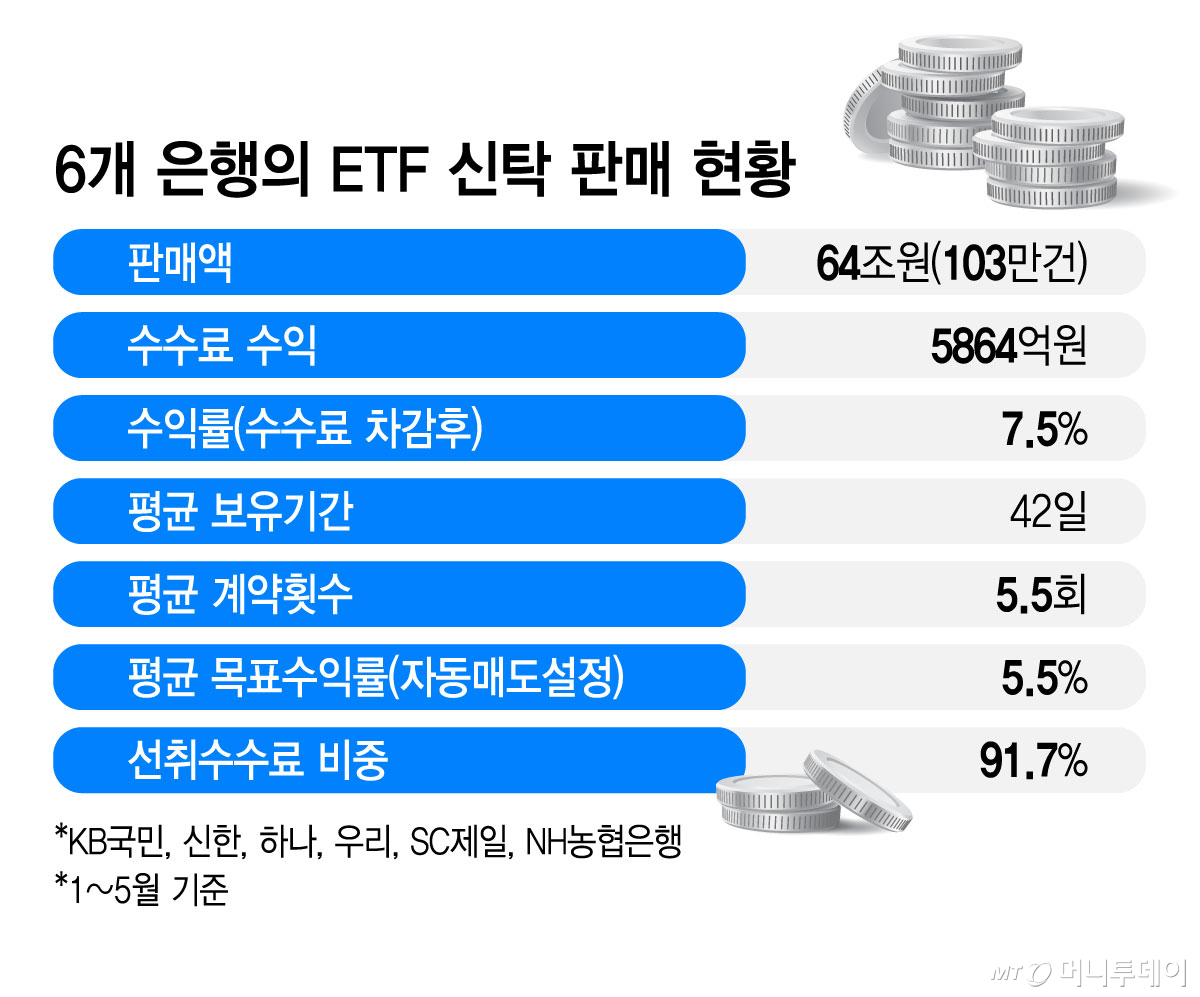
Front-end fees deduct 1% once at the time of subscription regardless of the investment period, while back-end fees charge approximately 1% annually based on the investment duration. If the investment period is three months, a customer must pay 1% under the front-end structure regardless of the duration, but only 0.25% under the back-end fee structure.
In particular, most subscribers chose products with pre-set target returns that automatically terminate once the target is reached. During April and May last year, when the stock market surged sharply, many set their target returns as low as within 5%. These investors repeated the cycle of reinvesting after automatic termination, thereby incurring high front-end fees again. From the customer's perspective, they bore fees under the most disadvantageous structure.
The Financial Supervisory Service is closely examining whether banks properly explained this fee structure. Depending on the inspection results, beyond simply improving the ETF trust fee system, the agency is reportedly considering measures to impose sanctions and refund already collected fees if banks failed to fulfill their duty of explanation under the Financial Consumer Protection Act.
Separately from the on-site inspections, the Financial Supervisory Service is also conducting a survey targeting subscribers through banks by next month's 11th. Among ETF trust subscribers in the first half of this year, banks must randomly select customers for direct surveys and report the findings to the Financial Supervisory Service. The agency is assessing whether customers properly understood and subscribed to ETFs and how they did so.
Article 19 of the Financial Consumer Protection Act stipulates that financial institutions must explain important matters regarding financial products in a manner that general financial consumers can understand. Additionally, they must not omit important matters determined by presidential decree that are necessary for consumers to make reasonable judgments. Fee levels are included among these important matters. Article 44 of the same law also specifies liability to compensate for damages if consumers suffer losses due to violations of the duty of explanation.
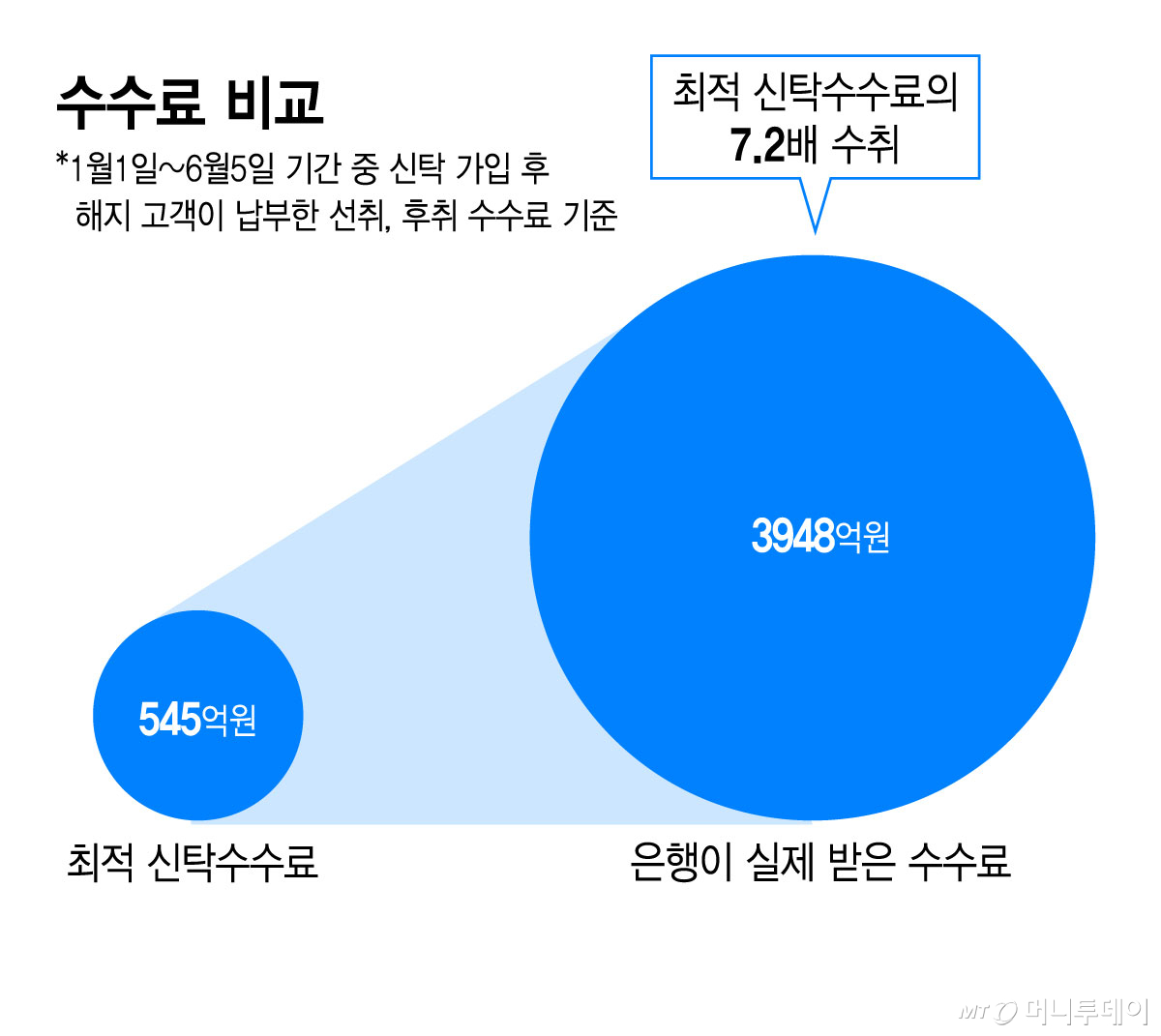
The total ETF trust fees collected by six banks from January to May amounted to 586.4 billion won, nearing 600 billion won. In May alone, they generated fee income of 103.6 billion won. Among these, if considering only customers who actually subscribed and terminated their accounts, the total fees collected by banks were 394.8 billion won. According to the Financial Supervisory Service's analysis, had subscribers chosen the optimal fee structure (back-end), they would have borne only 54.5 billion won in fees. This indicates that banks maximized profits by a factor of 7.2 times.
However, it remains unclear whether actual fee refunds will be made. The key issue is whether banks provided sufficient explanations understandable to consumers; depending on interpretations of the duty of explanation clause, the decision on refunds may vary. A financial industry official stated, "While back-end fees are advantageous for short-term investments, it is not easy for banks to assume whether consumers will invest for the short or long term."
In particular, there are also criticisms that customers who purchase ETFs through bank trusts rather than securities firms typically subscribe with a view toward diversified investment and expect returns of around 5%, so the disadvantage of front-end fees was merely due to the sharp rise in the stock market during the first half of this year.

 in FINANCE

