

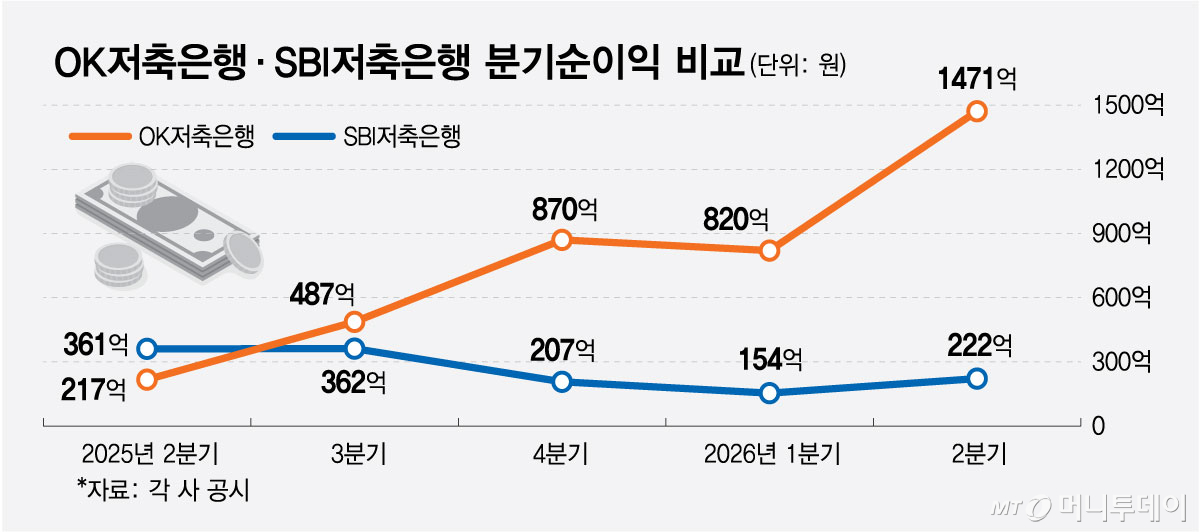
OK Savings Bank, which has solidified its position as the number one player in terms of net profit among savings banks, is also rapidly catching up to SBI Savings Bank based on total assets. OK Savings Bank has surpassed SBI Savings Bank in net profit for four consecutive quarters, including the first half of this year, and the asset gap between the two companies has narrowed by approximately 75% over the past year. Their differing approaches to securities management have led to contrasting outcomes.
According to industry data released on the 1st, OK Savings Bank recorded a net profit of 229.1 billion won in the first half of this year, an increase of 196 billion won compared to 33.1 billion won in the same period last year. This represents a growth rate of 592%. OK Savings Bank’s net profit accounts for 30% of the entire savings bank industry.
SBI Savings Bank, which had long held the top spot in the savings bank industry, reported a half-year net profit of 37.6 billion won, down 33% from 56.2 billion won in the same period last year. Although SBI Savings Bank remains the leader in total assets, it ranked fourth in terms of net profit for the first half of this year.
SBI Savings Bank was the industry leader in net profit for both 2024 and last year. However, OK Savings Bank overtook SBI Savings Bank in quarterly net profit starting from the third quarter of last year and has continued to outperform it for four consecutive quarters through the first half of this year.
OK Savings Bank is also quickly closing the asset gap with SBI Savings Bank. As of the first half, OK Savings Bank’s total assets stood at 12.576 trillion won, while SBI Savings Bank’s were 12.8354 trillion won. Although SBI still leads by 259.4 billion won, the gap was as large as 1.0298 trillion won a year ago. The asset disparity between the two companies has shrunk by about 75% in just one year. While OK Savings Bank’s assets increased by 422 billion won, SBI Savings Bank’s assets decreased by 296.2 billion won.
Based on the first half figures, both companies recorded identical interest income of 537.1 billion won. After deducting expenses, OK Savings Bank slightly edged out SBI with net interest income of 31 billion won more. In essence, there is no significant gap between the two in their core business of lending.
The reason for the difference in net profit lies in securities management, including stocks and funds. In the first half, OK Savings Bank recorded a gain of 240.6 billion won from securities investments, whereas SBI Savings Bank reported only 5.5 billion won.
SBI Savings Bank takes a conservative approach to securities investments. While securities make up 7.4% of its total asset composition, the figure for OK Savings Bank is 11.2%.
SBI Savings Bank’s BIS ratio stands at an impressive 19.52%, far exceeding the 11th% recommended by financial authorities. It is also 3.8 percentage points higher than the industry average. Despite having considerable room to handle riskier assets, SBI maintains a cautious stance.
SBI Savings Bank has focused more on its core business of lending as a financial institution. As a result, it has been more significantly affected by regulatory measures imposed by financial authorities. Since last year’s second half, when credit loan limits were capped at one times the borrower’s annual income, SBI’s lending operations have suffered. The company is now finding new avenues through products such as “mid-interest living stability loans,” which are not subject to current lending restrictions.
An industry insider stated, “As an owner-managed enterprise, OK has been able to make bold investment decisions and take responsibility for them. In contrast, SBI faces structural challenges that make such decision-making more difficult.”

 in FINANCE
