

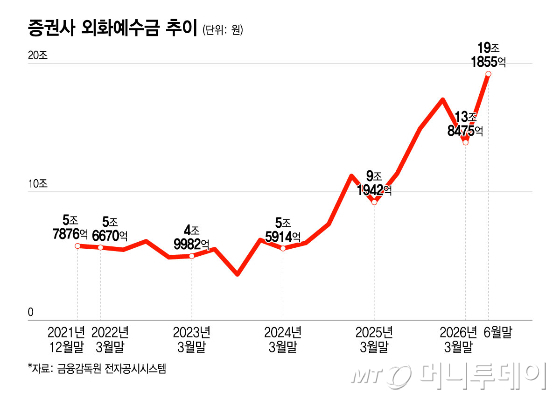
Foreign currency standby funds held by investors moving between domestic and global markets have reached their largest scale ever. This is interpreted as a result of investors realizing profits by selling overseas stocks, which showed relatively weak performance while the domestic stock market surged sharply in the first half of this year, combined with the impact of a strong dollar trend.
According to data from the Financial Supervisory Service’s electronic disclosure system on the 1st, the year-end balance of foreign currency deposits at Korea Securities Depository for the first half of this year was recorded at 19.1855 trillion won. This marks the highest level since the relevant regulations were introduced.
Foreign currency deposits refer to foreign currency investment funds (such as U.S. dollars and Japanese yen) that investors deposit into securities firm accounts for overseas stock and fund investments or derivative transactions. This includes cases where currency exchange was conducted in advance to purchase overseas stocks, or where proceeds from selling overseas stocks were not converted back into Korean won.
Under current Financial Investment Services and Capital Markets Act regulations, securities firms are required to deposit investors’ funds with Korea Securities Depository since the end of December 2021. However, the deposit ratio varies by currency: 80% for U.S. dollars and 50% for Japanese yen. Considering the high demand for dollars, it is estimated that the actual amount of foreign currency held by investors in securities firm accounts could approach 24 trillion won.
The sharp increase in foreign currency deposits during the first half of this year compared to the end of the first quarter is interpreted as a result of multiple factors acting in combination: domestic market boom, overseas stock investment standby, and rising won-dollar exchange rates. In particular, while funds flowed into the domestic stock market as it surged by more than 3,000 points in just three months from 5,277.30 at the end of March to 8,476.48 at the end of June, capital withdrew from global markets that showed relatively weak performance.
In fact, according to the Korea Securities Depository’s securities information portal, net sales of foreign currency-denominated securities (stocks) in the second quarter of this year reached $1.0991 billion. This ended a nine-quarter streak of net purchases that had continued since the fourth quarter of 2023.
As the won-dollar exchange rate continued to rise, demand emerged for investors to hold proceeds from selling overseas stocks in dollars rather than converting them into Korean won, anticipating gains from currency fluctuations. The weekly closing price of the won-dollar exchange rate rose by 19.3 won, from 1,530.1 won at the end of March to 1,549.4 won at the end of June. Analysts suggest that with the continued weakness of the Korean won, there was little incentive to rush into converting funds into won, and standby demand for timing reinvestment in overseas markets ahead of potential KOSPI corrections also contributed to the increase in foreign currency deposits.
The rise in exchange rates also had the effect of increasing the won-equivalent value of foreign currency deposits. Since foreign currency deposits are reflected in financial statements after conversion into Korean won, even if the amount of dollars held remains the same, a decline in the value of the won leads to an increase in the book balance.
An official from the financial investment industry said, “It appears that overseas stocks sold for profit during the first half of this year were released as the domestic stock market performed well while global markets such as the U.S. showed relatively weak performance.” The official added, “However, the reason these proceeds were not converted into Korean won is likely due to continued expectations for U.S. assets and the rising won-dollar exchange rate.”

 in STOCK
