

Although the assets managed by insurance companies far exceed 1,000 trillion won, they face difficulties in providing productive finance to growth industries and innovative enterprises or expanding overseas. Expanding investment destinations through government-promoted productive finance or making equity investments in foreign financial institutions leads to deterioration of the solvency margin ratio (K-ICS) and additional capital burdens.
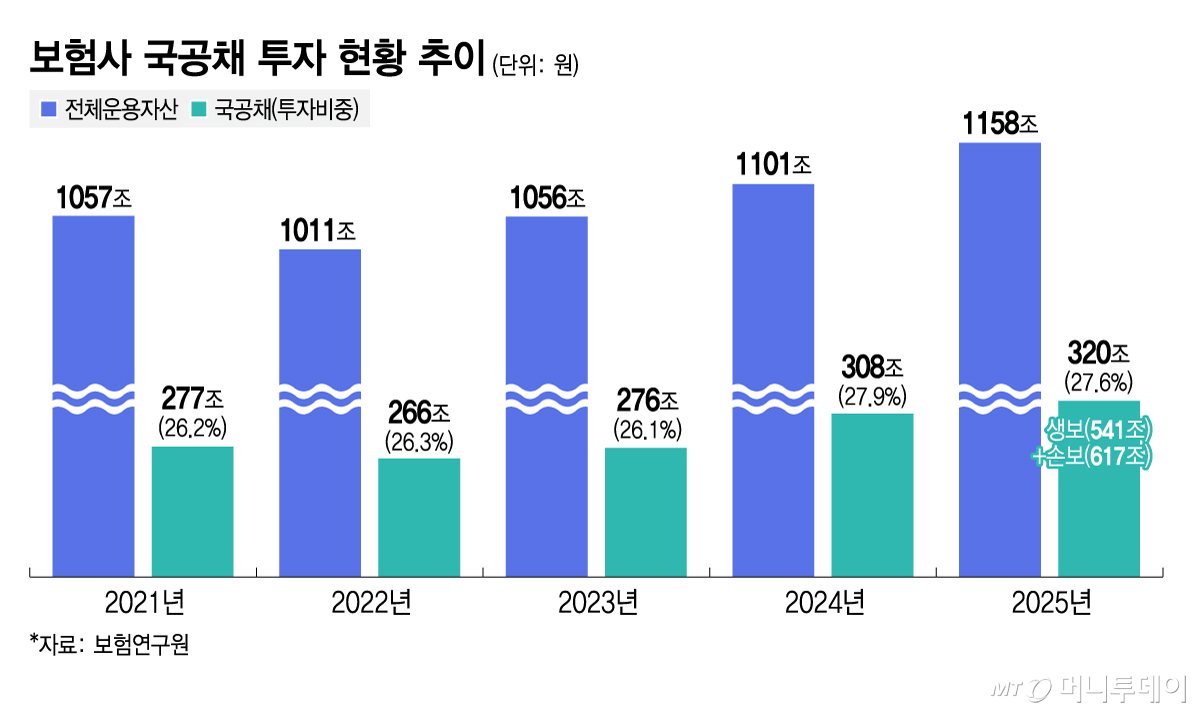
According to the insurance industry on the 2nd, total managed assets by all insurance companies reached 1,158 trillion won at the end of last year, an increase of 101 trillion won from 1,057 trillion won in 2021. During the same period, investments in government and corporate bonds increased by 43 trillion won, accounting for 43% of the total growth in managed assets. The share of government and corporate bonds also expanded from 26% in 2021 to 28% in 2025.
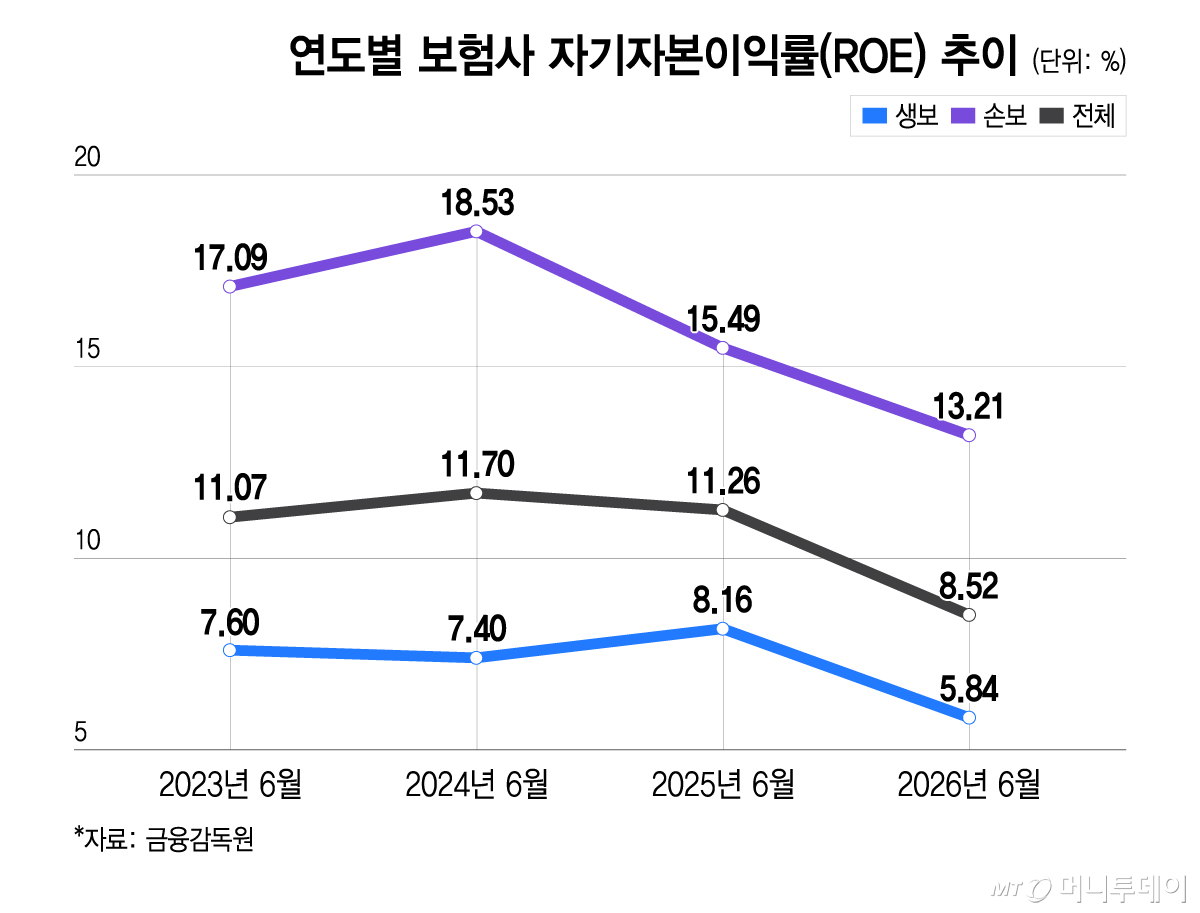
As insurance companies accumulate safe-haven assets like government and corporate bonds, profitability continues to decline. Looking at the return on equity (ROE) for insurance companies, it has fluctuated since the first half of 2023, falling below 10% to 8.52% in the first half of this year. In particular, life insurers saw their ROE drop to 5.84% in the first half of this year, while property and casualty insurers also fell to 13.21%. Although insurance companies' managed assets have grown to levels comparable to the National Pension Service, their ability to generate returns relative to capital is increasingly weakening. This becomes especially apparent when compared with major overseas insurers' ROEs. At the end of last year, Allianz reported 18.1%, Aviva 17.5%, Chubb 15.0%, and MetLife 12.9%—all significantly higher than domestic insurance companies.
Even when attempting to expand overseas beyond the saturated domestic market, capital burdens hold them back. DB Insurance acquired the U.S.-focused insurer Fortegra for approximately 2.3 trillion won last year, causing a sharp decline in its K-ICS ratio. Just before acquiring Fortegra, DB Insurance's K-ICS stood at 232.1% in the first quarter of this year; after the acquisition, it fell to 204.3% in the second quarter—a drop of 27.8 percentage points (P). A decline of nearly 30 percentage points in K-ICS, which indicates payment solvency for insurance claims, is unprecedented and inevitably places a heavy burden on the insurer.
Faced with capital burdens, DB Insurance was forced to improve its capital structure, including issuing new additional tier 1 capital securities worth 410 billion won in June. A DB Insurance official stated, "We understand that the company issued new additional tier 1 capital securities this year to resolve capital burdens arising from overseas expansion."
Since various investments directly affect solvency indicators, insurance companies find it difficult to actively participate in government-led productive finance. According to a simulation by the Korea Insurance Research Institute assuming 24 trillion won in productive finance investments, K-ICS was 208% before investment but dropped to 196%, a decline of 12 percentage points, due to increased required capital from the investment before any returns were generated. This means that insurance companies more actively engaged in government-promoted productive finance face greater capital burdens. This explains why there are calls to reduce equity risk charges for policy programs or qualified venture investments and to ease regulations on long-term holdings and infrastructure investments.
Insurance companies maintain the position that they need pathways opened to actively invest in artificial intelligence (AI) and healthcare industries. An industry official said, "We hope for more investment opportunities even in specific areas such as AI or healthcare," adding, "If insurance company profitability improves, it will ultimately lead to lower premiums or expanded coverage for consumers."

 in FINANCE

