

"Since last year, large insurance company listings have appeared one after another in the domestic M&A (mergers and acquisitions) market, yet they remained 'pie in the sky' for insurers. This is due to investment caps on insurance subsidiaries established 13 years ago. While exceptions are allowed for acquiring overseas financial firms, insurers have been unable to boldly enter bidding wars for domestic insurance companies that have gone without an owner for several years, sparking controversy over 'reverse discrimination.'
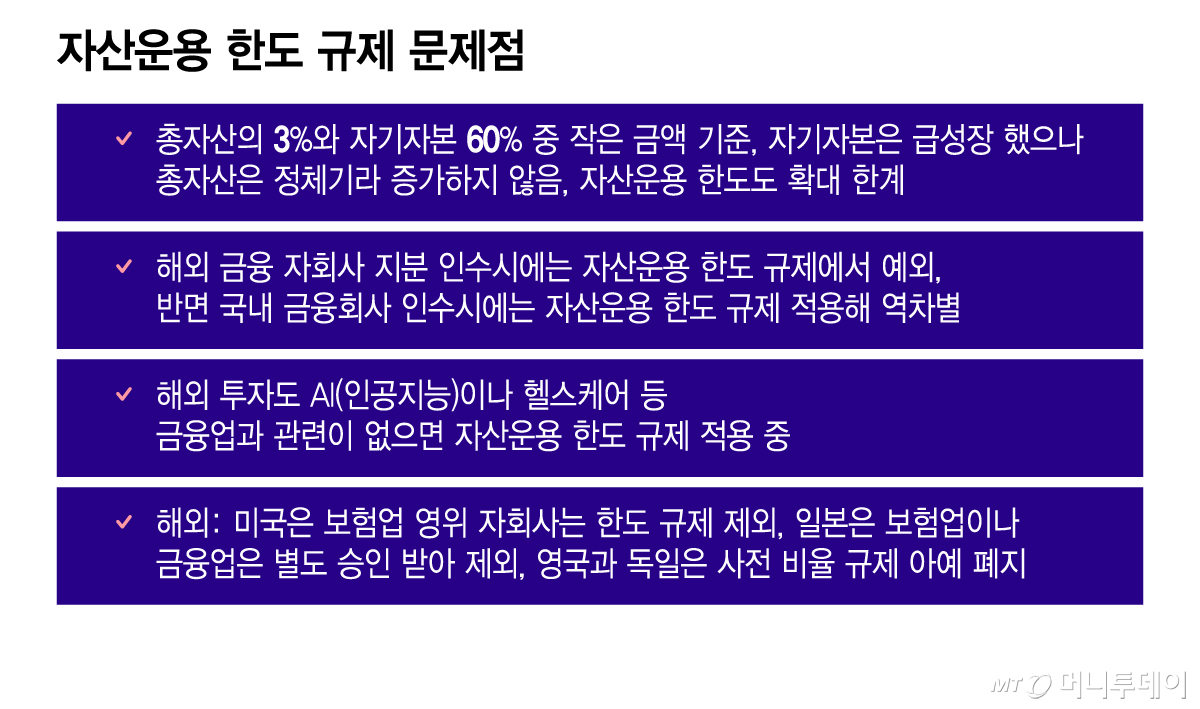
"According to the financial sector on the 2nd, the cap regulation under the Insurance Business Act, which requires insurers to acquire shares or bonds of subsidiaries based on the smaller of either 3% of total assets or 60% of own capital, is becoming an obstacle to insurers' M&A activities. In December last year, Hanwha Life and Heungkuk Life jumped into the bidding war for E-Z Asset Management, a domestic real estate Jeon Mun (CEO) management company, but ultimately ended up empty-handed.
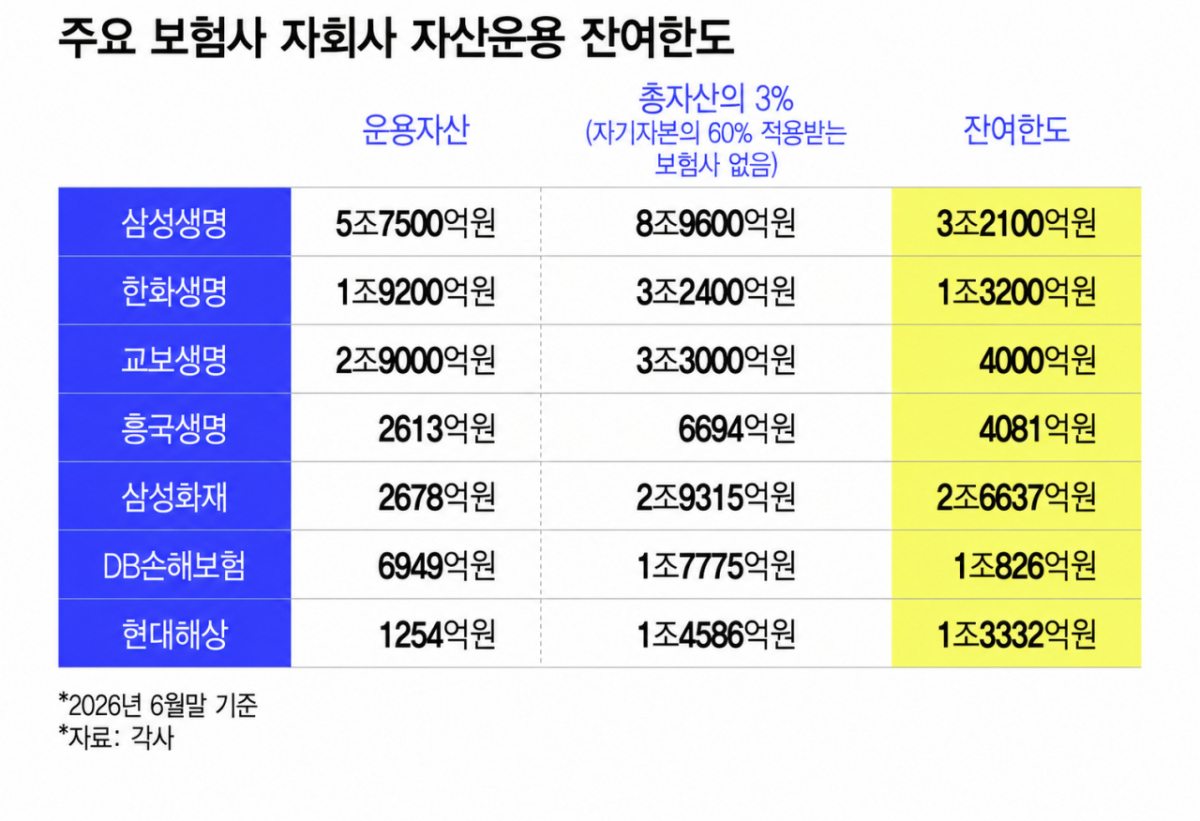
"Global private equity firm Hillhouse Capital, selected as the preferred bidder, offered an acquisition price of 1.1 trillion won. In contrast, Hanwha Life, whose subsidiary investment cap was limited to around 800 billion won at the time, could not make an aggressive 'bet.' Heungkuk Life, with an asset management cap of 400 billion won, barely entered the bidding war through complex methods such as project funds (PEFs) and acquisition financing (loans), but failed to be selected as the preferred bidder. An industry insider stated, 'Due to strict investment caps based on total assets, insurers must form a consortium rather than act alone to enter bidding wars,' adding, 'It is difficult to offer competitive prices, so good listings eventually go to foreign private equity funds.'
"A 'big market' emerged with insurance company listings such as Lotte General Insurance, Yebal General Insurance, and KDB Life Insurance pouring out one after another, yet insurers were ultimately ignored. OK Financial Group was selected as the preferred bidder for Yebal General Insurance, and Korea Investment Holdings for KDB Life Insurance. Although Samsung Life, Kyobo Life, and Heungkuk Fire & Marine participated in these insurance company bidding wars, it is pointed out that they could not offer competitive prices due to the burden of cap regulations.
"Kyobo Life's subsidiary investment cap is limited to around 400 billion won, making it difficult to absorb large listings exceeding 1 trillion won. While the company has shown interest in both major and minor listings ahead of its transition to a holding company structure, it has already exhausted its 900 billion won investment cap following the acquisition of SBI Savings Bank.
"Hanwha Life increased its investment cap to 1.32 trillion won by fully consolidating Hanwha Life Financial Services, in which it held a 90% stake, into a wholly-owned subsidiary (100%) at the end of last year. This is because wholly-owned subsidiaries are exempt from cap regulations. However, during the recent acquisition of Aequon Capital for 1 trillion won, a consortium was formed; industry analysts suggest that investment cap regulations were one contributing factor.
"Samsung Fire & Marine Insurance and DB Insurance have relatively ample investment caps. Their commonality is that they invested in overseas insurance companies in the U.S., the U.K., Southeast Asia, etc., rather than domestically. The financial authorities apply exceptions to overseas financial firm investments when calculating subsidiary investment caps. While this is a policy judgment aimed at encouraging insurers' overseas expansion, it has also been criticized as 'reverse discrimination regulations' that block domestic investments.
"Asset management cap regulations are virtually unique to Korea. In the U.S., subsidiaries engaged in insurance business are excluded from cap regulations, and Japan grants separate approval for cases involving financial services. The UK and Germany, known for stringent prudential regulations, have abolished such pre-emptive regulations entirely, judging that post-approval evaluation of solvency ratios is sufficient.
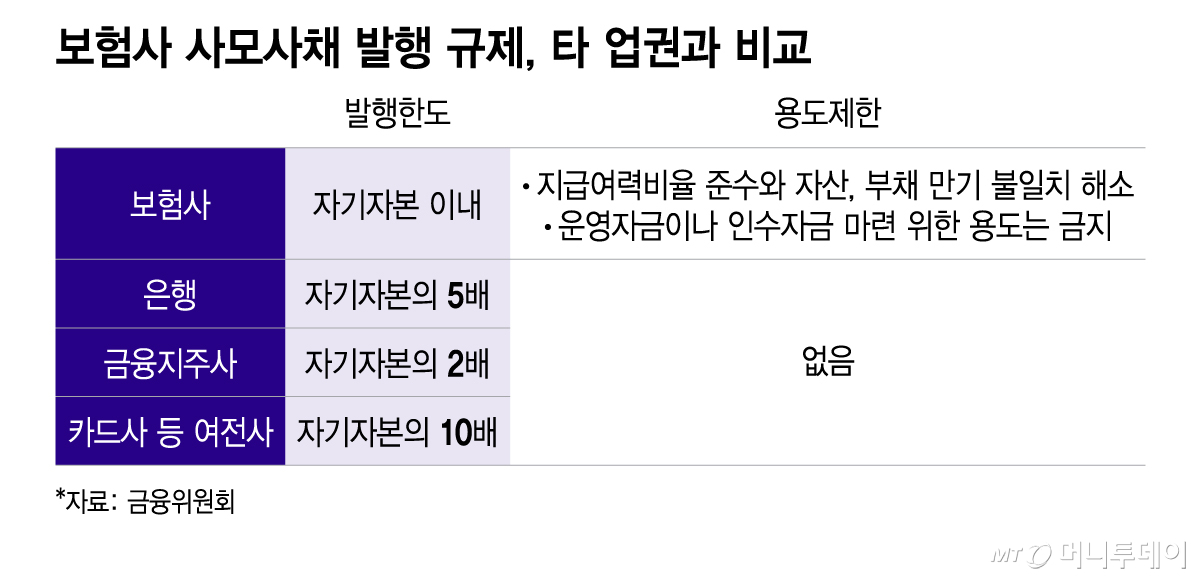
"Moreover, insurers face reverse discrimination in raising acquisition funds because the purpose and cap limits for issuing private bonds are restricted. Issuance of private bonds within own capital caps is only permitted for two purposes: capital enhancement (prudence) to improve K-ICS (Korean Insurance Capital Standard), or resolving asset-liability maturity mismatches (liquidity). In contrast, banks, financial holding companies, and card issuers can raise acquisition funds or operating funds through unrestricted bond issuance up to 2 to 10 times their own capital.

 in FINANCE


