

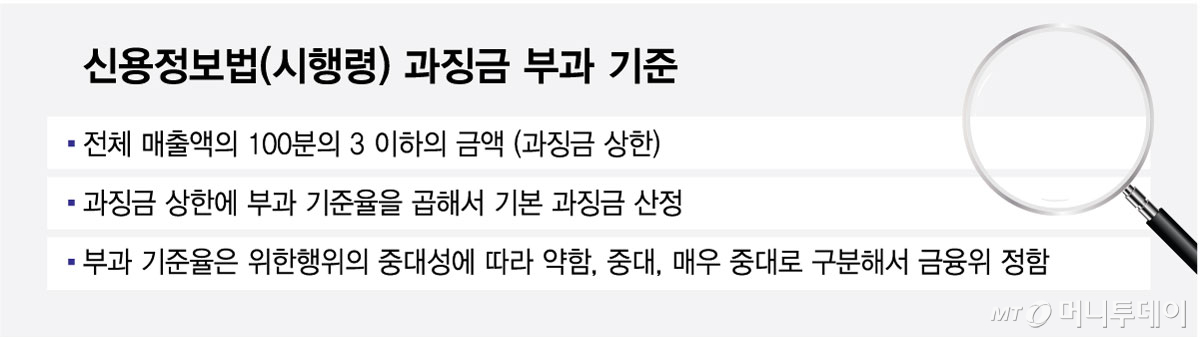
It has emerged that 12 financial institutions, including banks, insurers, and card companies, face the possibility of receiving "trillion-won" fines in the future over violations of the Credit Information Act. The revised law from 2020 sets a base fine at 3% of sales, and unlike other laws, it lacks separate detailed criteria, meaning even minor violations could result in "explosive-level" fines. In fact, recently Dongyang Life Insurance received a record-breaking fine of 140 billion won from the Financial Supervisory Service, which was later significantly reduced to 7 billion won by the Financial Services Commission.
According to financial industry sources on the 14th, the Financial Supervisory Service conducted on-site inspections targeting major commercial banks and internet-only banks to determine whether they violated the Credit Information Act. Some banks will be subject to additional scrutiny during regular inspections in the second half of the year. The Financial Supervisory Service focused intensively on verifying whether multiple banks utilized customer information for marketing or transmitted promotional information without prior consent. Even when customer consent was obtained, inspectors examined whether actual information usage remained within the disclosed purpose and whether proper consent procedures were followed during the transmission of promotional information.
Following the 2014 credit card company data breach incident, financial institutions have been prohibited from collecting or utilizing customer information for advertising or marketing without prior consent. This marks the first time the Financial Supervisory Service has conducted a comprehensive review across the entire banking sector to determine violations of the new law, as cases of marketing utilization without actual customer consent have reportedly been confirmed.
Tension over penalties under the new credit information law extends beyond banks to other sectors. It is reported that around 12 financial institutions have undergone inspections or are awaiting sanctions. Following Dongyang Life Insurance on the 9th, Shinhan Life and Lina Life were also found by the Financial Supervisory Service for transferring customer information to insurance agents (GAs) without prior consent.
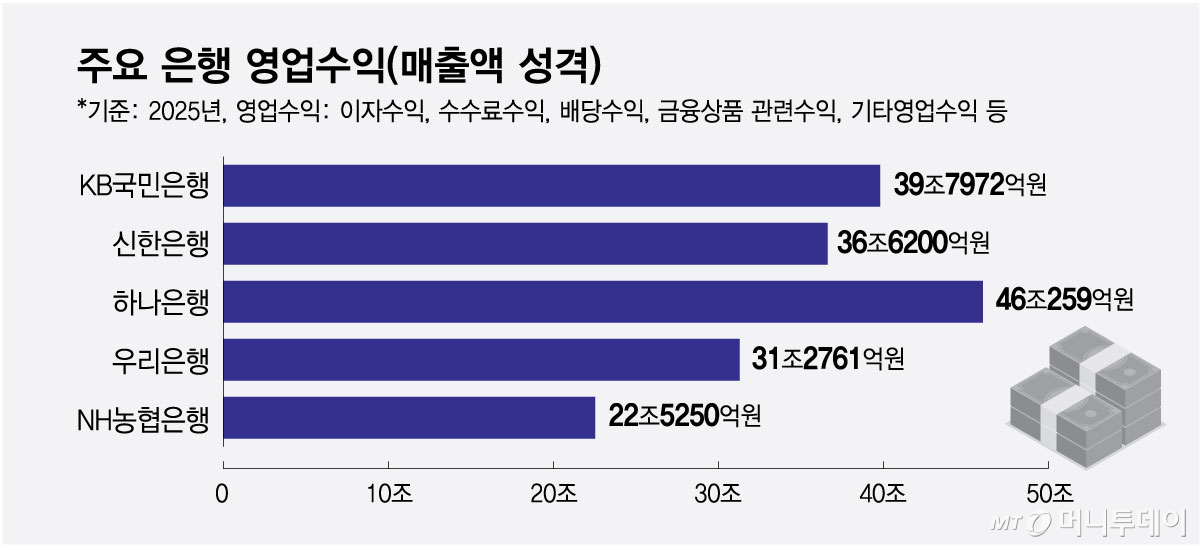
The problem is that if violations of the new credit information law are confirmed, financial institutions face the possibility of receiving "trillion-won" fines. The law sets a cap on fines at 3% of sales and allows the Financial Supervisory Service to impose base fines of 50%, 75%, or 100% according to its inspection and sanction regulations. Banks with sales (operating income) reaching 20 trillion to 40 trillion won could face "trillion-won" fines under Financial Supervisory Service sanctions. Only if the Financial Services Commission grants a "substantial reduction" is there room for the fine amount to be lowered.
Unlike the Personal Information Protection Act or the Financial Consumer Protection Act, the new credit information law lacks detailed criteria for determining fines, making it impossible to predict the final amount even for minor violations. A financial industry official responded, "There is significant room for debate over whether internal customer data inquiries made for asset management purposes constitute a violation of the new law, and excessive fines that do not proportionally reflect the severity of the violation are difficult for financial institutions to accept."

 in FINANCE

