

"Since we don't know how many times we'll be hit, we have no choice but to beg for our lives." (A source in the financial sector)
The financial sector is in chaos due to the 'rollercoaster' administrative penalties imposed by financial authorities. While the industry must develop aggressive sales strategies leveraging customer information in the age of AI, a single misstep could result in 'trillion-level' fines for violating the Credit Information Act. The Financial Supervisory Service mechanically imposes large-scale penalties, only for the Financial Services Commission to drastically reduce them—a 'rollercoaster' penalty pattern that repeats endlessly. Critics argue that fundamental countermeasures are urgently needed.
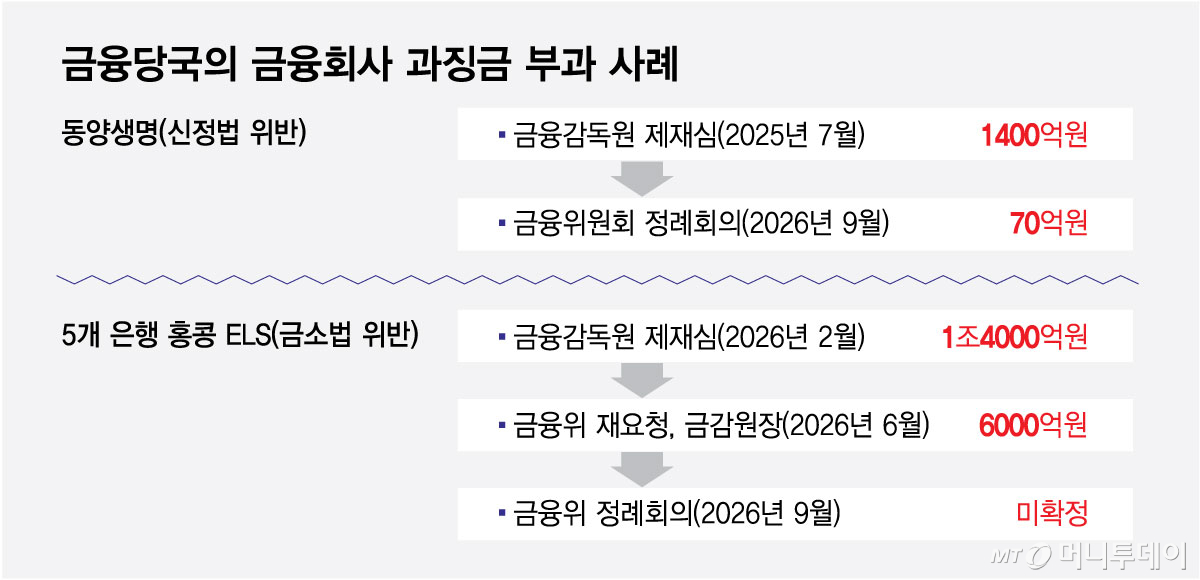
According to financial sector reports on the 14th, Dongyang Life Insurance received a final administrative penalty of 70 billion won from the Financial Services Commission for violating the new Credit Information Act. This marks four years since it was caught by the Financial Supervisory Service in 2022 for transferring customer information without consent to its affiliated insurance agencies (GAs). The penalty imposed on Dongyang Life Insurance drew intense attention not only from similar insurers but from the entire financial sector, as more than ten financial institutions have undergone inspections by the Financial Supervisory Service over allegations of violating the new Credit Information Act.
Administrative penalties under the new Credit Information Act are unpredictable. Since its revision in 2020, the maximum penalty has been set at 3% of sales revenue. The real issue lies beyond that. Financial authorities must consider factors such as the severity of the violation, the amount of damage caused, and the efforts made by financial institutions when imposing penalties. While laws like the Personal Information Protection Act and the Financial Consumer Protection Act apply differentiated penalties ranging from 1% to 100% of the base penalty, the new Credit Information Act lacks such detailed criteria. Once a violation is confirmed, the Financial Supervisory Service imposes a base penalty by selecting one reduction rate—50%, 75%, or 100%—based on inspection and penalty regulations. Even applying the maximum reduction rate of 50%, Dongyang Life Insurance faced a penalty of 140 billion won.
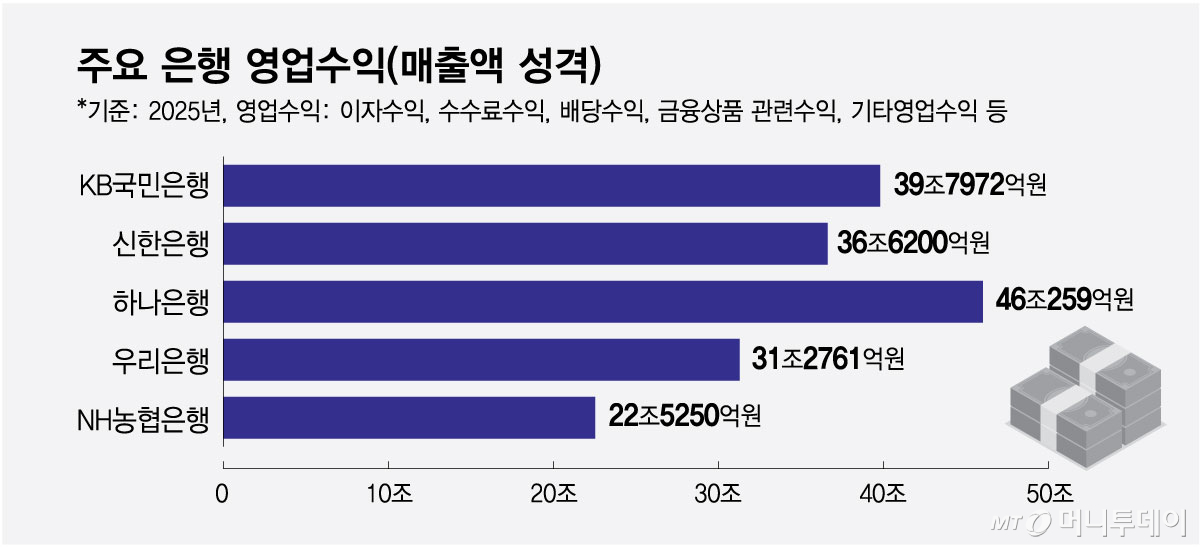
Banks face even greater tension because their sales revenue, which defines their business income, reaches tens of trillions of won. KB Kookmin Bank's revenue stands at 39 trillion won, Shinhan Bank at 36 trillion won, and Hana Bank at 46 trillion won. Simply applying 3% of business revenue with the Financial Supervisory Service's maximum reduction rate of 50% could result in base penalties amounting to hundreds of billions of won. Applying Dongyang Life Insurance's standard to Shinhan Life, which faces similar penalties over comparable issues, would yield a penalty exceeding 200 billion won.
Administrative penalties imposed by the Financial Supervisory Service are finalized by the Financial Services Commission. The Financial Services Commission has the authority to reduce penalties based on mitigating circumstances, taking into account the severity of violations. However, both the Financial Supervisory Service's excessive penalty imposition and the Financial Services Commission's drastic reductions place a burden on both institutional investors. The Financial Supervisory Service faces criticism for making mechanical judgments influenced by audits from the Board of Audit and Inspection, while the Financial Services Commission's drastic reductions, made with consideration of acceptability, may appear as 'sentimentalism.'
This was also evident in penalties related to Hong Kong H-Index ELS (equity-linked securities). The Financial Supervisory Service initially sent a penalty of 1.4 trillion won to the Financial Services Commission "according to principle," but after a re-request from the Financial Services Commission, it reduced the penalty to 600 billion won and resubmitted it. The fact that the Financial Services Commission did not immediately reduce the penalty but instead requested a re-evaluation from the Financial Supervisory Service sparked various interpretations, making this an unusual case. Even after receiving a 600 billion won penalty proposal, the Financial Services Commission held 14 subcommittee meetings but still failed to reach a conclusion.
Financial institutions unanimously agree that urgent improvements are needed for the 'jumping' administrative penalty system. They argue that penalties imposed by the Financial Supervisory Service must be revised first, as they fail to account for the severity of violations. Although financial authorities are working on establishing detailed criteria for penalties under the new Credit Information Act, progress remains slow. Some also advocate for a complete restructuring of the dualized penalty system involving both the Financial Supervisory Service and the Financial Services Commission.
A source in the financial sector stated, "If we face penalties that are simply unacceptable, we will inevitably have to challenge them through litigation." In the case of Hong Kong ELS, banks recently won a lawsuit filed by investors.

 in FINANCE

