

Financial authorities are set to release the first comprehensive supervision plan at a "reform level" targeting insurance agencies (GAs), which have grown larger than insurance companies. While super-large GAs with over 10,000 affiliated agents and annual sales in the trillions are shaking up the insurance market, financial authorities lack adequate means to apply the brakes. The authorities plan to raise sanction standards for GAs to the level of insurance companies and will generally prohibit indiscriminate cross-business operations.
According to financial authorities on the 22nd, the Financial Services Commission and the Financial Supervisory Service have begun preparing the first-ever comprehensive supervision plan for GAs. As a channel selling products from multiple insurance companies, GAs employ 316,000 agents, far exceeding the 224,000 exclusive agents of insurance companies. There are four GAs with annual sales exceeding one trillion won.
While insurance companies pour tens of trillions of won in annual sales commissions into "super-gab" GAs, the level of internal control within these GAs and the financial authorities' sanction regulations remain stuck at 10 years ago. Operating in a management blind spot, GAs have recently been involved in a series of major incidents, including illegal loan brokering operations, illegal private lending harming young people, tampering with policy funds, and fraudulent receipt of medical care benefits.
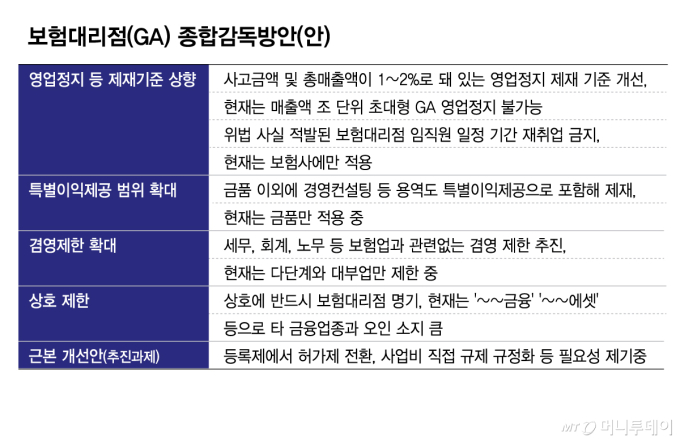
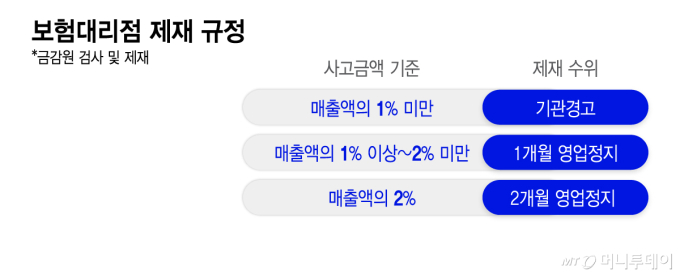
Financial authorities are considering significantly raising sanction standards for GAs, such as business suspensions, to the level of insurance companies. Currently, under the Financial Supervisory Service's inspection and sanction regulations, a GA can only be suspended if the proportion of claim amounts in total sales (operating revenue) exceeds 1-2%. Proposals include lowering this ratio or introducing new standards based on claim amounts. For large GAs, with total sales soaring into the trillions, business suspension sanctions are practically impossible under current sentencing guidelines.
For example, Incash Financial Services, the industry's second-largest player, saw its sales grow nearly tenfold from 120 billion won in 2015 to 1.2 trillion won in 2025. To impose a two-month business suspension on this company, claim amounts would need to exceed 20 billion won today, compared to 24 billion won a decade ago. The Financial Supervisory Service explains that even with inspection personnel deployed year-round, suspending the operations of large GAs is realistically difficult.
Similar to insurance companies, measures are being pushed to ban employees of GAs from working in the industry for a certain period if they commit violations during their tenure. Insurance company executives face a five-year employment ban upon sanction, whereas GAs have no tracking system and no separate regulations restricting re-employment. Even while under Financial Supervisory Service sanctions, if a GA is shut down and only its signboard is changed to operate as a new company, financial authorities are powerless.
With recent incidents occurring in succession, "octopus-style" cross-business operations will also be curbed. GAs face no separate legal restrictions on business types except for multi-level marketing and lending businesses. Consequently, incidents are arising where high-priced insurance products are forced upon clients or illegal acts are encouraged under the guise of consulting services such as tax, accounting, and labor affairs. Furthermore, the authorities plan to include non-monetary services like financial consulting in "special benefits," making it punishable to provide them above a certain amount. Currently, only cases involving monetary gifts exceeding the lesser of 10% of the first-year premium or 30,000 won are subject to punishment under existing laws.
Restrictions on business names will also be introduced. Signs for GAs displaying names like "~Asset" or "~Finance" along major roads in Seoul's bustling Gangnam district, Seongsu-dong, and Yeongdeungpo will disappear. Regulations will be strengthened to require "Insurance Agency" to be explicitly included in the business name, similar to insurance companies, lending firms, and mutual credit unions. The aim is to prevent confusion with other financial businesses.
A financial authority official stated, "Although insurance agencies have become super-large compared to insurance companies, financial authorities lack effective sanction measures, and insurance companies influenced by GAs are spending business expenses without brakes. We are determined that if the future of insurance is at stake, we will prepare a comprehensive supervision plan at a reform level."
Despite the rapid growth of insurance agencies (GAs) as a core sales channel for the insurance industry, internal controls and sales accountability have failed to keep pace. Recently, data breaches caused by hacking have also occurred. Since GAs can simply shut down and re-register upon receiving sanctions, the effectiveness of these sanctions is low. This is why there are calls to change the GA registration system from a notification-based model to a licensing one and to prevent indiscriminate cross-business operations.
According to the insurance industry on the 22nd, problems with GAs selling products from various insurance companies were even mentioned by President Lee Jae-myung. During his presidential campaign, President Lee said via social networking services (SNS), "Because GAs focus solely on sales, they neglect complaint handling and other areas, leaving insufficient management of damages suffered by insurance consumers." He added, "For GAs of a certain scale, we will make them jointly liable with insurance companies for compensation regarding consumer damages, thereby realizing accountability and curbing illegal operations."
However, despite President Lee's criticisms, problems with GAs continue. Sixty-seven agents affiliated with PS Pine Service were caught by the Financial Supervisory Service during an inspection for brokering loans totaling 111.3 billion won to 415 policyholders through lending companies. The agents approached young people entering society under the guise of financial planning or salary management study groups unrelated to their main business of insurance sales, promoting illegal loans with promises of returns around 20% annually and principal guarantees. These were not formal financial investment products but contracts to lend money to lending companies.
Incidents continue at GAs under large financial groups. At Hanwha Life Lab and Shinhan Financial Plus, a so-called "tampering" issue arose where clients applying for policy funds available to SMEs (small and medium-sized enterprises) were approached with consultation and consulting services, only to be induced to purchase insurance in exchange for receiving the loan. This is an example of GAs exploiting the lack of cross-business restrictions by using "policy funds" as bait to secure insurance contracts.
Even more unusual cases emerged in corporate insurance operations. There were instances where a GA approached a nursing facility (institutional investor) by proposing tax and accounting consulting, then induced them to purchase whole life insurance under the corporate name. Subsequently, policyholders were changed so that the surrender value could be taken by the CEO personally. Essentially, insurance was used as a conduit to move funds from a nursing facility into whole life insurance and then withdraw them as personal funds of the representative. Tax accountants also participated in these incidents in large numbers because the recruitment commissions generated from selling hundreds of millions of won worth of whole life insurance per case far exceeded earnings from tax services. For example, selling 2 million won worth of monthly premiums could yield a first-year commission of 2.4 billion won. This is why tax accountants posed as insurance agents.
The loose internal controls at GAs also raise significant concerns about personal information leaks. In fact, incidents occurred where personal information of approximately 1,100 customers and agents was leaked from Ufirst Insurance Marketing and Shinhan Financial Find due to reasons such as malware infection. Sensitive contract information, including insurance types, insurance companies, policy numbers, and premiums, was exposed in a row, heightening anxiety among policyholders.
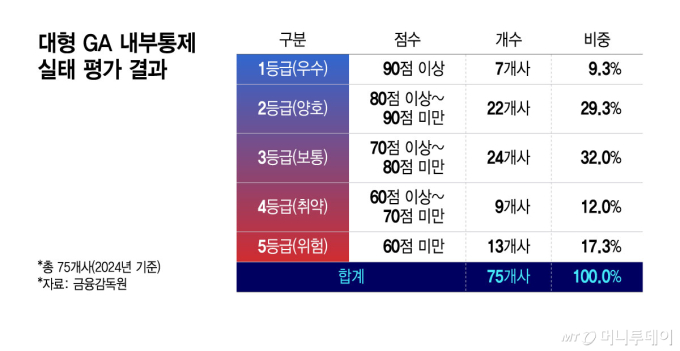
Although financial authorities have continuously urged GAs to strengthen internal controls, vulnerabilities remain. In the 2024 Financial Supervisory Service's assessment of internal control status for large GAs, the proportion of vulnerable GAs rated at levels 4 or 5 reached 29.3%. This revealed a structural problem where, despite the growth of agent organizations, it is difficult for headquarters to control the sales activities of field agents in real time.
An insurance industry official stated, "Large GAs have grown to such an extent that they virtually lead the sale of insurance products, but when incidents occur, most cases are resolved as issues involving individual recruiters or branch offices. Since they operate by shutting down corporations and re-registering, the effectiveness of sanctions is low."
In fact, in 2020, Leaders Financial Sales received a business suspension order from the Financial Supervisory Service due to false contracts and improper transfers. However, while the Financial Supervisory Service's inspection and sanctions were underway, thousands of affiliated agents moved en masse to new GAs under different names. Although Leaders Financial Sales and its special affiliates merely changed their signboards to continue operations after registering a business license and opening an office, there is no way to stop them.

 in FINANCE


