

Bancassurance sales by banks are showing renewed vigor. As the trend of rising interest rates continues, funds are once again flowing into savings insurance products. Life insurers view this increase in savings insurance sales positively from a fund inflow perspective, even if it does not immediately translate into improved financial performance.
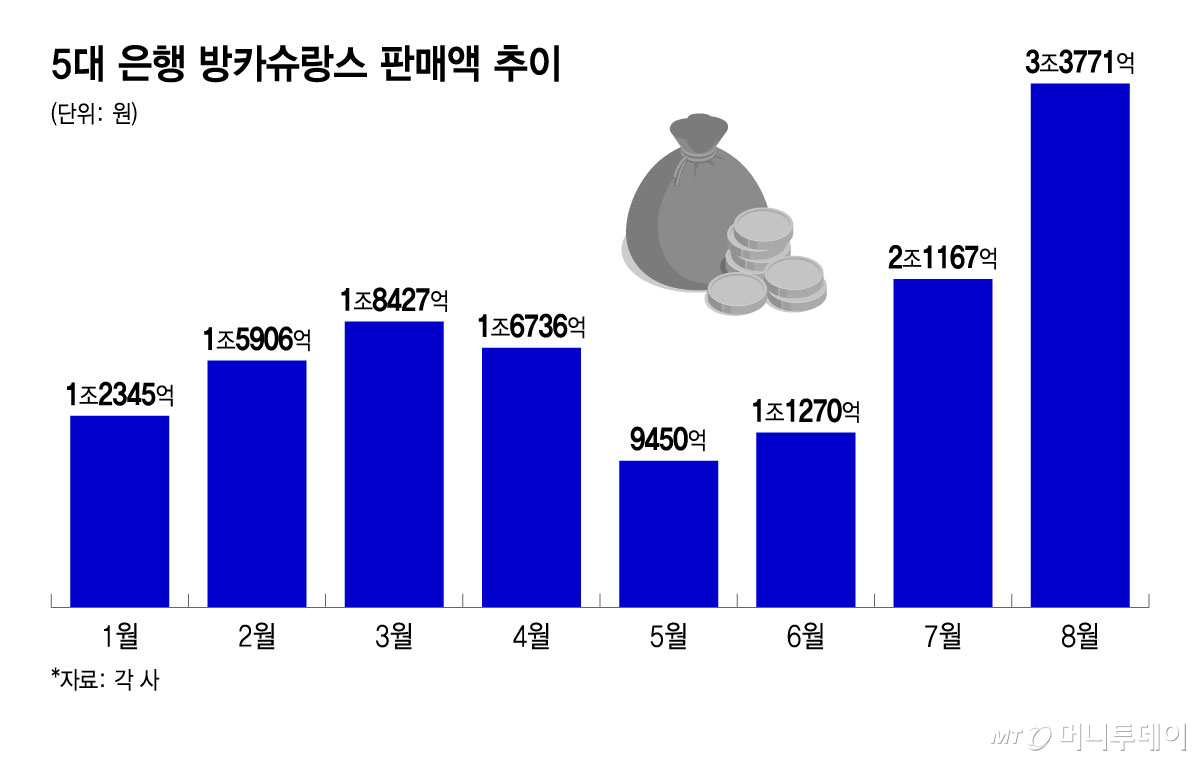
According to the financial sector on the 20th, the total bancassurance sales of the five major banks—KB Kookmin, Shinhan, Hana, Woori, and NH NongHyup Bank—reached 3.3771 trillion won last month, a 1.2604 trillion won (59.6%) increase from the previous month's 2.1167 trillion won. This figure is three times higher than the 1.2325 trillion won recorded at the beginning of the year and six times higher than the 945 billion won in May, when funds rapidly shifted into exchange-traded funds (ETFs).
Most products sold through banks are savings insurance or pension insurance. Pension insurance is designed to mitigate income gaps that occur upon job loss or retirement, while savings insurance helps customers accumulate a large sum of money over the long term. Both offer tax-exempt benefits on gains depending on the subscription period and other factors. Recently, with rising interest rates, more people have been seeking such savings insurance products. In fact, major life insurers have introduced savings and pension insurance products guaranteeing annual returns in the 4th% range, successfully attracting funds that had previously moved toward risky assets like stocks.
Banks are once again intensifying efforts to boost non-interest income through insurance sales, increasing product offerings targeting retirement assets from an asset management (WM) perspective. Pension and savings insurance align well with the asset management strategies of both banks and insurers, as they allow for long-term management of customer funds. Additionally, since last year, the "25% rule," which restricts banks from selling more than 25% of products from any single insurer, has been relaxed to 33% for life insurers, opening the door for them to actively sell their most popular products.
Life insurers remain cautious about expanding savings insurance sales, as it does not immediately lead to profitability improvements. Under the new accounting standards (IFRS17), savings insurance carries a strong liability character, involving insurance benefits and refunds payable to customers, resulting in limited effectiveness in securing contract service margins (CSM) compared to protection-type insurance. This explains why life insurers have historically focused more on selling protection-type insurance, which offers relatively better CSM opportunities.
Nevertheless, many believe that bancassurance ultimately brings more benefits than drawbacks for life insurers by enabling them to secure large-scale funds and expand their customer base over the long term. In particular, savings insurance premiums are typically high, ranging from 200,000 to 300,000 won per month per policyholder, ensuring stable acquisition of principal insurance premiums. From an asset management perspective, this also enables the realization of economies of scale.
A representative of a major life insurer stated, "Savings insurance has a liability character that requires repayment at specific times, meaning insurers may face increased burdens depending on interest rate conditions at the time of refund." However, they added, "Despite this, securing high premiums per policyholder and expanding asset management scale through these funds ultimately proves beneficial."

 in FINANCE
