

"If we leave insurance agents (GAs) as they are, there will be no future for insurance. Changes at the level of reform are necessary."(Financial authority official)
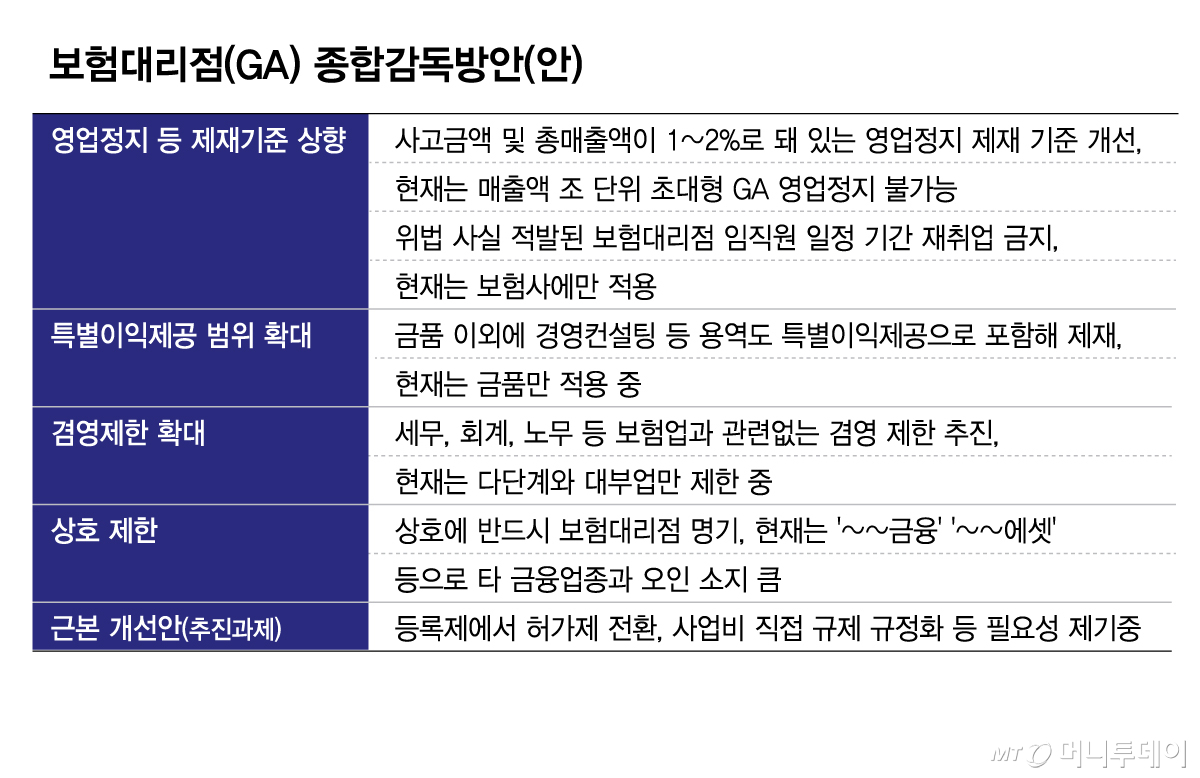
The financial authorities are preparing a comprehensive supervision plan at the "reform" level because they feel a crisis that if the GA problem is left unaddressed, the entire insurance industry could face total destruction. GAs are no longer simple channels on the periphery of insurance companies; they now intervene in everything from product development to sales commissions (business expenses) for insurance companies. Yet, the regulatory level of the authorities remains stuck at 10 years ago, failing to secure effective means to penalize super-large GAs. The insurance industry points out that measures at the level of reform require fundamental legal direct regulation and a shift to a licensing system regarding insurance business expenses (sales commissions).
According to the insurance industry on the 22nd, last year's annual collection commissions spent by insurance companies are estimated at about 32 trillion won. It is analyzed that most of these collection commissions likely went into the pockets of GAs, which account for 60% of channels. In particular, since the introduction of new accounting standards (IFRS17), even if business expenses are incurred, costs are recognized over time until insurance maturity rather than at the point of expenditure, leading insurance companies to engage in bloody competition without brakes on spending business expenses. They cannot refuse unreasonable demands from major GAs such as "We will sell more products for you."
The financial authorities deleted the regulation requiring "reasonable execution of business expenses within projected business expenses" from the Insurance Business Supervision Regulations in 2014. Since then, a vacuum has continued with no explicit direct regulation of business expenses codified in the Insurance Business Act. To prevent excessive business expense execution triggered by GAs, it is argued that the financial authorities must apply the brakes by reviving the clause previously deleted from the Insurance Business Act. It is pointed out that the window for insurance companies to reduce business expenses on their own has already passed.
The need to shift GAs to a licensing system is also raised. Currently, over 4,000 GAs are scattered nationwide. Anyone can easily start operations simply by registering as a business and opening an office. It is entirely possible to engage in other industries such as tax and labor services alongside insurance. If penalized by the financial authorities, they can close down and put up a new signboard. Executives of penalized GAs are not subject to re-employment restrictions. Converting from a registration system to a licensing system could curb such disorderly situations to some extent.
The financial authorities recently announced plans to convert the receivables collection business, which involves purchasing overdue receivables and collecting them, from a registration system to a licensing system. Following President Lee Jae-myung's criticism of "cruel finance," the 911th collection agencies that proliferated were converted to a licensing system and reduced to around 30. The logic is to apply this to GAs as well. An insurance industry official stated, "Converting to a licensing system requires major GAs to meet corresponding internal control standards," adding, "This could also serve as a preliminary move to convert GAs into sales specialist companies in the future."

 in FINANCE
