

Fixed-rate housing mortgage loan rates, which briefly dipped below the 7th percent mark due to recent self-adjustments by banks, are once again rising.
With the Federal Reserve System (Federal Reserve·Fed) signaling further base rate hikes within the year, forecasts suggest that bank bond yields linked to loan rates will reach 5% by year-end, further increasing the burden on borrowers.
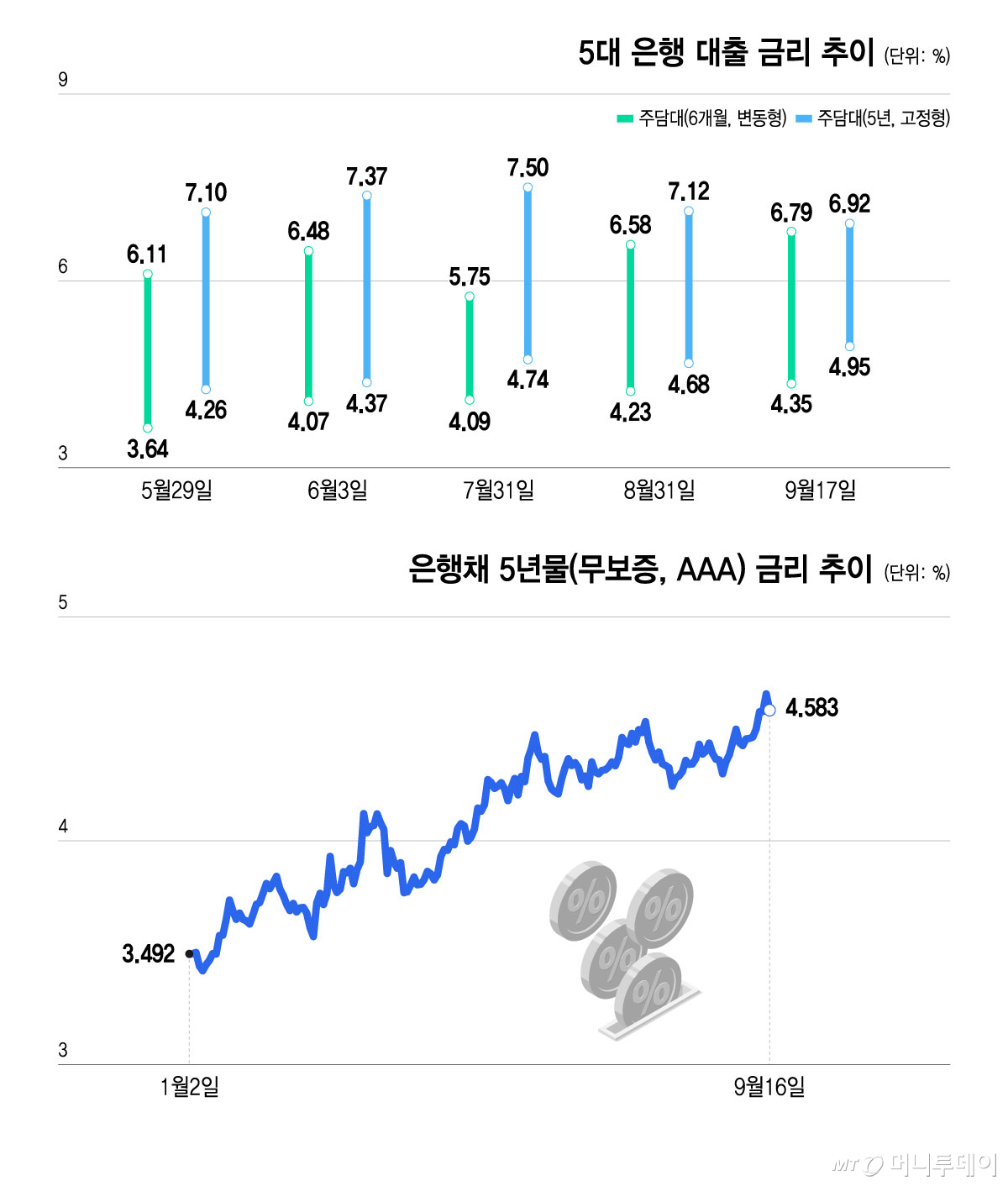
According to the financial sector on the 17th, the 5th-year fixed-rate housing mortgage loan rates at five major banks—KB Kookmin, Shinhan, Hana, Woori, and NH Agricultural Cooperative Bank—were recorded at an annual rate of 4.95% to 6.92%. The lower limit rose by 27 basis points (1bp=0.01 percentage point) compared to the end of August. Compared to four months ago at the end of May, it surged by 69 basis points.
The upper limit fell by 20 basis points compared to the end of last month. This decline was largely due to NH Agricultural Cooperative Bank, which had the highest mortgage rates among the five major banks, lowering its rates.
On the 16th, NH Agricultural Cooperative Bank reduced both the upper and lower limits of its housing mortgage loan rates by 0.45 percentage points (P) and 0.20 percentage points, respectively, to strengthen support for genuine homebuyers. The upper limits at the other four banks all increased.
Variable-rate housing mortgage loan rates were recorded at an annual rate of 4.35% to 6.79%. These products fluctuate every six months based on bank bond or COFIX (Cost of Funds Index) rates. Both the upper and lower limits rose by approximately 70 basis points compared to four months ago.
Credit loan rates are also rising. The upper limit for variable-rate credit loans with a six-month cycle exceeded the 6th% mark at 6.11%, representing a 58-basis-point increase from the end of May. For one-year variable-rate loans, the upper limit rose by 41 basis points to 6.3%.
Domestic and global macroeconomic conditions are fueling further increases in loan rates. On the 16th (local time), the U.S. Federal Reserve held its Federal Open Market Committee (FOMC) meeting and raised the base rate by 25 basis points to 3.75%–4.00%.
This marks the first interest rate hike in three years and two months, with the Federal Reserve citing inflation rates exceeding its 2% target as the reason for entering a tightening phase.
Federal Reserve Chair Kevin Warsh expressed determination to maintain price stability, and the dot plot revealed that 16 out of 18 FOMC members anticipate further rate hikes. Consequently, the yield on U.S. 10-year Treasury bonds once again broke through the 5th% threshold.
The U.S. tightening trend is expected to exert upward pressure on domestic government bond yields. Previously, the Bank of Korea implemented consecutive base rate hikes in July and August, narrowing the interest rate differential between South Korea and the United States to 0.75 percentage points.
However, this FOMC's base rate hike has widened the gap back to 1.00 percentage point. As the interest rate differential between the two countries widens, concerns over foreign capital outflows and high exchange rate risks grow, stimulating further increases in market rates.
This also affects bank bond yields, which serve as benchmarks for loan rates. Recently, bank bond yields have been soaring. The 5-year unsecured AAA bank bond yield, which serves as the benchmark for fixed-rate mortgages, reached 4.656% on the 15th, marking its highest level in two years and ten months since November 1, 2023 (4.733%).
The 6-month bank bond yield, which benchmarks variable-rate mortgage rates, is also at its highest level since March 29, 2024 (3.642%).
As interest rates continue to rise, concerns among borrowers with variable-rate mortgages are growing. As of the end of July, the proportion of new housing mortgages taken out with variable rates reached 68.1%, the highest in 12 years.
With seven out of ten borrowers choosing variable rates, future interest rate hikes will significantly increase their interest repayment burdens. In response, authorities have begun inspecting the status of both variable and fixed-rate mortgages at banks, and introducing long-term fixed-rate mortgages with terms exceeding ten years is being discussed as a potential solution.
Forecasts even suggest that 5-year bank bond yields could rise to 5%, which, if additional margins are applied or preferential rates are reduced, could threaten the 8th% threshold for loan rates.
Park Hyung-jung, an economist at Woori Bank, stated, "With the September FOMC confirming the likelihood of high interest rates persisting for a considerable period, domestic market rates are expected to face upward pressure as well. We anticipate that bank bond yields will rise to around 5% by year-end," adding, "The upper limits of some loan products could approach 8%."

 in FINANCE
