

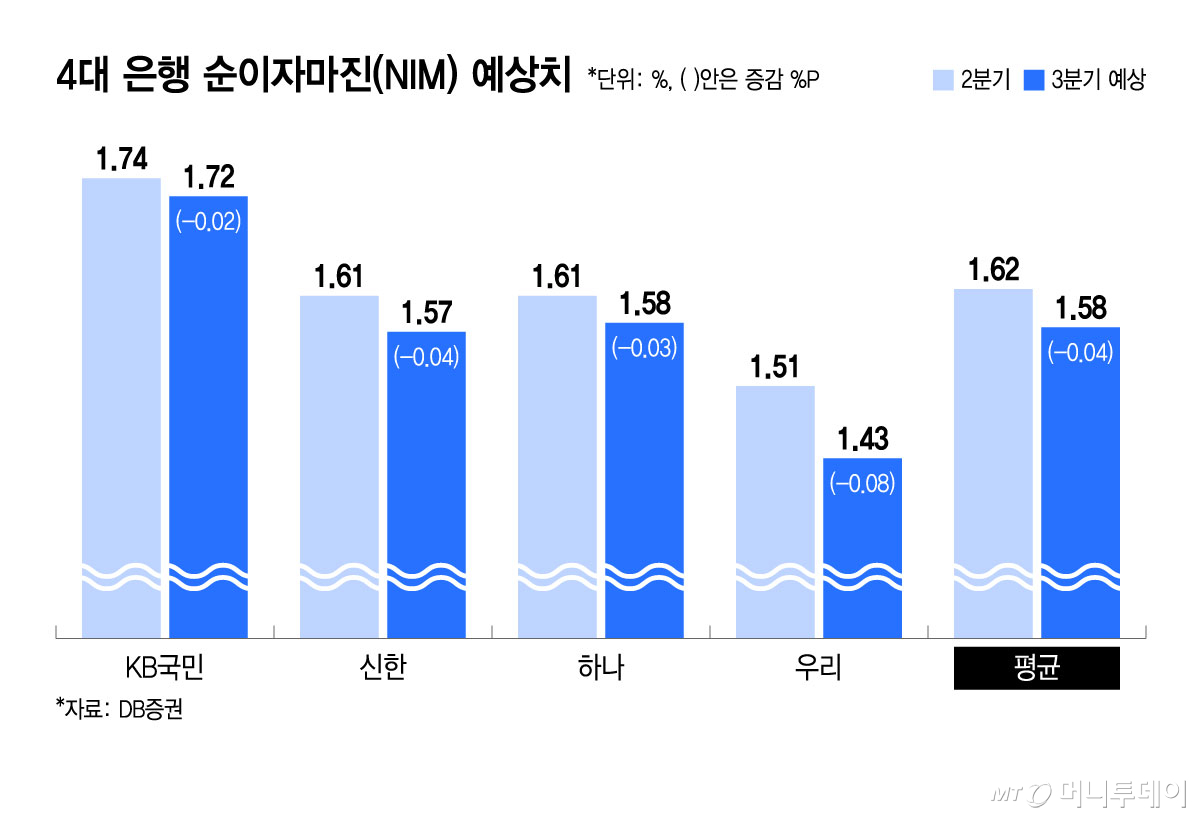
The third-quarter net interest margin (NIM) of the four major banks is expected to decline by at least 2BP (1BP = 0.01 percentage points). While NIM typically improves during periods of rising interest rates, this time around, cost pressures stemming from higher funding costs have had a more pronounced impact. With loan growth constrained, year-end performance across the banking sector is likely to hinge on how quickly NIM recovers.
According to financial industry sources on the 15th, the average end-of-third-quarter NIM for KB Kookmin Bank, Shinhan Bank, Hana Bank, and Woori Bank is projected at 1.58%, a drop of 4BP compared with the previous quarter.
By bank, Kookmin Bank’s NIM is expected to fall by 2BP from 1.74% in the second quarter to 1.72% in the third quarter. Over the same period, Shinhan Bank is estimated to see its NIM decline by 4BP from 1.61% to 1.57%, while Hana Bank’s NIM is projected to drop by 3BP from 1.61% to 1.58%. Woori Bank’s NIM is expected to slide from 1.51% to 1.43%, with the decline reaching as much as 8BP.
NIM measures the ratio of net interest income (interest income minus interest expense) to interest-earning assets, serving as a key profitability indicator that gauges how much margin banks generate by deploying funds raised in the market through loans and other operations. Although NIM generally improves during periods of rising rates, recent trends show that the benefits of rate hikes have been limited.
Deposits, a primary source of funding, are typically locked in for about a year, causing their interest rates to rise more slowly during rate-hiking cycles. In contrast, loans—which generate interest income—are predominantly variable-rate instruments with adjustment periods of three to six months, allowing them to track interest rate movements relatively quickly. This timing gap between asset and liability pricing has historically led to NIM expansion during periods of rising rates.
However, recent intensifying pressure on funding costs has instead pushed NIM downward. A “reverse money move,” in which funds that had flowed into the stock market in the first half are returning to bank deposits, has intensified competition among banks over deposit rates. In the second half, banks have introduced products offering 4% annual interest on one-year deposits, and special savings accounts yielding up to 9% annually have also been launched. As a result, the average deposit rate at commercial banks, based on new intake amounts, rose by 13BP from 3.08% at the end of June to 3.21% at the end of August.
Bank bond yields, another key funding channel, are also climbing steadily. The one-year yield on AAA-rated bank bonds, which stood in the 3.7% range at the end of June, continued its upward trajectory and broke above 4% in mid-September. As of the end of the third quarter, the yield reached 4.145%, a jump of 40BP over the course of one quarter. Despite these burdens, banks have increased their bond issuance amid concerns that the base rate will continue to rise through the first half of next year.
On the other hand, loan rates face significant headwinds. With limited room for household lending growth, banks are competing on price to expand corporate loans. Consequently, the average interest rate on new corporate loans rose only 3BP, from 4.27% at the end of June to 4.30% at the end of August. In particular, interest rates on new small and medium-sized enterprise (SME) loans—where banks are focusing as part of their productive finance initiatives—remained unchanged over the same period.
Woori Bank is expected to be hit especially hard, given its relatively high share of loans linked to certificates of deposit (CD) rates compared with other banks. While three-month bank bond yields surged by 36BP, 91-day CD rates rose by only 30BP. Analysts note that because the increase in CD rates—the benchmark for setting loan rates—was comparatively modest, banks struggled to fully pass on rising funding costs to borrowers through higher loan rates.
As a result, analysts say year-end performance across the banking sector will depend on how quickly NIM improves going forward. “If banks fail to control the rapid rise in new funding costs amid constrained loan growth, they will not be able to fully capture the benefits of widening interest spreads driven by base rate hikes,” said SK Securities analyst Seol Yong-jin. He added, “How well banks secure low-cost deposits through next year will become a key differentiator in profitability among banks.”

 in FINANCE
