

The Korea Deposit Insurance Corporation (KDIC) will push to protect defined benefit (DB) type retirement pensions and high-value deposits that temporarily exceed 100 million won, such as home sale proceeds. It is also considering a protection system based on the actual owner of funds rather than the account holder, as well as protection measures for digital assets.
On Tuesday, the KDIC held the launch ceremony and first meeting of the "Financial Contract Holder Protection Committee" and deliberated on the "Roadmap for Promoting Financial Contract Holder Protection," which includes these contents.
The committee will push to include DB-type retirement pension reserves in the scope of deposit insurance coverage. The DB type is a system where an employee's retirement benefits are determined based on length of service, average wages, and other factors, with the company managing the reserves. Unlike the defined contribution (DC) type, where employees choose and direct investment methods from their own accounts, the company bears responsibility for management and payment of retirement benefits.
This is also why DB-type pensions have been excluded from deposit protection coverage, unlike DC-type pensions. The logic was that if a problem arises with the financial institution holding the reserves, the company must cover any shortfall to pay the promised retirement benefits, so the company's responsibility is sufficient.
However, as the scale of retirement pensions grows and the government pushes for mandatory off-site accumulation of retirement benefits, the need to supplement the protection system has increased.
On Oct. 29, in its "Plan to Strengthen Retirement Pension Functions," the government announced a plan to mandate that all workplaces accumulate retirement benefits with financial institutions outside the company by 2030. Off-site accumulation is a measure to reduce the risk of not receiving severance pay due to a company's financial difficulties or closure.
However, conversely, if a problem arises with the financial institution holding the reserves, the responsibility to cover losses remains with the company. A Deposit Insurance Corporation official said, "If large-scale reserve losses occur due to the insolvency of a financial institution, the company may also be destabilized as it must cover them with its own funds," adding, "We view this risk as a blind spot in protection and are considering including DB-type reserves in the scope of protection."
In addition, the KDIC is considering a "temporary protection" measure for large deposits exceeding the 100th million won deposit protection limit. For example, if a person who sold their house deposits 1 billion won in sale proceeds with a financial institution while looking for a new home, and that institution goes bankrupt, any amount exceeding the current 100 million won deposit protection limit would not be guaranteed by deposit insurance. In fact, many victims suffered such losses during the savings bank crisis.
The same applies to cases where large accident insurance payouts are temporarily deposited. This is because individuals may receive large insurance payouts temporarily due to events such as a family member's death and deposit them with a financial institution, which could potentially go bankrupt at any time. In fact, deposit protection agencies in advanced European countries such as the UK, Germany, and France protect high-value deposits on a temporary basis.
It will also push for a real depositor protection system that provides protection based on the actual rights holder when the account holder differs from the substantive owner of the funds.
The Stepping Stone Account, which supports asset formation for vulnerable children by local governments, is a representative case. Although deposits in the name of Local Government are generally excluded from deposit protection coverage, it was judged inappropriate to exclude them solely based on the name if the actual beneficiary of the funds is a child eligible for support.
It will also respond to new risks arising from the spread of digital finance. It will develop protection measures for digital assets and consider introducing a compensation system for financial contract holder damages. The introduction of a post-hoc protection system for securities and strengthening continuous monitoring of labeling systems based on artificial intelligence (AI) are also included in the agenda.
20 tasks selected under President Kim Seong-sik… "We will identify protection blind spots in advance"
The newly established Financial Contract Holder Protection Committee is a body that comprehensively reviews related policies and institutional improvements and monitors task implementation. It also deliberates on important matters regarding the determination of protected financial institutions and financial products, as well as inspections and post-hoc measures for financial institutions enrolled in deposit insurance.
KDIC President Kim Seong-sik of serves as committee chair, with a total of seven members participating, including two internal members and four others. Regular meetings will be held once every six months.
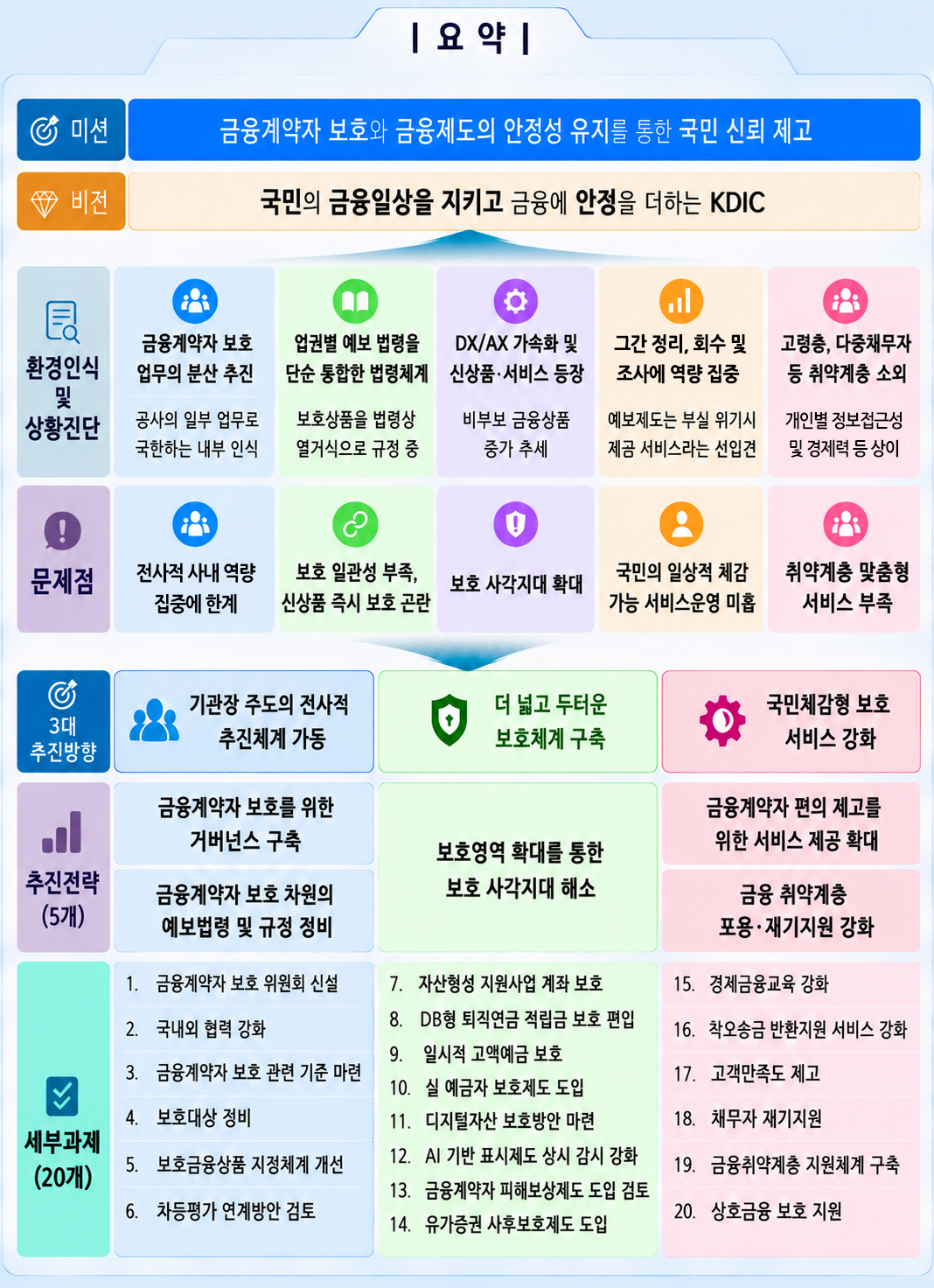
On this day, the committee prepared a roadmap under three major directions: Launching a company-wide promotion system led by institutional investor management, Building a broader and thicker protection system, and Strengthening tangible protection services for citizens, including five strategies and 20 detailed tasks.
To launch a company-wide promotion system led by institutional investor management, it will pursue the strategies of "Building governance for financial contract holder protection" and "Revising Deposit Insurance Corporation laws and regulations at the level of financial contract holder protection."
It will solidify the foundation for promotion through the establishment of the committee and strengthened domestic and international cooperation, while working on establishing standards related to financial contract holder protection, organizing protected targets, and improving the designation system for protected financial products. It will also consider linking differentiated evaluations of financial institutions with financial contract holder protection.
Building a broader and thicker protection system is concretized through the strategy of "Resolving protection blind spots by expanding the scope of protection." This includes protecting DB-type retirement pensions and temporary high-value deposits, introducing a real depositor protection system, and developing protection measures for digital assets.
Strengthening tangible protection services for citizens includes the strategies of "Expanding service provision to enhance financial contract holder benefits" and "Strengthening inclusion and re-start support for financially vulnerable groups."
It will strengthen economic and financial education and mistaken transfer return support services while improving customer satisfaction, and promote debtor re-start support, building a support system for financially vulnerable groups, and supporting mutual finance protection.
However, this roadmap does not signify the finalization of institutional introduction. The KDIC plans to broadly identify areas where protection is needed before reviewing the feasibility and institutional design for each task. Matters requiring legal amendments may change in content during consultations with the government, National Assembly, etc., and the legislative process.
KDIC President Kim said, "The faster the financial environment changes, the more important it is to examine what risks citizens may be exposed to and identify protection blind spots in advance," adding, "We will build a protection system that citizens can feel in their daily lives."

 in FINANCE
