

[For more diverse company information on the startups mentioned in this article, please visit the Unicorn Factory big data platform 'Data Lab'.]
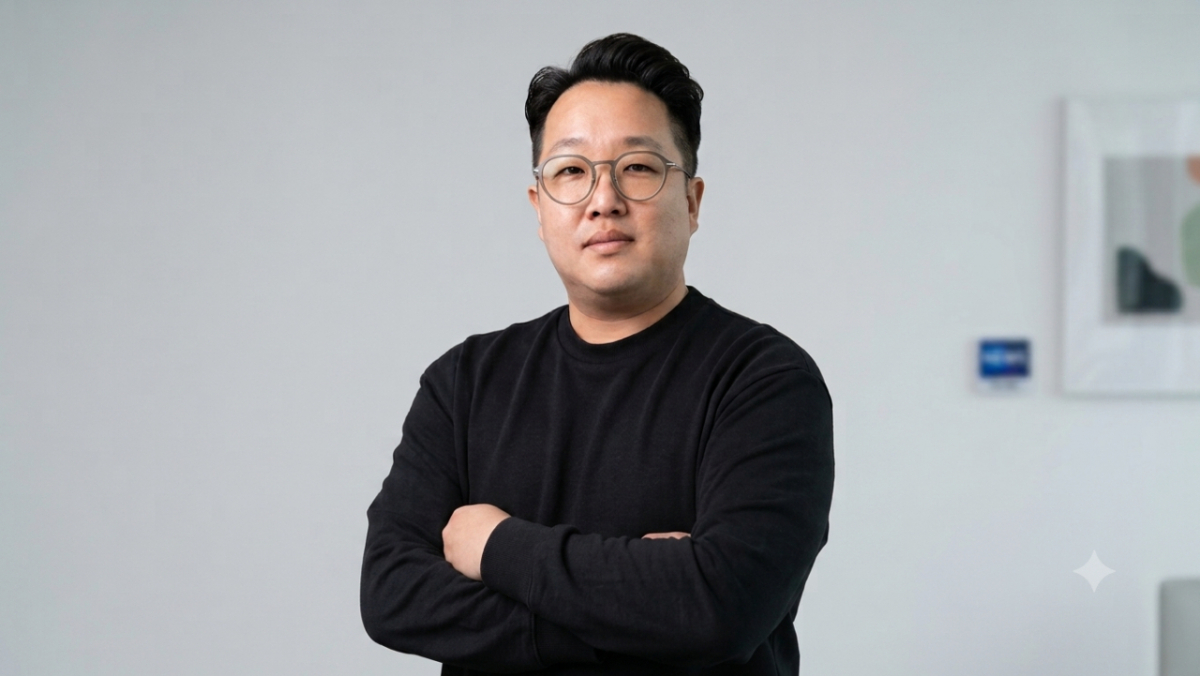
"MRI (Magnetic Resonance Imaging) is an examination that checks brain health only once or twice in a lifetime. However, glasses are products people use every day. If we can continuously monitor the central nervous system through glasses in daily life, strokes and degenerative brain disorders could be detected even faster."
Kim Min-kyu Oh Kyul-reo-seu (CEO), who develops AI-powered smart glasses, explained the company's direction in this manner.
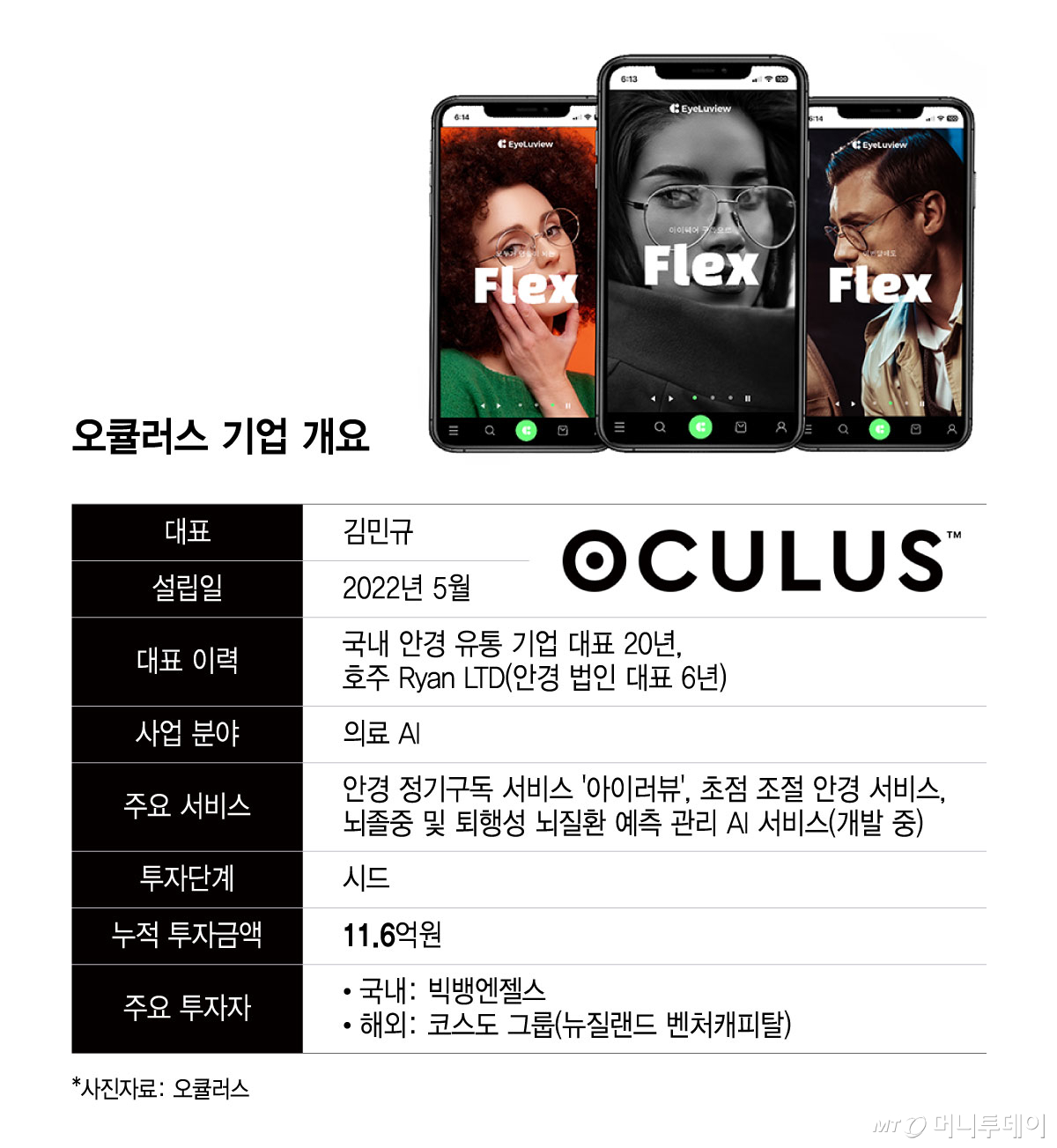
Oculus, a digital healthcare company that began with Korea's first eyewear subscription service 'EyeView', is transforming into a medical AI company focused on managing degenerative brain disorders beyond vision correction. The company has successfully developed adjustable-focus glasses for presbyopia patients and has recently begun R&D on AI-based smart glasses for early stroke detection, rapidly expanding its business model (BM).
Zeroing in on the 'Neglected Presbyopia Market'… Developing Auto-Focus Glasses
Kim (CEO) initially focused on the presbyopia market. Kim (CEO), who has been engaged in the eyewear distribution business for over 20 years, including in Korea and Australia, felt increasingly frustrated that the discomfort experienced by presbyopia patients had long gone unresolved. In particular, while operating the EyeView service after starting a business in Korea, Kim (CEO) observed that female customers aged 40 and above consistently reported difficulties in daily life due to presbyopia. Kim (CEO) stated, "The presbyopia market felt like one that had been neglected for a long time," adding, "We began technology development with the idea of addressing customers' discomfort."
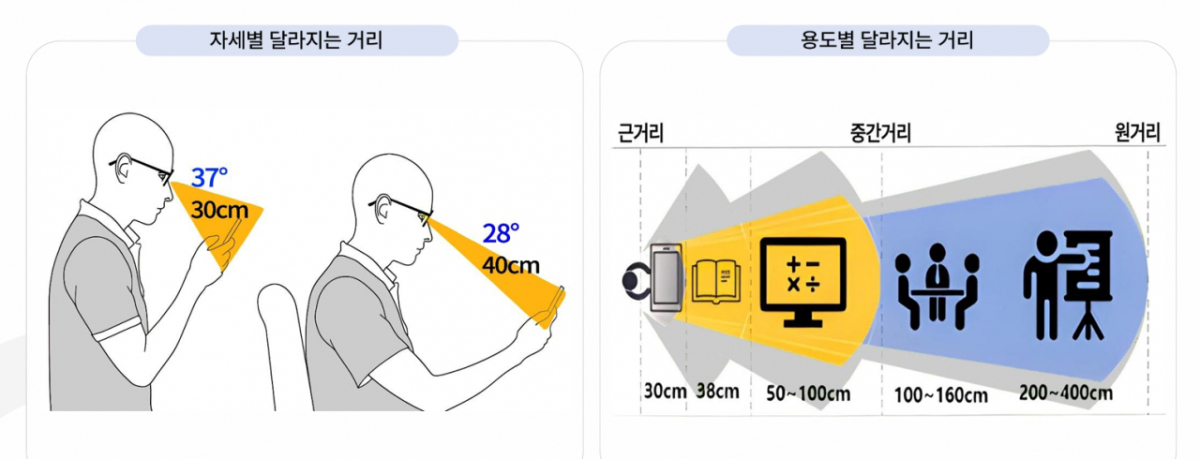
Specifically, presbyopia patients need different focal points depending on viewing distance—whether using smartphones, reading books, working on computers, or watching TV—requiring them to carry multiple pairs of magnifying glasses for different purposes. While multifocal glasses are considered an alternative, many users struggle with adaptation because a single lens contains multiple focal points for far, intermediate, and near distances.
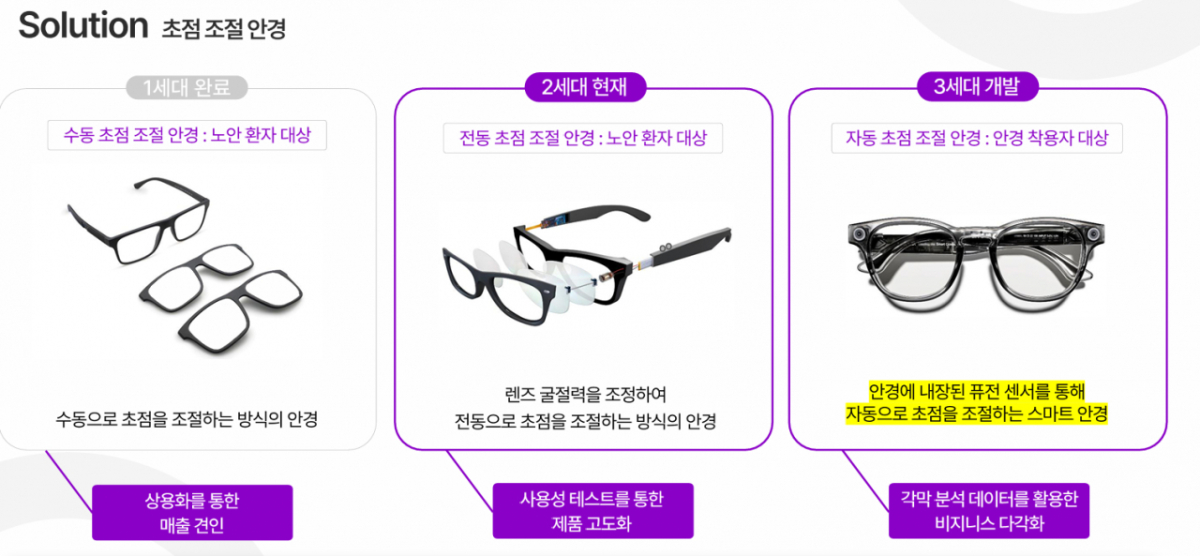
Driven by this awareness, Oculus set out to develop auto-focus-adjustable smart glasses. The currently commercialized first-generation product allows lenses tailored for specific uses—such as reading or smartphone use—to be attached and detached from a single pair of glasses. The second-generation product, which has completed development, is an electrically adjustable-focus eyewear that controls lens refractive power with just a button press. The third-generation product currently under development features AI sensors embedded in the glasses that recognize the user's gaze and distance, automatically adjusting focus without any manual operation.
Beyond Vision Correction… Reading the Brain Through 'Eyes'
Oculus aims to develop fourth-generation smart glasses equipped not only with auto-focus adjustment but also with AI-based early stroke detection capabilities. Kim (CEO) stated, "While developing auto-focus glasses, we confirmed the possibility of detecting signals of central nervous system abnormalities through even subtle changes in the eyes, such as corneal data and pupil movement," adding, "Based on this, we have begun developing AI technology for early stroke detection."
Ultimately, the fourth-generation smart glasses will be equipped with sensors that analyze eye movements and pupil changes, along with a lightweight AI chip. When abnormal signs are detected, the system sends alerts to the wearer and, via app integration, immediately notifies guardians or medical institutions, as well as emergency services (119).
This technology development is grounded in data accumulated over several years of operating the eyewear subscription service 'EyeView'. Oculus has secured vision correction data from approximately 400,000 users through EyeView and is using this data to train AI models and develop algorithms that detect central nervous system abnormalities by analyzing pupil changes.
In particular, the stable cash flow generated by EyeView serves as a foundation for R&D (research and development). Currently, EyeView has about 4,470 subscribers, and the company is investing subscription revenue into smart glasses R&D. The company expects to achieve its highest-ever annual sales of 1 billion won this year.
Oculus Dreams of World's First Stroke-Detecting Smart Glasses… Expanding from Oceania to the U.S.
The company is also dedicating significant effort to intellectual property (IP) strategy for securing the 'world's first' title. Oculus aims to achieve the 'world's first' status for AI-based early stroke-detecting smart glasses by sequentially patenting core technologies at each stage of product development—from focus-adjustment technology and sensor fusion systems to AI-based vision prediction algorithms, eye health management systems, and early brain disorder diagnosis technologies. As of this year, 10 patents have been registered.
Kim (CEO) stated, "The title of 'world's first' is not merely obtained by developing a technology first; it must be accompanied by commercialization and patent acquisition to hold meaning," adding, "We are patenting core technologies one by one according to the product development stage."
Global market expansion is also underway. Oculus plans to enter the Oceania market this year, focusing on Australia and New Zealand, before expanding its business into the United States. Kim (CEO) determined that securing references in Oceania would be advantageous for global market expansion. Kim (CEO), who graduated from an Australian university, has lived in Australia for over 10 years and has experience operating an eyewear distribution business there for six years. Based on this local business network and understanding of the culture, the company expects to quickly establish itself in the market. Currently, the establishment of local subsidiaries in New Zealand and Australia and recruitment of personnel have been completed.
Kim (CEO) stated, "Our ultimate goal is to leapfrog as a global digital healthcare company that creates new standards for managing degenerative brain disorders beyond vision correction."
[MoneyToday Startup Media Platform Unicorn Factory]

 in FUTURE


