

[For more diverse corporate information on the startups mentioned in this article, visit Unicorn Factory's big data platform 'Data Lab'.]
![[Seoul=NEWSIS] Reporter Jeon Jin-hwan = On the morning of the 23rd, an employee is seen trying on the first AI smart glasses prototype from Samsung Electronics at the kt west office in Jung-gu, Seoul. (Joint reporting) July 23, 2026. photo@newsis.com /Photo=Jeon Jin-hwan](https://thumb.mt.co.kr/cdn-cgi/image/f=avif/21/2026/07/2026072714115820973_1.jpg)
Global tech giants including Meta, Alibaba, and Samsung Electronics are successively launching AI-powered smart glasses, drawing attention to domestic startups that possess related technologies. The venture capital (VC) industry is also actively investing in relevant startups as the smart glasses market begins to fully bloom.
According to the venture investment industry on the 29th, Spatial AI technology company Deep Pine recently completed a Series B funding round totaling 10 billion won. Although the initial target was between 5 billion and 7 billion won, overwhelming investment demand led to overbooking, prompting the company to increase the final fundraising amount to 10 billion won to conclude the round. This investment was led by Hyosung Venture Capital, with participation from POSCO Technology Investment and LIG Defense & Aerospace (formerly LIG Nex1).
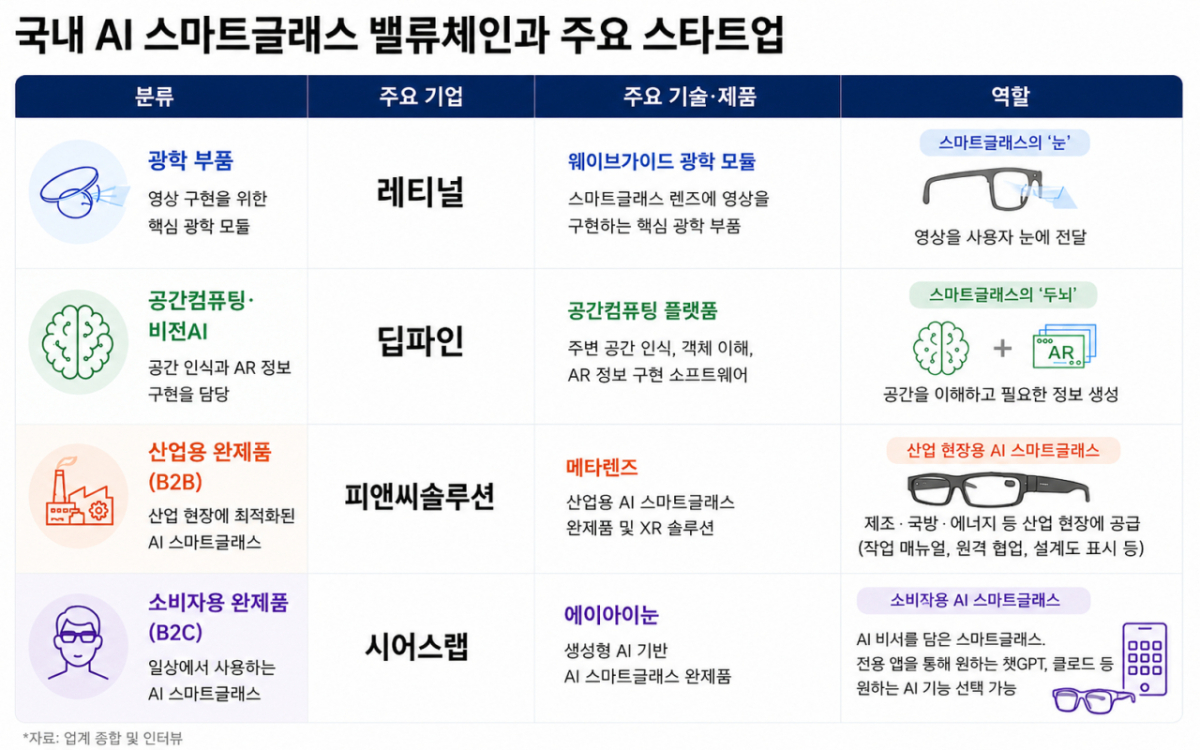
Deep Pine is a startup developing spatial computing technology that enables AI to recognize users' surrounding spaces and objects, providing necessary information in augmented reality (AR) format. Spatial computing is considered a foundational technology for smart glasses, as it allows AI to recognize the user's environment and location in real time and deliver relevant information. Currently, the company provides AR solutions optimized across various industries including logistics, manufacturing, and shipbuilding based on its spatial computing technology. Kim Hyun-bae, CEO of Deep Pine, explained, "Investors have highly evaluated the growth potential of spatial computing technology needed for the upcoming era of smart glasses."
The surge in investor interest in Deep Pine's Series B round is driven by the rapid growth of the smart glasses market. According to market research firm Omdia, global shipments of AI-powered smart glasses reached 8.7 million units last year, representing a more than 300% increase compared to the previous year. Shipments are expected to exceed 15 million units this year. Bae Jun-seong, Executive Vice President at Lotte Ventures, stated, "As wearable devices that most naturally utilize AI, big tech companies are now fully entering the market. In particular, Meta's Ray-Ban smart glasses have received a positive response in the market, giving other companies confidence to enter."
Retinal, which develops optical modules, also secured pre-IPO (pre-listing equity investment) funding totaling 27.8 billion won on the 27th. Sixteen VCs participated in the investment, including Kolon Investment, Openwater Investment, and Lotte Ventures. Retinal develops optical modules that render images onto smart glasses lenses and is preparing for full-scale mass production next year. While Deep Pine serves as the "brain" of smart glasses by handling spatial recognition and AR implementation, Retinal plays the role of the "eyes."
Startups are increasingly emerging that directly manufacture smart glasses to target niche markets. P&C Solutions and ThursLab are prime examples. P&C Solutions has independently developed and manufactured a complete industrial smart glasses product called "MetaLens," supplying it to industrial sites in sectors such as manufacturing, defense, and energy. The company provides XR solutions based on smart glasses, including work manuals, remote collaboration tools, and design drawings with inspection item displays, expanding its application scope primarily within industrial settings. Its distinguishing feature is a strong focus on the B2B market, including military training, safety, education, and manufacturing sites, rather than general consumer markets.
ThursLab is developing an AI-powered smart glasses product called "AI Eye" based on generative AI. AI Eye is an AI smart glasses device that provides voice-centric functions powered by large language models (LLMs) without requiring a camera. Its distinctive feature is the ability to select and use generative AI models such as ChatGPT, Gemini, and Claude through its dedicated app, "AI Eye X."
The VC industry identifies "lightweighting" and battery efficiency as key challenges for the future smart glasses market. Executive Vice President Bae noted, "While AI performance is advancing rapidly, improving hardware aspects such as weight, battery efficiency, and comfort to allow all-day wear remains the core challenge for market expansion. Once these issues are resolved, mass adoption of smart glasses will accelerate significantly."
[MoneyToday Startup Media Platform Unicorn Factory]

 in FUTURE

