

[For more diverse company information on the startups mentioned in this article, visit Unicorn Factory's big data platform 'Data Lab'.]
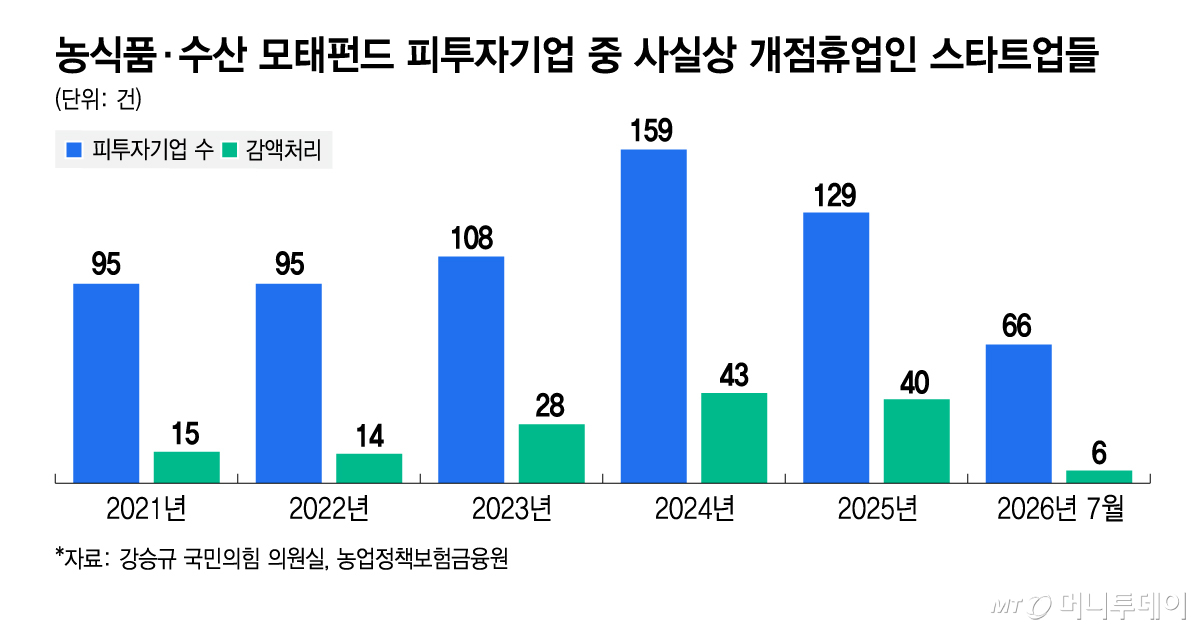
It has been revealed that the number of food, agriculture, and fisheries startups receiving investment from the Agricultural Policy Insurance Financial Corporation (Nonggeumwon) fund of funds (Korea venture fund) that have fallen into an 'operating while closed' state has recently surged. Consequently, even Nonggeumwon's fund capital contribution projects are being shunned by venture capitalists (VCs), prompting urgent calls for improved post-investment management such as nurturing and development of food, agriculture, and fisheries startups.
According to data submitted by Kang Seung-kyu, a People Power Party member of the National Assembly's Agriculture, Food, Fisheries, and Ocean Affairs Committee, obtained from Nonggeumwon on the 24th, the number of portfolio companies under Nonggeumwon's fund of funds (Korea venture fund) that underwent 'downward adjustment' (value reduction) was recorded as follows: △28 in 2023, △43 in 2024, and △40 in 2025. Of the 186th companies that have undergone downward adjustments since the introduction of Nonggeumwon's fund of funds (Korea venture fund) in 2010, 59.7% were concentrated in the past three years.
Downward adjustment refers to cases where companies are effectively suspended from operations due to default, suspension of business, or closure; owe wages for more than three months; suffer capital impairment; or face corporate reorganization or bankruptcy, resulting in accounting losses. This indicates that while these companies initially attracted investment by demonstrating growth potential, an increasing number have recently faced severe difficulties with no prospect for management improvement.
Industry sources cited the sluggish performance of the food, agriculture, and fisheries sector and the prolonged winter of venture capital investment as primary causes. A venture capital industry official stated, "Recently, the entire food, agriculture, and fisheries sector has been struggling due to rising raw material and logistics costs," adding, "The freeze on venture capital investments since 2023 likely exacerbated funding shortages."
Amid this situation, interest from the venture capital industry in Nonggeumwon's fund of funds (Korea venture fund) is also waning. This year's regular capital contribution project for Nonggeumwon's fund of funds (Korea venture fund) saw a competition ratio of only 1.4 to 1. Notably, the smart agriculture sector, which planned to recruit two companies, received no proposals at all, while the future innovation growth sector also fell short with only one application submitted for three planned recruitment slots. This is attributed to capital flowing into large-scale policy funds such as the National Growth Fund amid industry downturns.
Industry experts pointed out that Nonggeumwon must improve its fund of funds (Korea venture fund) management approach to break the vicious cycle where even promising startups fail to secure funding on time. An industry official remarked, "Nonggeumwon's fund of funds (Korea venture fund) has low GP (fund manager) autonomy due to annual mandatory investment ratios, detailed regulations on primary investment targets, and requirements for IR participation and investor review of participating companies organized by Nonggeumwon, resulting in low preference among VCs." They added, "Improving these aspects will increase VC interest and ensure proper capital supply to startups."
Kang Seung-gyu (Rep.) stated, "With investment funds concentrating on advanced industries such as robotics and AI, worsening external economic conditions could further exacerbate funding and management challenges for food, agriculture, and fisheries sector companies." He emphasized, "We must thoroughly analyze the reasons behind the increase in downward-adjusted companies and underfunded fund of funds (Korea venture fund) projects, while strengthening post-investment management through continuous nurturing and development of portfolio companies."
[MoneyToday startup media platform Unicorn Factory]

 in FUTURE
