

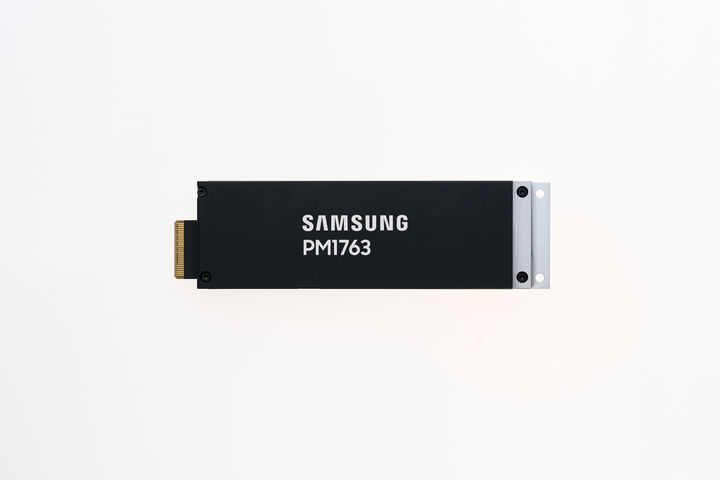
Despite exceeding market expectations in its performance, SanDisk issued a conservative revenue forecast citing supply shortages, confirming supply constraints in the AI (artificial intelligence) SSD (solid-state drive) market. Industry observers anticipate favorable conditions for the NAND businesses of Samsung Electronics and SK Hynix, as it is unlikely that NAND supply shortages will be resolved in the short term.
According to the semiconductor industry on the 8th, SanDisk projected its first-quarter (July–September) revenue for the fiscal year at $10.3 billion to $10.8 billion (approximately 14 trillion won to 15 trillion won). This range falls below the market expectation of $10.82 billion. However, the company attributed the downward revision in its revenue forecast not to slowing demand but to supply shortages.
David Goeckeler, CEO of SanDisk, stated during an earnings announcement conference call that "customer demand exceeds supply, and as a result, supply will remain allocated through 2027." This remark is interpreted as indicating that the supply shortage in the AI SSD market is not a temporary phenomenon. Enterprise SSDs (eSSDs) feature higher NAND capacities, meaning that as investments in AI data centers expand, pressure on NAND demand increases. However, production capacity at NAND manufacturers has failed to keep pace with rising demand.
Industry observers view SanDisk's announcement as a case reflecting the global NAND market supply situation. While demand for SSDs used in AI data centers is growing rapidly, supply cannot keep up, maintaining the pricing power of memory manufacturers.
Market conditions are expected to impact domestic NAND manufacturers as well. In particular, Samsung Electronics and SK Hynix are increasing their share of AI SSDs and eSSDs, so if supply shortages persist, improvements in profitability for their NAND businesses are anticipated. According to market research firm TrendForce, global revenue from the top five enterprise SSD (eSSD) vendors in the first quarter of this year rose 86.1% quarter-over-quarter to $18.46 billion (approximately 26 trillion won), and eSSD contract prices increased by approximately 80% during the same period. Second-quarter statistics have not yet been compiled, but it is expected that growth continued due to sustained demand driven by expanded AI data center investments.
Market analysis also suggests that the recent rise in NAND prices represents a structural shift driven by expanding AI demand, unlike past short-term rebounds following inventory adjustments. This is because the foundation of NAND demand itself is growing as new demand sources expand beyond AI servers to include edge AI, smart vehicles, and industrial automation. Market research firm Omdia forecasts that the global NAND market size will grow from approximately $73 billion (about 103 trillion won) last year to $360.1 billion (approximately 510 trillion won) this year and reach $489.2 billion (about 693 trillion won) next year based on revenue.
Samsung Electronics and SK Hynix are also expanding NAND production capacity in line with the growth of the SSD market to secure future demand. Samsung Electronics plans to sequentially operate its P5 and P5-2 facilities in Pyeongtaek, Gyeonggi Province, starting in 2028 and 2029, respectively. SK Hynix is also scheduled to begin construction on its Cheongju M17 fab next year and prepare for Yangsan operations by 2029. Industry observers believe that proactive expansion of production capacity will translate into future NAND competitiveness as eSSD demand grows with the expansion of AI data centers.
An industry insider stated, "In the past, NAND price increases were often short-term rebounds due to inventory adjustments, but recently, AI SSD demand has outpaced supply growth rates." The insider added, "If supply shortages continue, there is a high likelihood that the trend of improving profitability for Samsung Electronics and SK Hynix's NAND businesses will persist."

 in INDUSTRY
