

Food and beverage stocks, including Samyang Foods, which had been riding a wave of rising share prices due to strong exports, are now faltering amid the strengthening won. However, experts in the financial investment industry maintain that the growth trajectory of Samyang Foods and cosmetics companies remains solid and have recommended increasing their portfolio weightings.
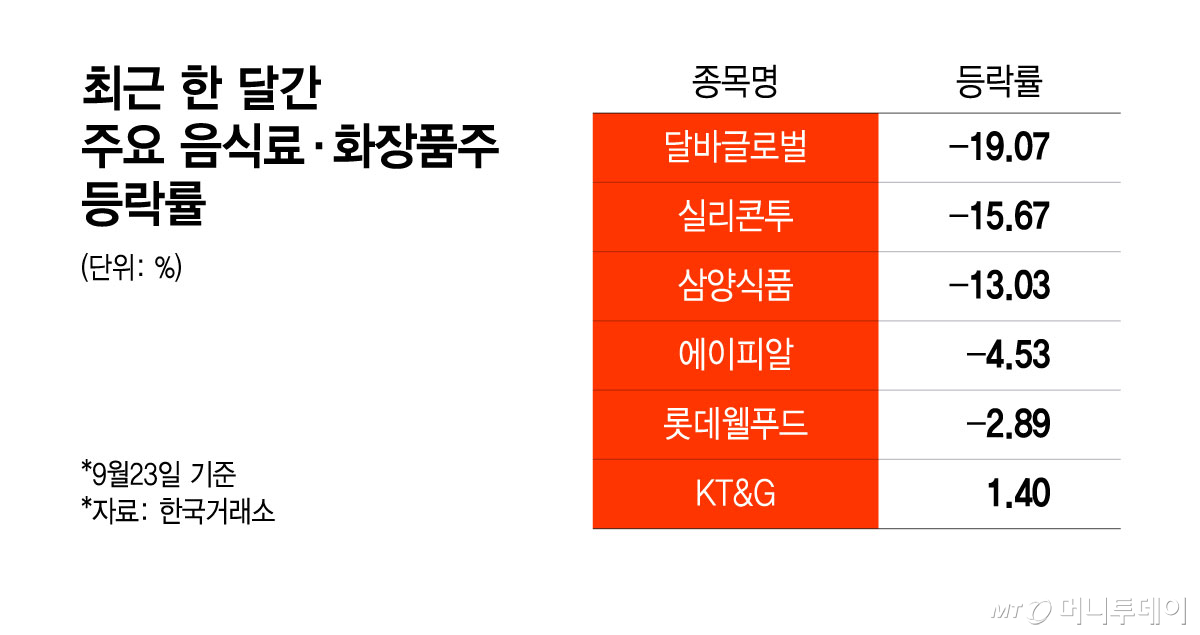
According to data from Korea Exchange on the 26th, Samyang Foods’ stock price fell by 13.03% over the past month through the 23rd. The upward trend driven by the global popularity of Buldak (spicy chicken) instant noodles has been reversed.
Lotte Wellfood, which has seen rising exports recently, also declined by 2.89%. KT&G managed only a modest gain of 1.4%.
It was not just food and beverage stocks; cosmetics stocks also posted declines over the past month. Dalba Global plummeted by 19.07%, while Silicon T and APR fell by 15.67% and 4.53%, respectively.
The underperformance of these stocks is due to the decline in the won/dollar exchange rate (strengthening of the won). Concerns that a stronger won could negatively impact export performance have hurt companies with strong export momentum.
On this day, the won/dollar exchange rate closed at 1,358.4 won for weekly trading, down 28.1 won (2.03%) from a month ago. Strong exports centered on semiconductors and export-oriented companies converting dollars into won have driven the decline in the exchange rate.
Experts acknowledge that share price declines due to the strengthening won are inevitable but argue that the growth drivers for food and beverage stocks like Samyang Foods and cosmetics companies remain intact. Some even suggest that the drop in stock prices presents an opportunity to increase portfolio weightings.
Choi Go-wun, a researcher at Korea Investment & Securities, stated, “The food and beverage sector entered a brief consolidation phase in September after a sharp rebound in August.” He added, “Given that market movements this year have consistently shifted faster than expected, now is the time to reassess and select investment opportunities following a period of reorganization.”
Researcher Choi further noted, “Looking at the longer term, attention should be paid to the potential for stock price recovery after exchange rates hit their bottom. The fundamental global competitiveness of products makes KT&G and Samyang Foods more important than concerns over falling exchange rates, signaling a return to these companies as key investment targets.”
There is also analysis suggesting that losses for Samyang Foods due to the decline in the won/dollar exchange rate will not be as severe as market concerns suggest.
Ryu Eun-ae, a researcher at KB Securities, explained, “Samyang Foods uses an annual cumulative exchange rate based on consolidated financial statements.” She added, “The impact of recent sharp declines in exchange rates is therefore limited.” The annual cumulative exchange rate represents the average of daily exchange rates from January 1 to the current date.
Analyses also indicate that the negative impact of a stronger won on cosmetics stocks will be smaller than expected. Kim Myeong-ju, a researcher at Korea Investment & Securities, explained, “Both APR and Silicon T incur costs in local markets. For APR, discount rates driven by competitive intensity within the market have a greater impact on performance than exchange rate fluctuations. For Silicon T, diversification of its customer base has had a larger effect on results than the strengthening won.”
The fact that cosmetics exports continue to grow is also positive. From the 1st to the 20th of this month, cosmetics export value reached $857 million (approximately 1.1654 trillion won), a 41.6% increase compared to the same period last year.
Researcher Kim stated, “Despite rising shipping costs and fuel prices, as well as an unfavorable exchange rate environment, strong cosmetics export performance indicates explosive demand for Korean cosmetics in local markets.” She added, “Companies with high exposure to both the U.S. and European markets will benefit the most.”

 in STOCK
