

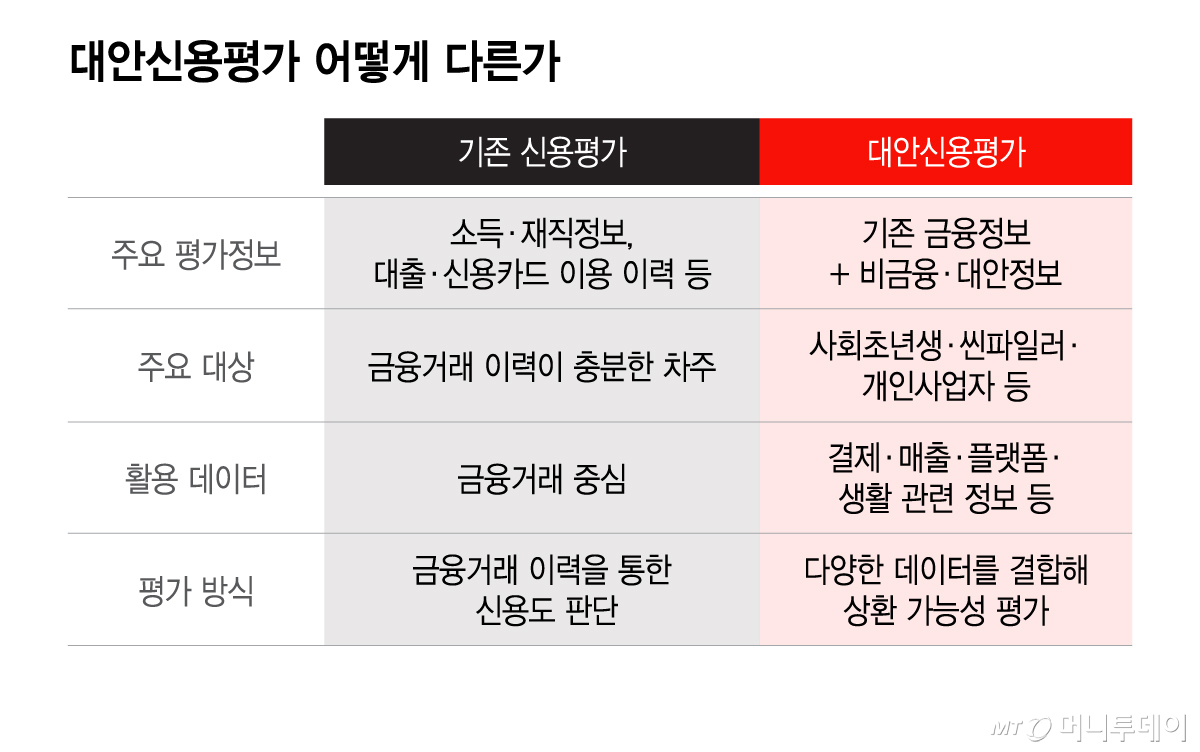
#Social newcomer A, in his 30s, has a credit score in the 700s and limited financial transaction experience. With an annual income of 35 million won, A received his first credit card just one year after joining his company and had never taken out a loan before. Desperate for a lump sum to cover living expenses, he hurriedly looked for loans here and there but found it difficult to secure any. After much deliberation, A turned to KakaoBank. Because high-quality non-financial information such as taxi usage records, book purchase history, and group savings account activity was verified, he was able to obtain a loan.
Financially excluded groups who struggled to cross the threshold for credit loans due to insufficient financial transaction history are expanding their loan opportunities through alternative credit scoring that utilizes non-financial information. Three internet-only banks active in lending to medium- and low-credit borrowers are incorporating information not previously used in traditional credit evaluations—such as taxi usage, book purchases, and group savings account activity—into their loan underwriting processes.
According to KakaoBank, as of the end of August, cumulative loans supplied through its proprietary credit scoring model have reached 1.2 trillion won.
When banks evaluate personal credit loans, they typically utilize income data, employment information, existing loan history, and credit card usage records. However, for so-called "thin-file" borrowers—such as social newcomers with short financial transaction histories or self-employed individuals whose stable income and employment details are difficult to verify—it is challenging to adequately assess creditworthiness using only traditional evaluation methods. Alternative credit scoring has emerged as a means to enhance credit assessments by leveraging alternative data such as consumption patterns and automatic payment records.
KakaoBank has been applying an alternative credit scoring model since 2023 to provide loans to medium- and low-credit borrowers among thin-file customers. This is based on "KakaoBank Score," a proprietary model developed using data pseudonymously linked with Lotte Members, Kyobo Book Center, Kakao Mobility, and others. The model reflects over 18 million pseudonymously linked data points and approximately 3,800 evaluation variables.
Expanding the scope of evaluation to include small business owners is another distinctive feature. Starting with food service operators, KakaoBank has developed and applied a "Business Type-Specific Model" that reflects industry characteristics of individual entrepreneurs, including service sector workers, special employment contract workers, and online sellers. For example, a beauty salon owner in his early 800s credit score range was unable to secure a business credit loan from major banks due to short operating experience and being classified as a multiple-debt holder with three existing loans. KakaoBank evaluated the application using card sales data, business location information, hourly sales data collected via Cash Note, and automatic payment records from the Financial Services Commission, ultimately approving the loan.
K Bank focuses on enhancing the precision of loan underwriting by combining non-financial data with existing financial information. Notably, it is the only internet bank to utilize an evaluation model called Equal, jointly funded by telecommunications companies, as well as Naver Pay information. It has also expanded its data usage to include Equal's telecom data, merchant information from BC Card, Samsung Card, and Shinhan Card, and alternative data from the Financial Services Commission.
K Bank plans to further enhance its alternative credit scoring collaboration with Naver Pay within this year and expand the use of non-financial data to apply it to personal business credit loan products.
Toss Bank goes beyond incorporating diverse information into a single evaluation model; it utilizes multiple credit scoring models tailored to customer profiles and loan characteristics. Alongside its main proprietary model, TSS, it operates nine additional credit scoring models specialized for loan underwriting.
Toss Bank's evaluations incorporate not only traditional financial data but also various information such as consumption tendencies, cash flow, job stability, insurance premium payment records, and savings account enrollment and contribution history.
However, more important than how much alternative data is secured is how that data is actually utilized in credit scoring. Simply adding new information to existing statistical models makes it difficult to fully reflect the unique characteristics of the data. Consequently, the competitive benchmark among the three internet banks' alternative credit scoring models is expected to shift from merely adding new data to determining how best to combine existing financial and non-financial information to more accurately assess actual credit risk.
A financial industry official stated, "As consumers' choices expand, loan products may evolve beyond simple interest rate competition to include diverse forms such as varied repayment methods or products featuring redesigned interest rates."

 in FINANCE
