

The financial authorities are moving to strengthen the soundness management of comprehensive financial investment companies (punching companies) by reapplying the net capital ratio (NCR), as loans by these firms have surged recently. As the scale of punching companies that lend customer funds raised through commercial paper and IMA (comprehensive investment accounts) has grown, authorities deemed it necessary to implement risk management at a level similar to banks.
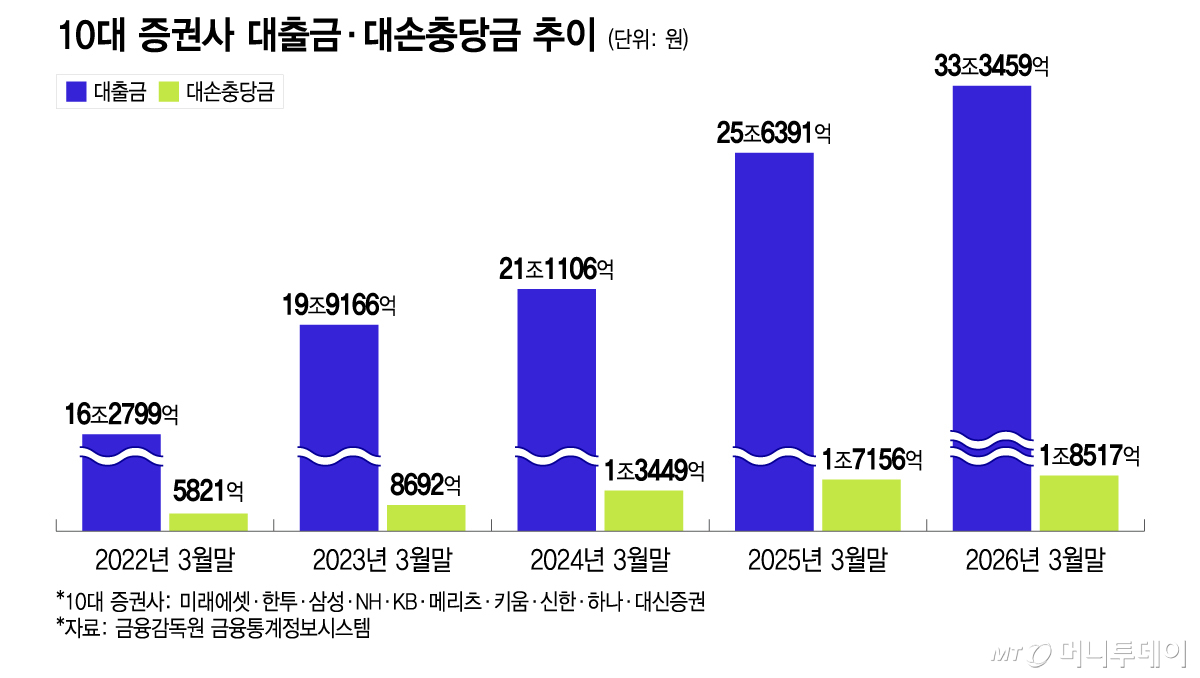
According to data from the Financial Supervisory Service's financial statistics information system released on the 10th, as of the end of the first quarter this year, loans by the top 10 punching companies totaled 33.3459 trillion won, an increase of 17.66 trillion won (104.83%) over the past four years. Compared to one year ago (25.6391 trillion won), this represents a rise of 7.7068 trillion won (30.06%), showing particularly sharp growth in loan amounts over the last year. While major banks managed their loan asset growth rates at single-digit levels due to the authorities' stance on household loan management and policies to expand shareholder returns, lending by securities firms has surged dramatically.
As loans increased, loan loss provisions set aside to cover potential losses also grew sharply. Loan loss provisions for the top 10 punching companies reached 1.8517 trillion won as of the end of the first quarter this year, a 218% increase compared to four years ago (582.1 billion won). After rising by about 55% in one year to 1.3449 trillion won at the end of the first quarter of 2024, they increased by about 28% to 1.7156 trillion won in the first quarter of last year as well.
Narrowing the scope to individual punching companies also shows increases in corporate lending and non-performing loans (NPL). According to Mirae Asset Securities' first-quarter earnings announcement data, corporate lending rose by 50% in one year from 1.8 trillion won in the first quarter of last year to 2.7 trillion won this year. Corporate lending income increased by about 15%, from 23.6 billion won to 27.2 billion won during the same period. NH Investment & Securities' corporate loan balance stood at 8.6 trillion won, up 18% in the first quarter of this year.
Non-performing loans (NPL) among all loan portfolios are also rising. In the first half of this year, Hana Securities' NPL ratio reached 2.22%, a 0.72 percentage point increase from last year's 1.5%. This is 1.72 percentage points higher than the bank NPL ratio (0.48%). Shinhan Investment Corp reported that non-accruing loans increased by 26 billion won in the first quarter of this year.
Corporate loans are generally riskier and larger in scale compared to household loans, so strengthening soundness management increases the burden on punching companies. Nevertheless, the authorities are moving to strengthen soundness regulations because 'fund management through customer funds' is increasing. The financial authorities view that punching companies' business of lending funds to corporations based on customer money raised through commercial paper and IMA is similar to banks' 'deposit-loan (Yeosu-sin)' business activities.
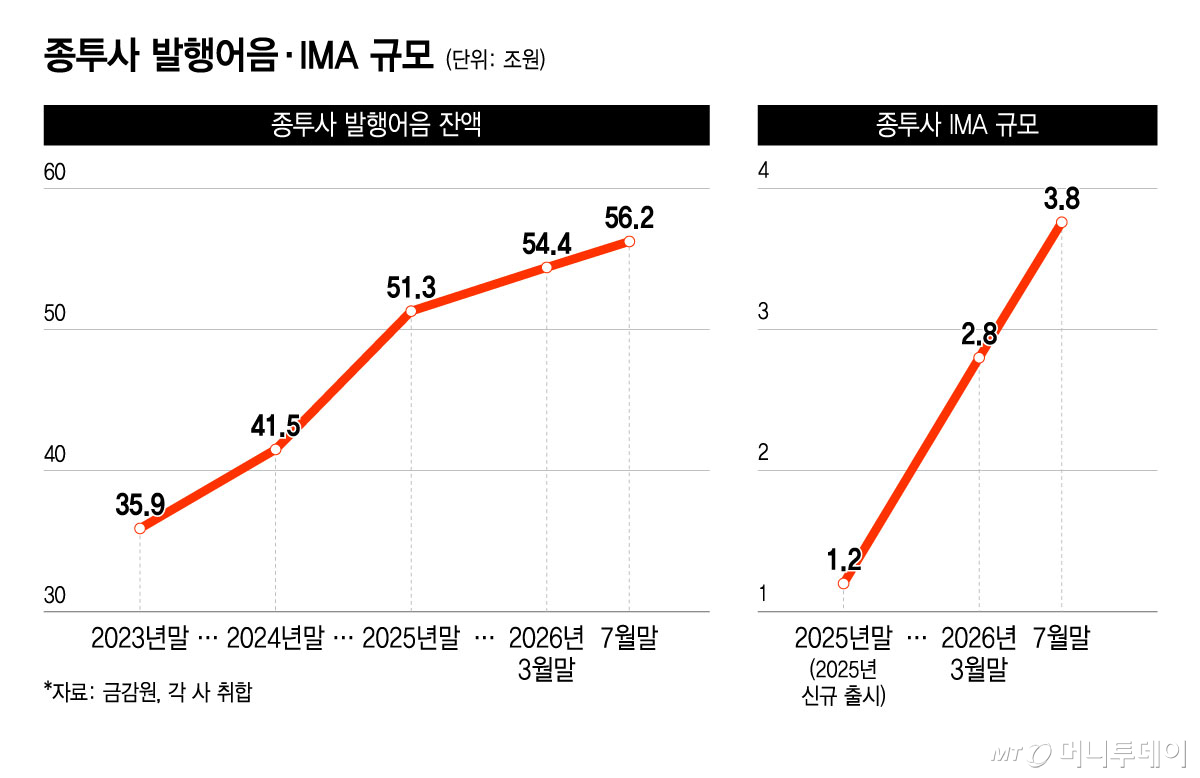
In fact, funding raised by punching companies through commercial paper and IMA reached 60 trillion won. As of the end of July this year, outstanding commercial paper balances for seven punching companies (Mirae Asset, Korea Investment, NH, KB, Kiwoom, Shinhan, Hana Securities) totaled 56.2 trillion won, nearly a 10% increase from the end of last year. IMA funding by the three largest punching companies (Mirae Asset, Korea Investment, Hana) surged 217% to about 3.8 trillion won compared to the end of last year. In particular, since punching companies must allocate more than 10% of funds raised through commercial paper and IMA to venture capital supply, corporate loan volumes are expected to grow further.
However, punching companies do not have corporate loan review and management systems at the level of banks. An industry official stated, "When handling corporate loans, punching companies calculate risk values based on corporate credit ratings from external credit rating agencies and reflect them in NCR," adding that "credit assessments are not as sophisticated as those of banks with internal credit rating systems."
Asset soundness regulations are also weaker compared to the banking sector. The Financial Investment Business Act classifies loan portfolios into five categories each quarter: normal, special mention, substandard, doubtful, and estimated loss, requiring provisions for bad debts according to relevant regulations. However, regulations are weaker than those for banks, as loans to small and medium-sized enterprises and venture companies meeting certain criteria are not counted as risk-weighted assets.
In response, some voices argue that the financial authorities should introduce bank-level regulations specifically for punching companies. The logic is that commercial paper and IMA must return principal to customers at maturity, similar to bank deposits, necessitating strengthened liquidity and asset-liability management regulations. Hong Jong-soo, a research fellow at KDI, stated in last year's report: "It is necessary to gradually expand Basel III-type liquidity and leverage regulations, such as the Liquidity Coverage Ratio (LCR), for major securities firms by referencing cases from major overseas countries."
However, it is understood that the financial authorities consider applying Basel III regulations premature, given that punching companies' asset structures differ significantly from those of banks.

 in STOCK

