

The finished vehicle industry is facing a situation where it must apply recycled materials to nearly all automotive plastic parts within the next six years.
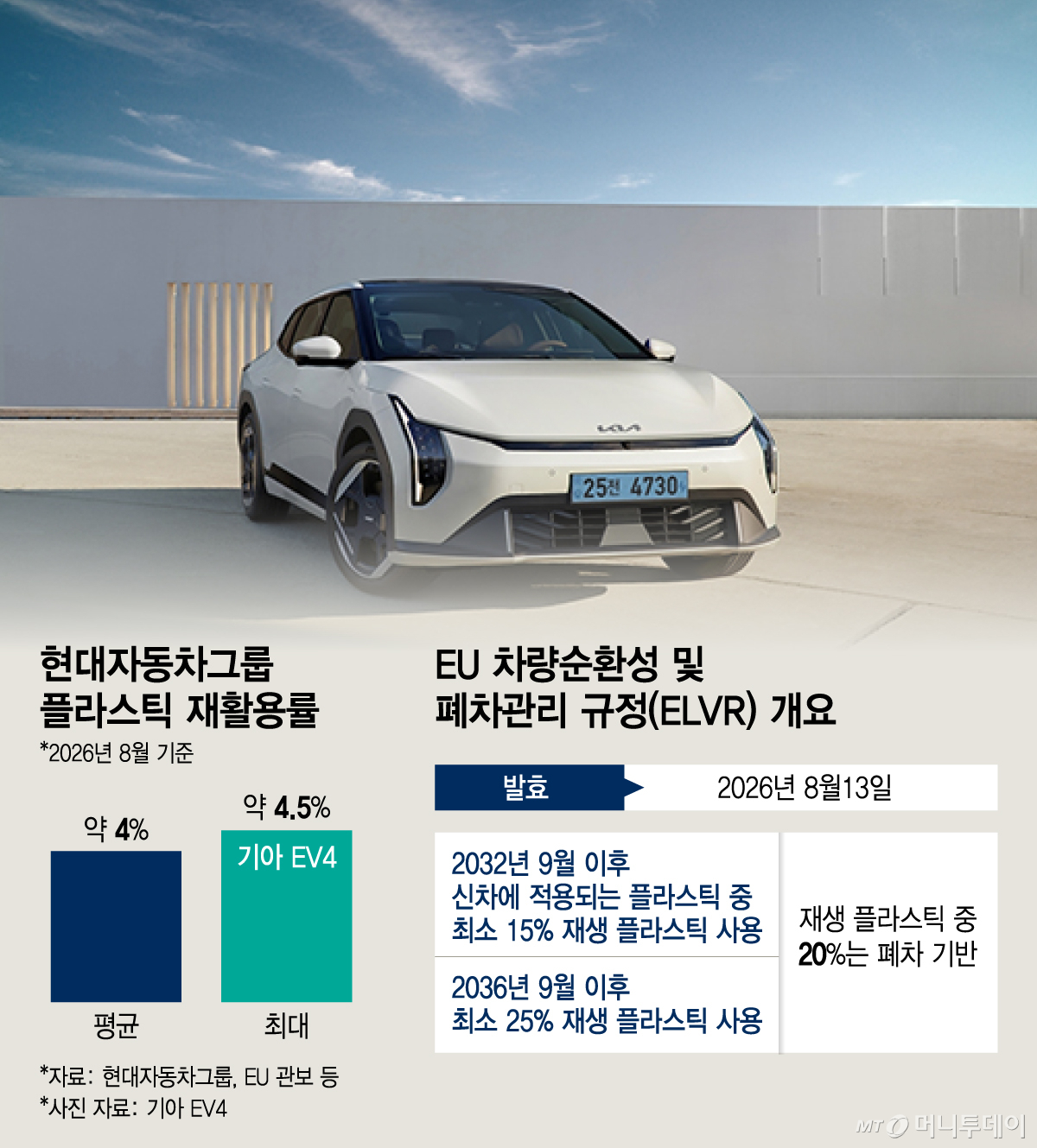
According to relevant industry sources on the 12th, the average plastic recycling rate for vehicles launched by Hyundai Motor Group stands at approximately 4%. The vehicle with the highest recycling rate is Kia's EV4, at about 4.5%. In addition, Hyundai Motor Group recovers approximately 200,000 tons of resources annually from scrapped cars, including steel, non-ferrous metals, and plastics.
The market environment for scrap car Lisa Recycling (recycling) is becoming increasingly challenging. This is because global regulations are tightening, with the EU (European Union) implementing the ELVR (End-of-Life Vehicle Regulation) starting this month. According to ELVR, from September 2032 onward, new vehicles must incorporate at least 15% recycled plastic. Of this, a minimum of 20% must be material derived from plastics recovered from scrapped cars. If the current plastic recycling rate of around 4% cannot be raised to 15%, it may become difficult to sell automobiles in overseas markets. The key challenge lies in increasing the proportion of recycled materials while simultaneously satisfying performance, pricing, and production volume requirements.
Hong Seong-jun, Hyundai Motor's Carbon Neutrality Gi Sul-hyeok-sin (Team Lead), explained, "To comply with ELVR, recycled materials must be applied to most of the approximately 150–200 visible parts," adding, "This is a task we must overcome through collaboration with the petrochemical industry."
The government and the finished vehicle industry, including Hyundai Motor, plan to respond to market changes centered on the "Car to Car" project, which involves reapplying materials developed from recycled scrap car parts to new vehicles. While the recycling ecosystem remains underdeveloped, a more significant variable is cost. The GIC (Global Impact Consortium), which includes global chemical companies such as BASF, LG Chem, Mitsubishi Chemical, and SABIC, conducted an automotive recycling project over the past year. Results indicate that costs must be reduced by more than 75% compared to current levels.
Charlie Tan, CEO of GIC, emphasized, "As industrial efficiency improves and processing volumes increase, costs will naturally decrease." He added, "South Korea, a leading automotive manufacturing nation, must also find practical methods to recover more high-value materials from scrapped cars."

 in INDUSTRY
