

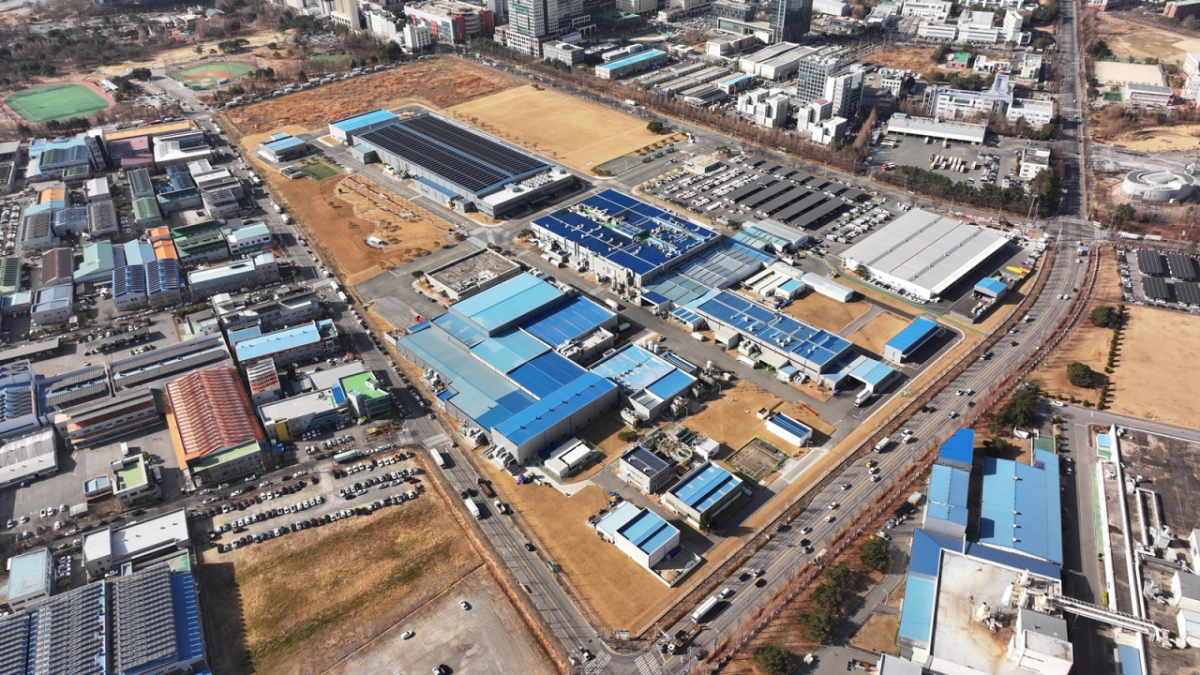
To respond to the rapidly growing global HVAC (heating, ventilation, and air conditioning) market, Samsung Electronics will establish a new HVAC production line from Fract Group at its Gwangju facility.
The company plans to build this production line at its Gwangju site.
Samsung Electronics announced on the 19th that it will invest approximately 240 billion won to construct an air conditioning product production line with a total floor area of 21,800 square meters (about 6,600 pyeong), equivalent to three soccer fields, at its Gwangju Campus 3 in Buk-gu, Gwangju Metropolitan City, Jeollanam-do.
On the same day, Samsung Electronics, Fract Group Korea, and Jeollanam-do Gwangju Metropolitan City signed an investment agreement at the Gwangju City Hall. The signing ceremony was attended by Min Hyung-bae, Governor of Jeollanam-do Gwangju Metropolitan City; Kim Cheol-ki, Head of DA Business Division (Executive Vice President) of Samsung Electronics; and Im Sung-taek, CEO of Fract Group Korea (Head of HVAC Business Team, DA Business Division).
Through the establishment of this production line, Samsung Electronics plans to integrate the technology and production capabilities of Fract Group, acquired last year, into domestic operations and fully launch its global HVAC business as a new growth engine. The Gwangju production line will serve as a key hub for targeting AI data centers and is set to become Fract Group's 15th global production facility.
At the new production line, core air conditioning products from Fract Group, such as Coolant Distribution Units (CDUs), are scheduled to begin production in early 2028. CDUs act as "intermediaries" that connect chillers, which are building cooling systems, and cold plates that directly cool servers. They precisely control the pressure and temperature of coolant generated by chillers, remove impurities, and supply clean and safe coolant to server equipment. The coolant that absorbs heat from servers undergoes a circulation process: it passes through a heat exchanger in the CDU before returning to the chiller for re-cooling.
In addition, Fan Wall Units (FWUs) for air cooling in data centers, Computer Room Air Handlers (CRAHs), and Air Handling Units (AHUs) for large buildings will also be produced at the Gwangju production line.
Furthermore, Samsung Electronics plans to combine its B2B (business-to-business) integrated control platform, "SmartThings Pro," with building-integrated solutions (b.IoT).
By integrating Fract Group's central air conditioning systems with Samsung Electronics' connectivity platforms, the company aims to deliver differentiated HVAC solutions and realize smart buildings capable of unified control. Based on this synergy, Samsung Electronics plans to leapfrog as a leading global HVAC company by 2030.
Kim Cheol-ki, Head of DA Business Division (Executive Vice President) at Samsung Electronics, stated, "Samsung Electronics will rapidly expand its HVAC business, a future growth engine, and establish itself as a leading player in the global market." He added, "The establishment of this Gwangju production line will serve as an important foundation for securing differentiated competitive strength in the HVAC business."
Meanwhile, Samsung Electronics' latest investment marks the first large-scale production facility investment since the founding of the Gwangju facility (formerly Gwangju Electronics) in 1989, 37 years later. The Gwangju facility began as a home appliance production base and now produces AI-powered appliances such as "Bespoke AI Family Hub" refrigerators, "Bespoke AI Combo" washer-dryers, and "Bespoke AI Wind-Free Air Conditioners."

 in INDUSTRY
