

[For more diverse corporate information on startups mentioned in this article, please visit the Unicorn Factory big data platform 'Data Lab'.]
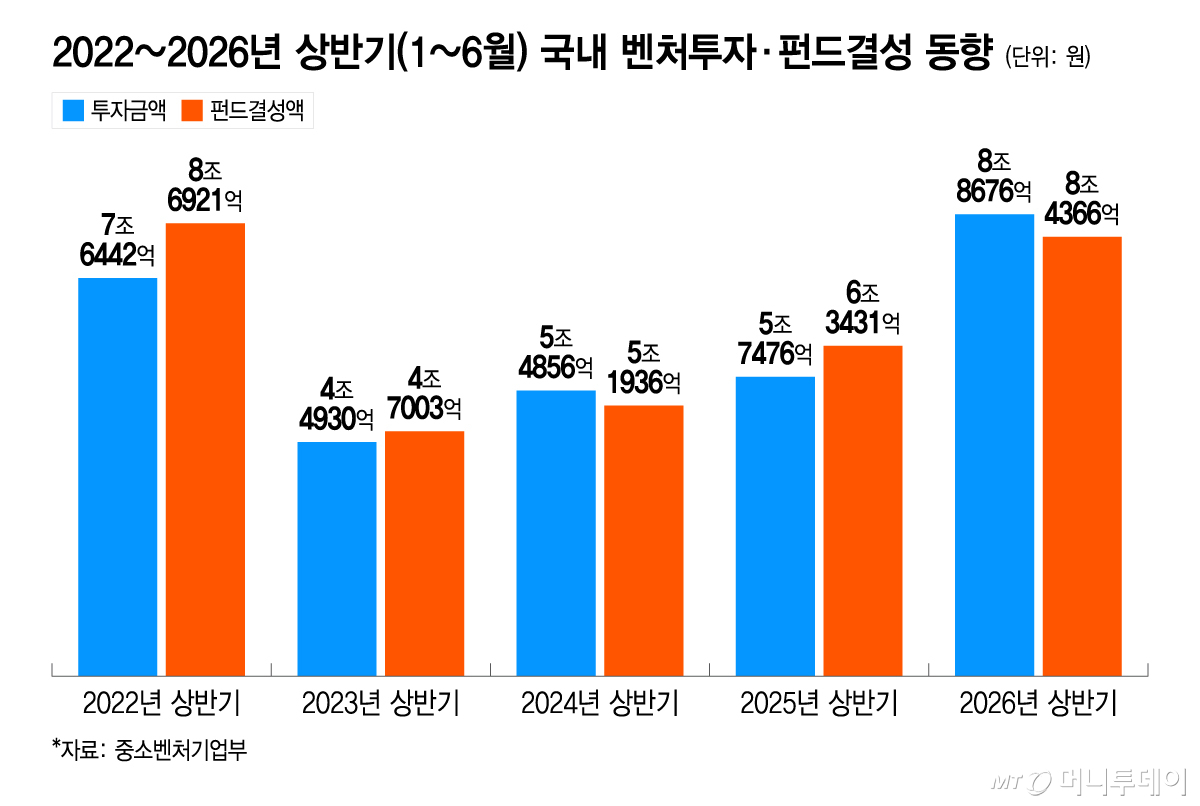
New venture investment in Korea reached a record high of 8.8676 trillion won in the first half of this year, representing a 54.3% increase compared to last year. The number of companies that secured investment also rose by 17% year-on-year to 2,296 firms, suggesting some alleviation of the concentration of investments in specific companies.
The Ministry of SMEs and Startups announced on the 18th the 'Trends in New Venture Investment and Venture Fund Establishment for the First Half of 2026'. Based on the first half of the year, venture investment peaked at 7.6442 trillion won in 2022 before plummeting to around 4 trillion won in 2023 due to factors such as interest rate hikes. Since then, it has shown a gradual recovery and has now surpassed its previous record.
The amount of venture funds established, which can serve as an indicator of future venture investment trends, also reached 8.4366 trillion won, a 33% increase year-on-year, marking the second-highest level for any first half of the year on record.
The industry receiving the most investment was ICT services, accounting for 21.0% (1.86 trillion won) of total investments. The Ministry of SMEs and Startups explained this as "a reflection of investments in technologies utilizing AI (artificial intelligence)." Following this were electrical, mechanical, and equipment industries at 17.3% (1.5359 trillion won), and bio-medical sectors at 17.0% (1.5041 trillion won).
The sector with the highest year-on-year growth rate was ICT manufacturing (144.3%). Electrical, mechanical, and equipment industries (90.4%) and ICT services (62.2%) also saw significant increases. This is attributed to large-scale investments of over 100 billion won in deep-tech startups such as AI semiconductors, robotics, and AI.
However, investment in the gaming sector decreased by 76.3% compared to last year, making it the only sector to show a decline. Its share of total venture investment dropped to just 0.5%. This is interpreted as reflecting overall challenges faced by the domestic gaming industry, including declining game usage rates, rising development costs, and growth in China's gaming sector.
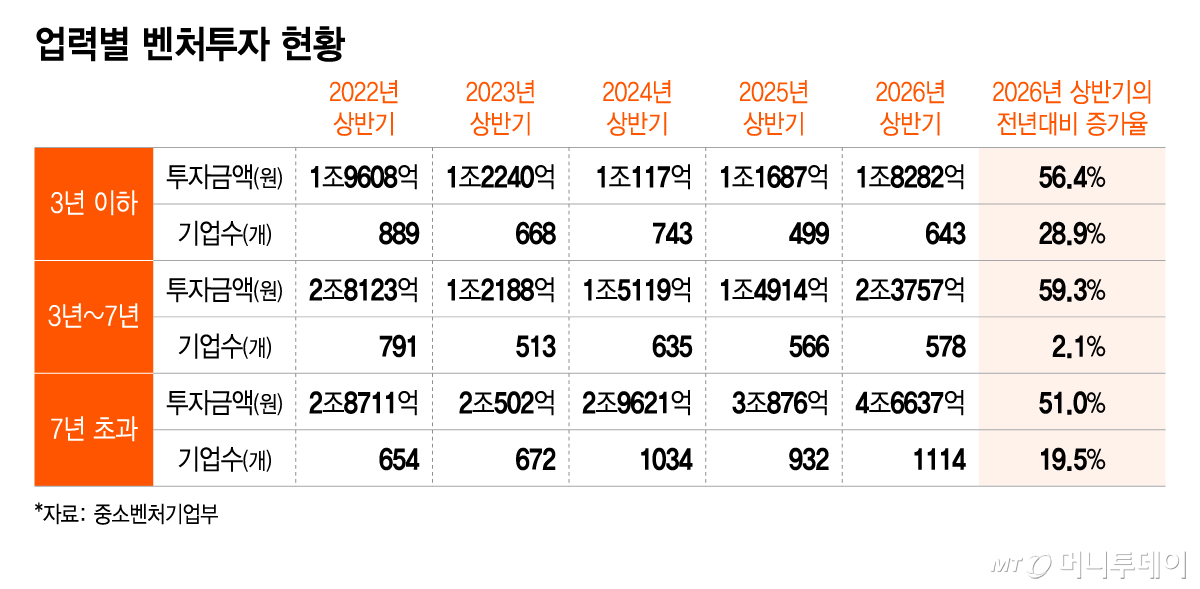
By company age, investment in early-stage startups aged three years or less, which had performed poorly in the first quarter, showed signs of recovery. Investment amounted to 1.8282 trillion won, a 56.4% increase year-on-year. The recovery was driven by deep-tech startups in AI, semiconductors, and robotics securing large investments exceeding 10 billion won from their founding stages.
The number of startups aged three years or less that secured investment rose to 643 firms, an increase of 28.9% (144 firms). The Ministry of SMEs and Startups emphasized, "We will continue policy support to revitalize early-stage investments, such as doubling the fund of funds (Korea venture fund) contribution to the early-stage sector to 200 billion won compared to last year."
Additionally, investment in startups aged 3–7 years reached 2.3757 trillion won, a 59.3% increase from the same period last year, while investment in companies older than seven years rose by 51.0% to 4.6637 trillion won.
By region, venture investment in non-metropolitan areas increased by 104.7%, surpassing the growth rate of metropolitan area investments (49.9%). In particular, Daejeon's venture investment scale reached 435.9 billion won, the largest among non-metropolitan regions. This is believed to result from securing large investments in new industry deep-tech fields such as aerospace and life sciences.
The amount of venture funds established, which can serve as an indicator of future venture investment ammunition, reached 8.4336 trillion won, a 33% increase year-on-year, marking the second-highest level for any first half of the year on record.
However, while public policy financing contributions increased by 58.3%, private contributions rose only by 28.1%, causing the share of policy financing to rise to 19.3%. The share of policy financing had averaged around 15% since 2020, when it reached 26.0% due to a significant expansion in fund of funds (Korea venture fund) contributions aimed at fostering a second venture boom.
Kim Bong-deok, Venture Policy Officer at the Ministry of SMEs and Startups, stated, "Both venture investment and fund establishment increased significantly in the first half of this year, indicating that the domestic venture investment market has entered a full-fledged growth phase." He added, "We will strengthen the role of fund of funds (Korea venture fund) to ensure that expanded venture investment leads not only to the growth of venture startups but also to job creation for youth and regional economic revitalization, while steadily implementing policy support such as tax benefits."
[MoneyToday startup media platform Unicorn Factory]

 in FUTURE

