

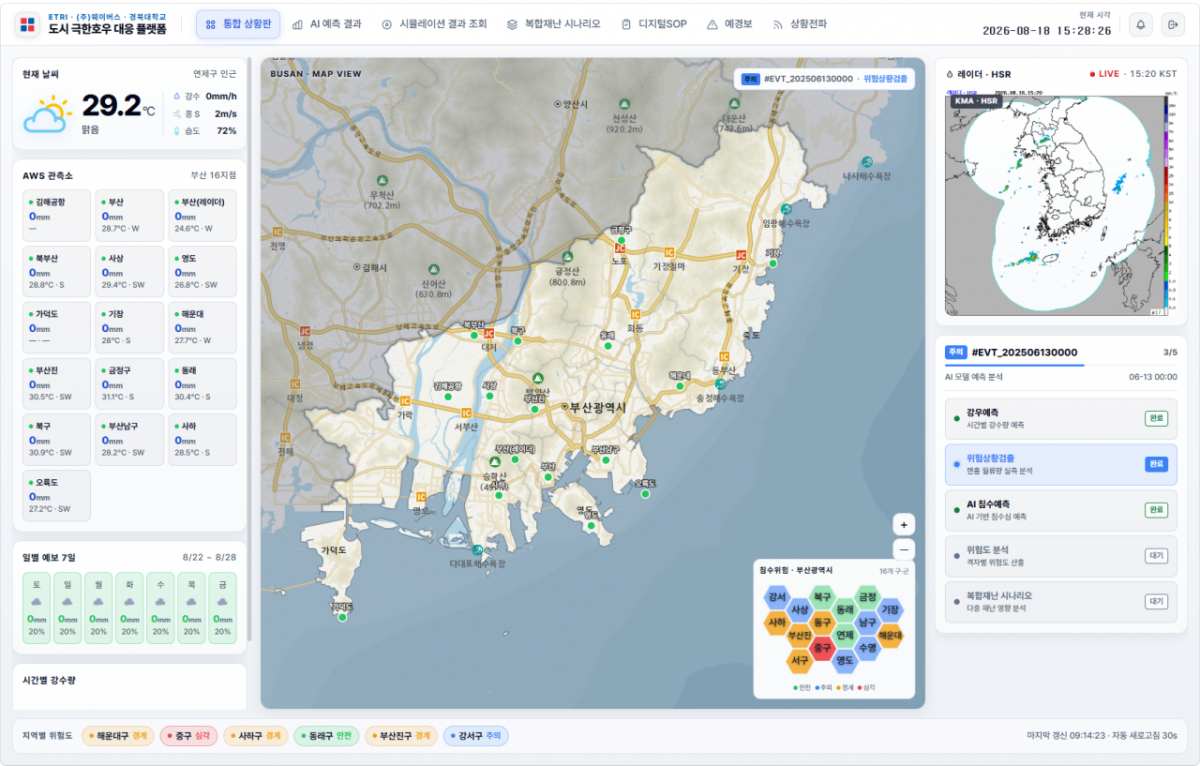
ETRI (Korea Electronics and Telecommunications Research Institute) is partnering with the city of Busan to develop a platform for predicting urban flooding risks.
On the 19th, ETRI announced that it has begun demonstrating an AI-based urban flood response platform in collaboration with the Busan Metropolitan City government and government-funded research institutions.
This cooperation aims to conduct field demonstrations and commercialize technology under the National Research Council of Science and Technology (NST) Convergence Basic Project titled "Development of Digital Urban Flood Control Technology for Realizing a 'No WET City'."
Experts note that in cities like Busan, where coastal areas meet mountainous terrain, there is a high likelihood of simultaneous flooding and ground disasters due to topographical characteristics. This underscores the need for sophisticated, real-time response technologies.
ETRI, the city of Busan, Korea Institute of Civil Engineering and Building Technology (KICT), Korea Institute of Geoscience and Mineral Resources (KIGAM), and Korea Railroad Research Institute (KRRI) will jointly establish an integrated digital disaster response system capable of predicting, analyzing, responding to, and disseminating information on urban floods by linking the specialized technologies and data of each research institution.
ETRI will lead the development of risk detection and urban flooding prediction technologies based on AI models. It plans to develop core technologies for an AI-based platform that integrates and analyzes diverse urban data, including rainfall information, CCTV footage, drainage networks, retention facilities, terrain and facility data, sensor data, and historical flood records.
The city of Busan will provide data on drainage networks, terrain and structural information, urban facility data, and flood history across the entire city, while promoting phased field demonstrations focused on areas prone to recurring flooding.
KICT will develop urban flood prediction and control technologies linked to urban infrastructure; KIGAM will develop a geological disaster response platform based on 4D urban geological environments; and KRRI will focus on enhancing the extreme rainfall response capabilities of railway infrastructure.
The project will be implemented over five years, concluding in 2029, with a total budget of approximately 33.8 billion won.

 in TECH
