

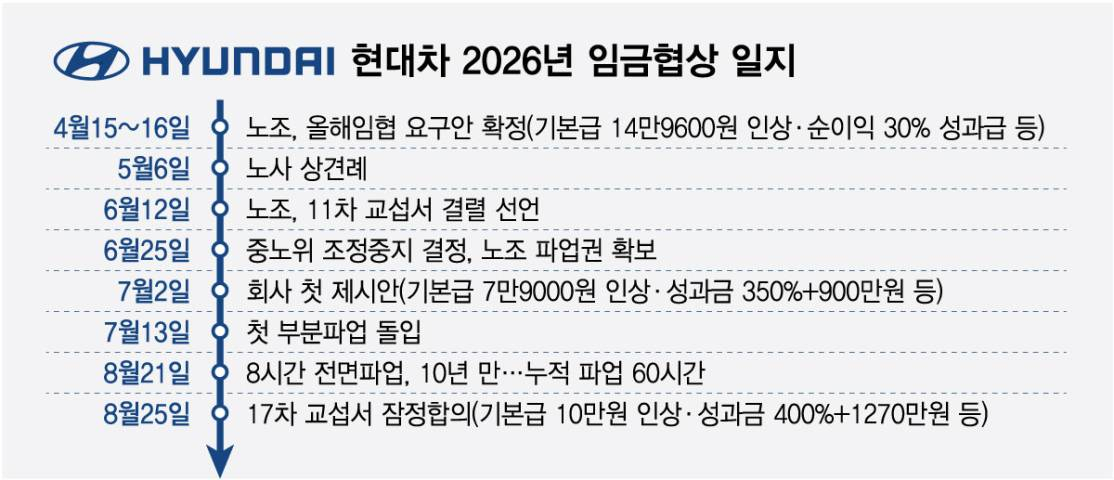
Hyundai Motor and its labor union, after enduring difficult negotiations, reached a 'tentative agreement on 2026 wage negotiations' on the 25th, preparing to regroup for a performance rebound. It is expected that Kia's management and labor will also soon find a compromise based on Hyundai Motor's tentative agreement.
Hyundai Motor's management and labor union had been at an impasse for 111 days since their first meeting on May 6, disagreeing over the level of wage increases. In particular, it was difficult to reach a consensus as the labor union demanded the reinstatement of dismissed workers, extension of retirement age, and an increase in bonuses—items that management had designated as "not subject to wage negotiations"—separate from base pay raises.
However, both sides agreed that they must prevent further production disruptions due to the prolonged strike and stop the expansion of employee wage losses, each taking a step back. In fact, on the 21st, Hyundai Motor's labor union conducted a total of 60 hours of strikes, including an eight-hour full-scale strike for the first time in 10 years. The estimated loss from production disruptions is believed to have exceeded 2.3 trillion won.
Consequently, management and labor found a compromise on base pay increases. Hyundai Motor proposed an increase of 89,000 won, while the union proposed 149,600 won; ultimately, they agreed on a 100,000 won increase (including seniority-based raises). They also agreed to a performance bonus structure that adds 12.7 million won on top of 400% of base pay. Previously, the union had demanded that 30% of the previous year's net profit be paid as a performance bonus.
Management and labor also decided to provide 15 shares of stock and Hashi Points (welfare points) worth 500,000 won, and to raise vacation allowances for the second half of the year from 800,000 won next year to 1 million won. Additionally, they agreed to hire 200 new technical workers in key positions in the second half of next year and 300 more by 2028. They will transparently share progress on new businesses and technologies, jointly respond to the transition to future industries, and promote improved adaptability to change, institutional improvements, productivity, and enhanced manufacturing competitiveness through discussions aimed at securing future competitiveness.
However, key contentious issues were only addressed to a limited extent. Regarding retirement age extension, it will be implemented without expanding the wage peak system when laws are revised, and the plan to raise bonuses from the current 750% to 800% will be discussed again in next year's collective bargaining. The issues that triggered this year's strike remain unresolved as they carry over into next year. Observers suggest that labor-management conflicts could reignite depending on the pace at which the National Assembly processes the retirement age extension bill.
A Hyundai Motor official stated, "Management and labor reached a difficult tentative agreement driven by an urgent need to prevent further damage," adding, "We will devote all our efforts to production in the second half of the year and repay customer support with mobility products of global top quality."
Kia, which resumed negotiations on this day, is also expected to seek a settlement at a level similar to Hyundai Motor's tentative agreement. Management had presented its third proposal on the 20th during the 10th round of formal negotiations, including a base pay increase of 98,000 won, performance and incentive bonuses totaling 400% plus 12 million won, 45 shares of company stock, 200,000 won in traditional market gift certificates, and 500,000 won in special points, but failed to reach a tentative agreement. Given that the proposal is not significantly different from Hyundai Motor's agreement and Kia concluded its collective bargaining agreement without labor disputes for five consecutive years until last year, it is expected that Kia will focus on finalizing an agreement.
With negotiations that had escalated into a standoff now settled, both Hyundai Motor and Kia plan to make up for the first-half slump with aggressive new model launches in the second half of the year. Following the launch of the new Grandeur in May, Hyundai Motor will sequentially introduce the new Elantra, Tucson, and Genesis flagship model GV90. Kia will also release the Seltos HYBE Lead and K4 HYBE Lead. Hyundai Motor plans to achieve its early-year guidance of an operating profit margin of 6.3% to 7.3% and annual sales of 4.1583 million units through new model launches and expanded production. Kia, meanwhile, intends to focus on operations with a target of selling 3.35 million units, a 7% increase from the previous year.
Hyundai Motor's first-half revenue increased by 2.7% year-on-year to 95.1542 trillion won, but operating profit fell 25.8% to 5.3656 trillion won. This was largely due to production disruptions in certain models caused by a fire at a parts supplier. As a result of this fallout, domestic sales in the second quarter dropped 16.4% year-on-year to 1.57647 million units. While sales held up well in the United States, Hyundai Motor's largest global market, European sales declined by 10.9%. Kia's first-half revenue also rose 9% to 62.5389 trillion won, but operating profit remained flat at 4.8337 trillion won, down 16.3% year-on-year. Profitability was dragged down by U.S. tariffs and expanded incentives in domestic and Western European markets as Chinese electric vehicle brands competed for market share.

 in INDUSTRY
