

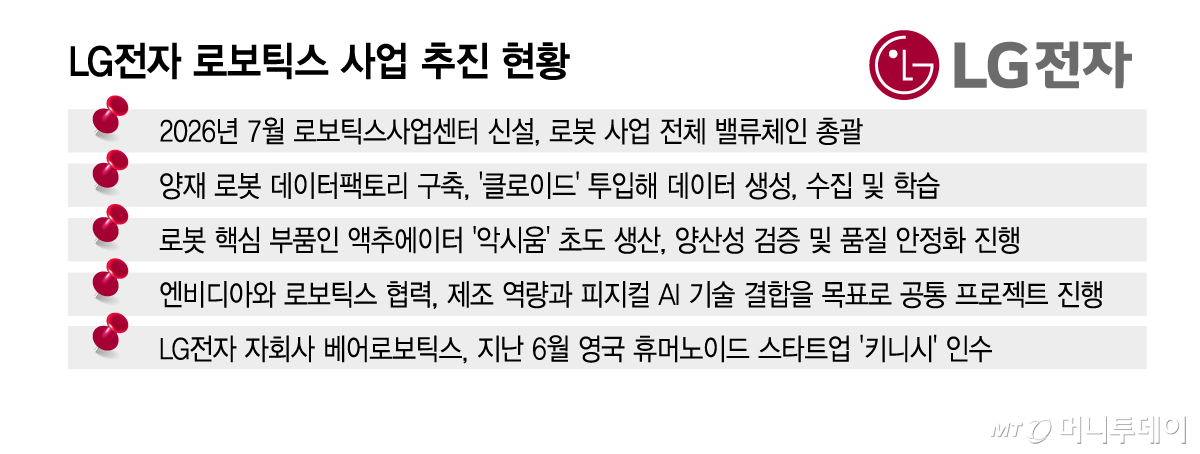
As global robot companies are recognized for valuations far exceeding their current performance based on growth prospects, expectations for a reevaluation of LG Electronics' corporate valuation are also rising. LG Electronics is accelerating the commercialization of its business, from preparing actuators (driving devices) at Yangsan to industrial and household robots. The securities industry is also giving high marks to the value of LG Electronics' robotics business.
According to relevant industry sources on the 30th, LG Electronics has completed the construction of a pilot production line for 'Axium,' an actuator that is a core component of robots, and is currently conducting Yangsan validation and quality stabilization through initial product production. It plans to establish a full-scale Yangsan system in connection with securing future B2B (business-to-business) orders.
LG Electronics has designated robotics as a new growth engine and is consolidating relevant capabilities centered on the newly established Robotics Business Center in July. It is gathering core technologies such as AI (artificial intelligence) models, software platforms, vision systems, cameras, and batteries held by its subsidiaries and group affiliates. It is also building a robot data factory, which serves as a sort of 'robot training camp.'
As LG Electronics officially launches its robotics business, the perspective on its corporate valuation is also changing. This is because recent cases show that global robot companies are receiving corporate valuations that significantly exceed their current revenue and profit scales and business performance.
This month, Unitree, a robot company listed on the STAR Market (KeChuangBan), a technology stock market of the Shanghai Stock Exchange in China, closed its first day of trading at 845 yuan, approximately 5.6 times higher than the initial public offering price of 150.8 yuan. Based on the closing price on the first day, its market capitalization reached approximately 341.8 billion yuan (about 70 trillion won). Compared to last year's revenue of 1.7 billion yuan, this scale exceeds 200 times.
XPeng, known as an electric vehicle manufacturer, has attached a separate valuation to its robot business. XPeng announced on the 24th that it secured its first external equity investment of over $900 million for its humanoid robot business. After the investment, the corporate valuation of the robot business exceeded $6.3 billion (about 8.7 trillion won). This is a level exceeding half of XPeng's total market capitalization, which stands at approximately 15 trillion won.
This trend is also positive for LG Electronics' corporate valuation reevaluation, as it has identified robotics as a future growth engine. LG Electronics is targeting the entire market from industrial and commercial robots to household robots, along with its subsidiary Robostar and Bear Robotics. Bear Robotics recently acquired the UK humanoid startup Kinisi in June, taking steps to secure related technologies.
Collaboration with NVIDIA is also strengthening. The approach involves combining LG Electronics' robot hardware technology and manufacturing capabilities with NVIDIA's physical AI technology to conduct joint projects. It is advancing from concept validation (PoC) for robots used in manufacturing sites to actual on-site implementation.
In particular, overseas securities firms are focusing on the fact that LG Electronics' robotics business is moving from a mere 'future project' to an actual commercialization stage. Morgan Stanley stated, "LG is not starting its robot business anew from scratch," viewing robots as a field naturally adjacent to its existing businesses.
This differentiates it from other robot companies with insufficient existing business foundations. LG Electronics already possesses technologies accumulated in home appliances, global distribution networks, and after-sales service (AS) businesses. It is also possible to supply service robots along with commercial displays and HVAC (heating, ventilation, and air conditioning) systems to B2B customers such as hotels. Morgan Stanley evaluated that the business experience LG Electronics has accumulated will serve as a foundation for making robotics a core pillar of its future strategy.
Citi's corporate valuation assessment shows a clear shift in perspective. In June, Citi calculated LG Electronics' target price using the SOTP (Sum-of-the-Parts) method and reflected the value of 'new growth businesses including robots' at 3.528 trillion won. It applied a higher business value multiple than for existing business segments. The target price was significantly raised from the previous 170,000 won to 400,000 won.
An industry official said, "Existing corporate valuation assessments that start from net assets or net profits still have limitations in independently reflecting the growth expectations and future value of robot businesses, which are currently in their early stages," adding, "A new valuation method that reflects technological capabilities and growth potential will be needed."

 in INDUSTRY
